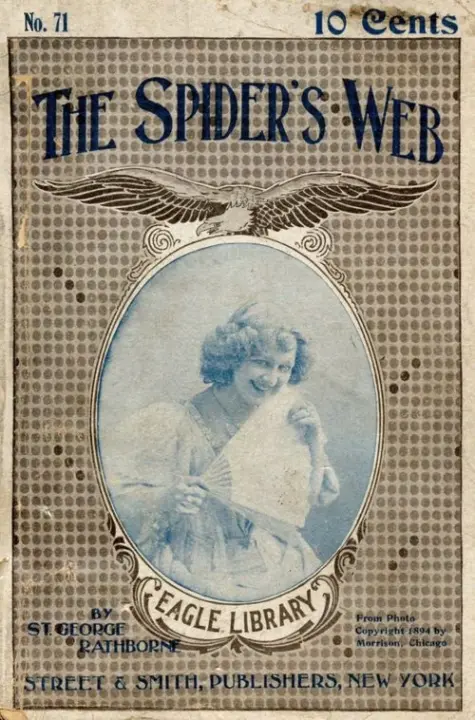
The spider’s web
St. George Rathborne
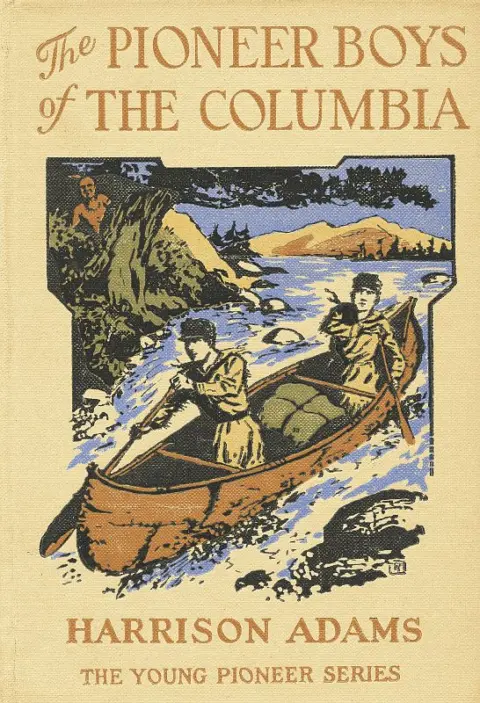
THE CLASSIC COLLECTION · 1916
"The Pioneer Boys of the Columbia; or, In the Wilderness of the Great Northwest" by Harrison Adams is a historical adventure novel written in the early 20th century. The narrative follows young pioneers Dick and Roger Armstrong as they embark on a perilous journey through the wilderness of the Pacific Northwest in the early 1800s. Faced with the dangers of the untamed landscape and the evolving complexities of their expedition, the boys exemplify bravery and resourcefulness typical of their time. At the start of the story, the Armstrong cousins are preparing to run the treacherous rapids of the Yellowstone River. Their initial excitement takes a sharp turn when their canoe, sabotaged by an unknown enemy, capsizes, forcing them to swim for their lives. After gathering themselves, they realize that they have been targeted by a traitor within their expedition, possibly linked to the unscrupulous French trader François Lascelles, who seeks revenge for their previous confrontations. As the story unfolds, readers can expect to see how the boys navigate both the physical challenges of the wilderness and the threats posed by human malice, setting the stage for a gripping adventure filled with excitement and danger.
Introduction adapted from the source catalogue; source summaries may be automatically generated.
Free to read · English · 71,320 words · No account needed
MAKE TIME FOR A GOOD BOOK
On by default. Untick to stop anonymous reading totals. Each page counts after 10 seconds in view. How this works.
Anonymous counting is on unless you have switched it off.
"When we fail to return to the camp of course they will send some of the men up to look the ground over," Dick answered, thoughtfully. "The disappearance of the friendly Indian will give them a clew. Then they are apt to find some of the trout that were left behind fastened to the willow withes."
"I hope they enjoy them," muttered Roger, with a grimace, for he could not help remembering how his mouth had fairly watered with anticipation of the treat he had expected to have that evening.
"I've been wondering, myself, how it came that the Indians overlooked taking the fish," continued Dick, "and the only thing I can see is that they were so anxious to get on the move before any of the white men came along with those terrible 'fire-shooting-sticks,' that they forgot about it."
"Yes," Roger added, "and that treacherous chap who guided us into the trap was so taken up looking over your gun, which Waller had turned over to him, that he forgot all about the fish, too. Well, I hope they are found, and will make a fine supper for the men."
"It has clouded up, and looks a little as if we might have a storm of some kind before morning breaks," went on Dick.
"More trouble if that happens," grumbled the other, glancing up at the heavens to verify his comrade's statement.
"Don't be too sure of that," Dick told him. "It may turn out to be a great help to us, for all we know, and give us a chance to make our escape."
"What, do you think that, after all, some of the trailers among our friends will be able to follow us, and take these Indians by surprise?" asked Roger.
Dick, however, shook his head at this.
"To tell you the truth, Roger," he observed, "I'm afraid we can count on no such help from our friends, even if they could discover our trail, which is much in doubt."
"But why not?" demanded the other. "Captain Lewis thinks a lot of us, and he is hardly the man to desert a friend, Dick."
"Every word of that is true," his chum assured him. "There never could be a finer man than Captain Lewis; but stop and think, Roger; he is not on business of his own now, but bent on carrying out a great exploring expedition that was sanctioned by Congress, and backed by President Jefferson himself. Every day counts in the spelling of success; a delay here might ruin all their plans."
Roger nodded his head, as though he grasped the idea.
Your reading position is saved on this browser. Take it to another device with a library code. Reading pages adapt to text, rather than matching a printed edition.
St. George Rathborne
St. George Rathborne & Charles L. (Charles Lewis) Wrenn
St. George Rathborne
St. George Rathborne
BEHIND THE BOOK
This eBook is for the use of anyone anywhere in the United States and most other parts of the world at no cost and with almost no restrictions whatsoever. You may copy it, give it away or re-use it under the terms of the Project Gutenberg License included with this eBook or online at www.gutenberg.org. If you are not located in the United States, you will have to check the laws of the country where you are located before using this eBook. Read the source licence.
The original source file, including credits and licence, is retained by this library. Request an original-format copy at no charge. Please include the book title and Project Gutenberg identifier #46799.
KEEP YOUR CURIOSITY GOING
Cécile Tormay

Moritz Busch
Coulson Kernahan
John L. Ransom

Maurice Baring
Frances Wright