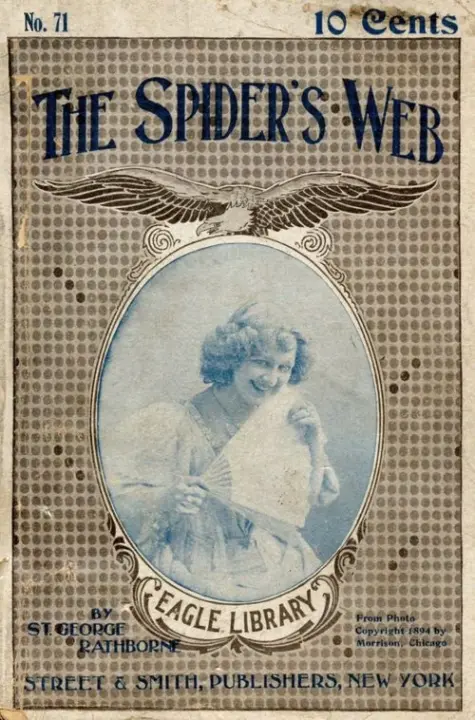
The spider’s web
St. George Rathborne
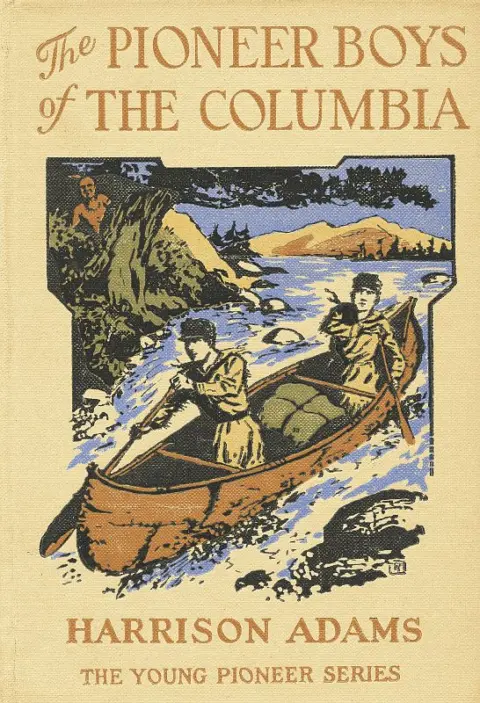
THE CLASSIC COLLECTION · 1916
"The Pioneer Boys of the Columbia; or, In the Wilderness of the Great Northwest" by Harrison Adams is a historical adventure novel written in the early 20th century. The narrative follows young pioneers Dick and Roger Armstrong as they embark on a perilous journey through the wilderness of the Pacific Northwest in the early 1800s. Faced with the dangers of the untamed landscape and the evolving complexities of their expedition, the boys exemplify bravery and resourcefulness typical of their time. At the start of the story, the Armstrong cousins are preparing to run the treacherous rapids of the Yellowstone River. Their initial excitement takes a sharp turn when their canoe, sabotaged by an unknown enemy, capsizes, forcing them to swim for their lives. After gathering themselves, they realize that they have been targeted by a traitor within their expedition, possibly linked to the unscrupulous French trader François Lascelles, who seeks revenge for their previous confrontations. As the story unfolds, readers can expect to see how the boys navigate both the physical challenges of the wilderness and the threats posed by human malice, setting the stage for a gripping adventure filled with excitement and danger.
Introduction adapted from the source catalogue; source summaries may be automatically generated.
Free to read · English · 71,320 words · No account needed
MAKE TIME FOR A GOOD BOOK
On by default. Untick to stop anonymous reading totals. Each page counts after 10 seconds in view. How this works.
Anonymous counting is on unless you have switched it off.
"THERE, I could see him reach down then and strike at a leaping wolf!" exclaimed Dick, showing signs of excitement, something he seldom did, since he had wonderful control over his emotions for a boy of his age.
"Just as I told you," continued Roger, trembling all over with eagerness, "he has used up his arrows, and is trying to cut down the number of his four-footed enemies by other means."
"There, listen to that howl!"
"Oh! he made a splendid strike that time, Dick!"
"Yes, and you can see what that clever brave is up to, if you notice the wild scuffle at the foot of the tree," the other replied.
"Why, the wolves seem to be fighting among themselves, Dick. What makes them act that way, do you know?"
"I can give a guess. These mad animals are almost starving, though just how that should be, at this season of the year, I am not able to say. The scent of blood makes them wild, you see, and, every time the brave's knife wounds one of the pack, the rest set upon the wretched beast to finish him."
"In that way the Indian could clean them up in time, I should say, without any help from us," Roger suggested, though he showed no sign that his intention of giving aid had changed in the least.
"But they might take warning, and stop jumping up at him," Dick explained; "then his knife would be useless. And, too, other wolves hearing the noise are apt to hasten to the spot, so that there might be an increasing pack, a new one for every beast he helped to kill."
"Dick, he is a brave fellow, even if his skin is red!"
"I agree with you there," said the other, softly.
"Then are we not going to bring about his rescue, even if it does cost us some of our precious powder and shot?" Roger demanded.
"Yes, but I hope it will not be more than one load," replied his cousin; for all their lives this question of a wastage of ammunition had been impressed on their minds as the utmost folly, and on that account they seldom used their guns except to make sure of worthy game.
"Come, let us rush forward with loud yells, waving our arms, and doing everything we can to scare the animals off before we begin to fire. After we get close up, and they are hesitating what to do, that is the time for us to blaze away."
"A good plan, Roger, and worthy of our fathers' old friend, Pat O'Mara. Only as a last resort will we use our fire-arms."
Your reading position is saved on this browser. Take it to another device with a library code. Reading pages adapt to text, rather than matching a printed edition.
St. George Rathborne
St. George Rathborne & Charles L. (Charles Lewis) Wrenn
St. George Rathborne
St. George Rathborne
BEHIND THE BOOK
This eBook is for the use of anyone anywhere in the United States and most other parts of the world at no cost and with almost no restrictions whatsoever. You may copy it, give it away or re-use it under the terms of the Project Gutenberg License included with this eBook or online at www.gutenberg.org. If you are not located in the United States, you will have to check the laws of the country where you are located before using this eBook. Read the source licence.
The original source file, including credits and licence, is retained by this library. Request an original-format copy at no charge. Please include the book title and Project Gutenberg identifier #46799.
KEEP YOUR CURIOSITY GOING
Cécile Tormay

Moritz Busch
Coulson Kernahan
John L. Ransom

Maurice Baring
Frances Wright