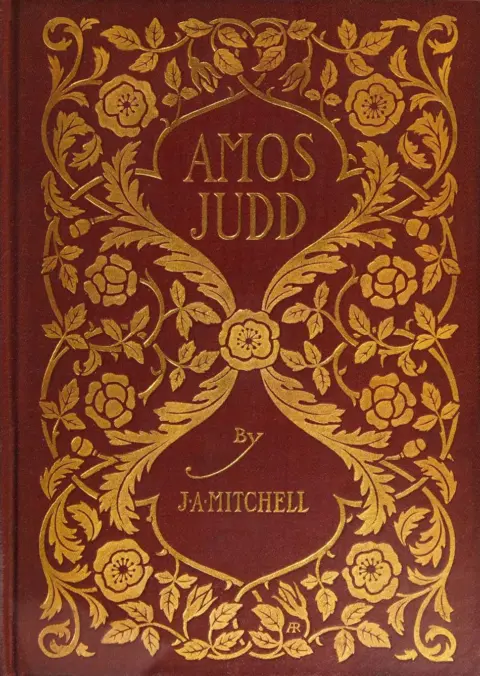
Amos Judd
John Ames Mitchell
THE CLASSIC COLLECTION · 1901
"The Pines of Lory" by John Ames Mitchell is a novel written in the early 20th century. The story introduces an intriguing connection between two main characters, Patrick Boyd, a man returning from Africa, and Elinor Marshall, an orphan with a generous heart. Their adventure begins when they find themselves passengers on a steamer bound for Boyd's Island, but soon they encounter unexpected circumstances that challenge their understanding of each other and compel them to confront deeper themes of love, virtue, and destiny. At the start of the novel, readers are introduced to the atmosphere aboard the steamer as the characters prepare for their journey. Boyd bears the scars of his recent past, still recovering physically and emotionally from his experiences in Africa. The narrative invites readers to witness his playful banter with his friend Billy Townsend, as well as the magnetic charm of Elinor, who is set to visit the Boyds’ house. Tension escalates amidst the humorous and social exchanges when the steamer unexpectedly lands at the wrong location, leaving both characters stranded in an isolated wilderness without someone to guide them. The initial light-heartedness gives way to a gripping tale intertwined with themes of romance and existential contemplation, as both characters are forced to confront their own vulnerabilities amidst unforeseen trials.
Introduction adapted from the source catalogue; source summaries may be automatically generated.
Free to read · English · 39,693 words · No account needed
MAKE TIME FOR A GOOD BOOK
On by default. Untick to stop anonymous reading totals. Each page counts after 10 seconds in view. How this works.
Anonymous counting is on unless you have switched it off.
This transformation from deepest grief to an overpowering ecstasy alarmed her companion. And in Elinor's eyes there was a feverish eagerness, intense, almost delirious, as she exclaimed:
"You heard it?"
"What?"
"That sound! The notes of a quail!"
The Princess shook her head.
"Oh, yes, you heard it! Don't say you did not hear it!"
Then, when the Princess, still looking up in vague alarm, gently shook her head a second time, Elinor reached forth a hand imploringly, as it were, and whispered:
"You must have heard it. The whistle of a quail, back there in the
woods?"
To the little woman upon the bench these words had no significance, but her sympathy was aroused. That sensitive nerves and an aching heart should succumb, at last, to despair and loneliness and fasting she could readily understand, and she answered, kindly:
"I heard no bird, dear child, but it may be there. Perhaps your hearing
is better than mine."
At this reply all the joy went out of Elinor's face, leaving a look so spiritless and despairing that her friend, who could only guess at her companion's thoughts, added:
"Or it may be nothing. You merely dreamed it, perhaps."
Elinor straightened up. She drew a long breath, and murmured, in a low voice from which all hope had fled:
"Of course! I dreamed it," and sank wearily into her place upon the
bench.
Furtively, but with pity in her face, the Princess regarded the drooping head and closed eyes; then she stood up and placed a hand affectionately upon Elinor's shoulder.
"I understand your feelings. Rest here until the boat goes."
Indicating, with a wave of her hand, the big trees towering high above,
she added:
"Your last moments with these old friends shall be respected. I am going to the two graves over there, and will return before it is time to start."
She walked away, into the grove.
Again, among the shadows of these pines, came memories of her childhood, with the feeling of being alone in a vast cathedral. And the fragrance, how she loved it! And she loved this obscurity, always impressive and always solemn, yet filling her soul with a dreamy joy.
Your reading position is saved on this browser. Take it to another device with a library code. Reading pages adapt to text, rather than matching a printed edition.
John Ames Mitchell
John Ames Mitchell

Francis Davis Millet & W. Hamilton (William Hamilton) Gibson & Will H. (Will Hicok) Low & John Ames Mitchell & Francis Hopkinson Smith
John Ames Mitchell
BEHIND THE BOOK
This eBook is for the use of anyone anywhere in the United States and most other parts of the world at no cost and with almost no restrictions whatsoever. You may copy it, give it away or re-use it under the terms of the Project Gutenberg License included with this eBook or online at www.gutenberg.org. If you are not located in the United States, you will have to check the laws of the country where you are located before using this eBook. Read the source licence.
The original source file, including credits and licence, is retained by this library. Request an original-format copy at no charge. Please include the book title and Project Gutenberg identifier #30600.
KEEP YOUR CURIOSITY GOING
Coulson Kernahan

Maurice Baring
Frances Wright
Cécile Tormay

Frederic Jesup Stimson

W. H. P. (William Henry Pope) Jarvis