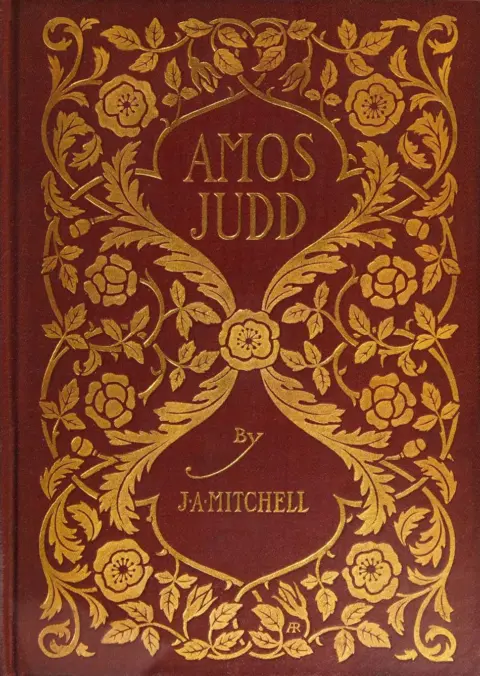
Amos Judd
John Ames Mitchell
THE CLASSIC COLLECTION · 1901
"The Pines of Lory" by John Ames Mitchell is a novel written in the early 20th century. The story introduces an intriguing connection between two main characters, Patrick Boyd, a man returning from Africa, and Elinor Marshall, an orphan with a generous heart. Their adventure begins when they find themselves passengers on a steamer bound for Boyd's Island, but soon they encounter unexpected circumstances that challenge their understanding of each other and compel them to confront deeper themes of love, virtue, and destiny. At the start of the novel, readers are introduced to the atmosphere aboard the steamer as the characters prepare for their journey. Boyd bears the scars of his recent past, still recovering physically and emotionally from his experiences in Africa. The narrative invites readers to witness his playful banter with his friend Billy Townsend, as well as the magnetic charm of Elinor, who is set to visit the Boyds’ house. Tension escalates amidst the humorous and social exchanges when the steamer unexpectedly lands at the wrong location, leaving both characters stranded in an isolated wilderness without someone to guide them. The initial light-heartedness gives way to a gripping tale intertwined with themes of romance and existential contemplation, as both characters are forced to confront their own vulnerabilities amidst unforeseen trials.
Introduction adapted from the source catalogue; source summaries may be automatically generated.
Free to read · English · 39,693 words · No account needed
MAKE TIME FOR A GOOD BOOK
On by default. Untick to stop anonymous reading totals. Each page counts after 10 seconds in view. How this works.
Anonymous counting is on unless you have switched it off.
With a deep sigh he replied, "The profundity of your contempt I can only guess at. Whatever it is, I share it. We are a poor lot.
"'At thirty, man suspects himself a fool;
Knows it at forty, and reforms his plan.'
Which is all true except the last line."
She smiled. "You are too severe. I consider man the highest form of animal life--after the dog and the elephant."
"Then where does woman come in?"
"Oh--as man's satellite she is hard to place. Her proper position might be anywhere between the peacock and the parrot."
Pats shook his head, slowly and sadly. "That's an awful utterance!"
"But it enables you to realize her vanity in aspiring to the wisdom of
man."
Father Burke laughed. "Fighting the Boer, Captain Boyd, is a different thing from skirmishing with the American girl."
"Indeed it is! For on the battle-field there is always one chance of victory. But I have not been fighting the Boers. I was trying to help the Boers against the English."
"Ah, good!" said the priest. "You were on the right side."
But the lady shook her head. "I don't know about that. I should have joined the English and fought against the Boers."
"But, my dear child," exclaimed Father Burke, "the cause of the Boers is so manifestly the cause of right and justice! They were fighting for their freedom,--the very existence of their country."
"Possibly, but the English officers are very handsome, and so stylish! And the Boers are common creatures--mostly farmers."
Pats regarded her in surprise. "That doesn't affect the principle of the thing. Even a farmer has rights."
"Principles are so tiresome!" and she looked away, as if the subject
wearied her.
"Does it make no difference with your sympathies," he asked with some earnestness, "whether a man is in the right or in the wrong? Would you have had no sympathy for the Greeks at Marathon?"
She raised her eyebrows, and with a faint shrug replied, "I am sure I don't know. Was that an important battle?"
"Very."
"In South Africa?"
Pats thought, at first, this question was in jest. She looked him serenely in the face, however, and he saw nothing in her eyes but the expectation of a serious answer to a simple question. Before he was ready with a reply, she inquired:
"Were you at that battle?"
He was so bewildered by this question, and from such a woman, that for a moment he could not respond. Father Burke, however, in his calm, paternal voice, gave the required facts.
Your reading position is saved on this browser. Take it to another device with a library code. Reading pages adapt to text, rather than matching a printed edition.
John Ames Mitchell
John Ames Mitchell

Francis Davis Millet & W. Hamilton (William Hamilton) Gibson & Will H. (Will Hicok) Low & John Ames Mitchell & Francis Hopkinson Smith
John Ames Mitchell
BEHIND THE BOOK
This eBook is for the use of anyone anywhere in the United States and most other parts of the world at no cost and with almost no restrictions whatsoever. You may copy it, give it away or re-use it under the terms of the Project Gutenberg License included with this eBook or online at www.gutenberg.org. If you are not located in the United States, you will have to check the laws of the country where you are located before using this eBook. Read the source licence.
The original source file, including credits and licence, is retained by this library. Request an original-format copy at no charge. Please include the book title and Project Gutenberg identifier #30600.
KEEP YOUR CURIOSITY GOING
Coulson Kernahan

Maurice Baring
Frances Wright
Cécile Tormay

Frederic Jesup Stimson

W. H. P. (William Henry Pope) Jarvis