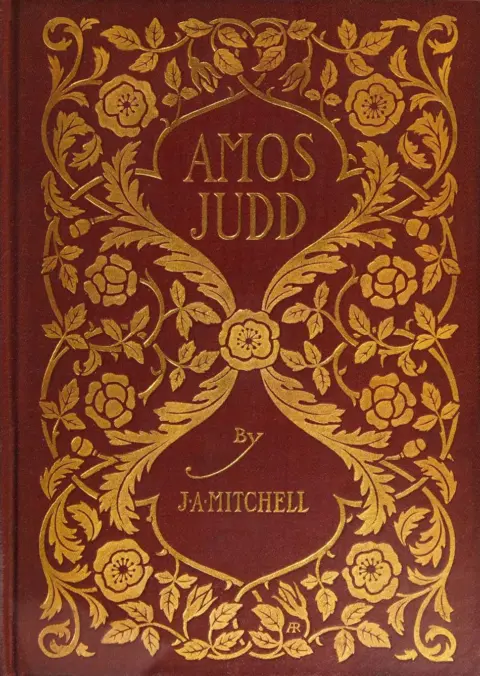
Amos Judd
John Ames Mitchell
THE CLASSIC COLLECTION · 1901
"The Pines of Lory" by John Ames Mitchell is a novel written in the early 20th century. The story introduces an intriguing connection between two main characters, Patrick Boyd, a man returning from Africa, and Elinor Marshall, an orphan with a generous heart. Their adventure begins when they find themselves passengers on a steamer bound for Boyd's Island, but soon they encounter unexpected circumstances that challenge their understanding of each other and compel them to confront deeper themes of love, virtue, and destiny. At the start of the novel, readers are introduced to the atmosphere aboard the steamer as the characters prepare for their journey. Boyd bears the scars of his recent past, still recovering physically and emotionally from his experiences in Africa. The narrative invites readers to witness his playful banter with his friend Billy Townsend, as well as the magnetic charm of Elinor, who is set to visit the Boyds’ house. Tension escalates amidst the humorous and social exchanges when the steamer unexpectedly lands at the wrong location, leaving both characters stranded in an isolated wilderness without someone to guide them. The initial light-heartedness gives way to a gripping tale intertwined with themes of romance and existential contemplation, as both characters are forced to confront their own vulnerabilities amidst unforeseen trials.
Introduction adapted from the source catalogue; source summaries may be automatically generated.
Free to read · English · 39,693 words · No account needed
MAKE TIME FOR A GOOD BOOK
On by default. Untick to stop anonymous reading totals. Each page counts after 10 seconds in view. How this works.
Anonymous counting is on unless you have switched it off.
There was no responsive movement. When it became clear that he had not been heard, Pats stepped a very little nearer and repeated, in a louder tone:
"I beg your pardon, sir."
Still the sleeper slept.
Pats glanced at Elinor Marshall, who smiled, involuntarily. Pats also smiled, as he realized that this ceremonious and somewhat labored greeting had a distinctly comic side, especially when so completely thrown away. However, he was about to repeat the salutation and in a louder voice, when he was struck by the color of the hand against the cheek. He went nearer and, stooping down, looked up into the sleeper's face. A glance was enough.
Slowly he straightened up, then reverently removed his hat.
Elinor, with a look of awe, came nearer and whispered:
"Dead! Is it possible!"
For a moment both stood in silence, looking down upon the seated figure. It was that of an elderly man, short, and slight of frame, with thick gray hair, and a beard cut roughly to a point. The face, brown, thin, and bony, was unduly emphasized by a Roman nose, too large for the other features. But the face, as a whole, impressed the two people now regarding it as almost handsome. He was clad in a dark gray suit, and a soft felt hat lay upon the seat beside him.
"How long has he been here, do you think?" asked Elinor, in a low voice.
"A day or two, I should say. His clothes are a little damp, and there are pine-needles on his shoulders and on his head."
"But how dreadfully sudden it must have come! Not a change in his position, or in his expression, even."
"An ideal death," said Pats. "I have helped bury a good many men this year, both friends and enemies, but very few went off as comfortably as this."
He took out his watch, seemed to hesitate a moment, then said,
reluctantly:
"This is bad for us, you know, finding him dead this way."
"Why?"
"It means there is no boat to get away with."
A look of alarm came into her face.
"We may as well face the situation," he continued, looking off over the water. "This man lived here alone, as we know from what we have seen in his house. And he evidently selected this place, not wishing to be disturbed. We are at the end of a bay at least ten miles deep, with no settlement in sight. There is nothing whatever to bring a visitor in here. The traffic of the gulf is away out there, perhaps thirty miles from here."
Your reading position is saved on this browser. Take it to another device with a library code. Reading pages adapt to text, rather than matching a printed edition.
John Ames Mitchell
John Ames Mitchell

Francis Davis Millet & W. Hamilton (William Hamilton) Gibson & Will H. (Will Hicok) Low & John Ames Mitchell & Francis Hopkinson Smith
John Ames Mitchell
BEHIND THE BOOK
This eBook is for the use of anyone anywhere in the United States and most other parts of the world at no cost and with almost no restrictions whatsoever. You may copy it, give it away or re-use it under the terms of the Project Gutenberg License included with this eBook or online at www.gutenberg.org. If you are not located in the United States, you will have to check the laws of the country where you are located before using this eBook. Read the source licence.
The original source file, including credits and licence, is retained by this library. Request an original-format copy at no charge. Please include the book title and Project Gutenberg identifier #30600.
KEEP YOUR CURIOSITY GOING
Coulson Kernahan

Maurice Baring
Frances Wright
Cécile Tormay

Frederic Jesup Stimson

W. H. P. (William Henry Pope) Jarvis