THE CLASSIC COLLECTION✦Lost DiariesCLASSIC FREE BOOKS
Lost Diaries
Maurice Baring
THE CLASSIC COLLECTION · 1914
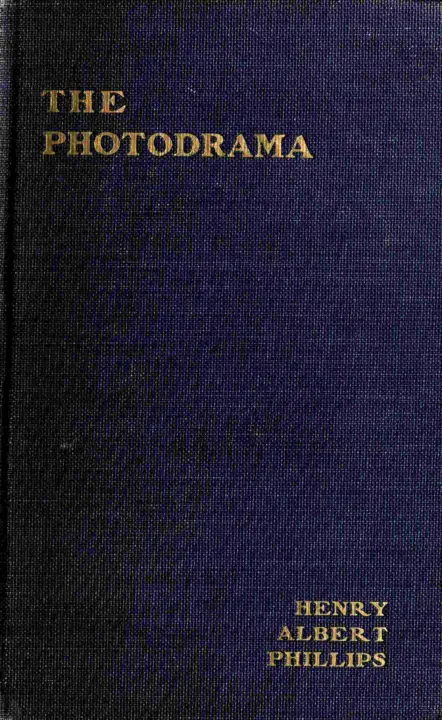
"The Photodrama: The Philosophy of Its Principles, the Nature of Its Plot, Its Dramatic Construction and Technique Illuminated by Copious Examples" by Henry Albert Phillips is a practical treatise focusing on the emerging art of photoplaywriting written in the early 20th century. The work explores the intersection of literature and cinema, detailing the techniques required to effectively craft photoplays—an innovative storytelling medium that combines visual and emotional elements to engage audiences. Phillips emphasizes the necessity of understanding not just the mechanics but also the artistic demands of this new form of dramatic expression. The opening of the book introduces the concept of the photodrama as an artistic medium distinct from traditional forms of literature and theater, advocating for the recognition of its potential to convey complex emotions and narratives through visual storytelling. Phillips elaborates on the importance of technique, asserting that successful photoplays must prioritize direct action and visual engagement over dialogue and literary prose. He invites readers to appreciate the unique challenges and creative opportunities presented by silent cinema, promoting a deeper understanding of how to evoke emotional responses through carefully structured scenes and character interactions.
Introduction adapted from the source catalogue; source summaries may be automatically generated.
Free to read · English · 38,413 words · No account needed
MAKE TIME FOR A GOOD BOOK
On by default. Untick to stop anonymous reading totals. Each page counts after 10 seconds in view. How this works.
Anonymous counting is on unless you have switched it off.
Author of “A Complete Course in Short Story Writing,” “A Complete Course in Photoplay Writing,” “A Complete Course in Plot Construction,” “Art in Short Story Narration,” “The Photodrama,” and formerly Associate Editor of the “Metropolitan Magazine.”
Introduction by Matthew White, Jr., Editor of “Munsey’s”
The only serious work on Plot Sources, Construction and Analysis there is; just as valuable to Photoplaywright as to Fiction Writer.
“We think the Photoplaywright will find many helpful hints in ‘The Plot of the Short Story.’ Those who are building up their working library will find this book a welcome addition. Mr. Phillips proves himself a teacher as well as an author.”--EPES WINTHROP SARGENT in The Moving Picture World.
“‘The Plot of the Short Story’ will prove invaluable to the Photoplaywright. Originality and treatment of plot are the essence of the successful picture play, and Mr. Phillips points out very clearly how these plots may be obtained.”--PHIL LANG, Editor of the Kalem Company.
“The most practical hand-book for Photoplaywrights ever written.”--E. V. BREWSTER, Editor Motion Picture Magazine.
“It is certainly a fine little work!”--ARTHUR LEEDS, Editor Photoplay
Author.
“It is the best thing of the kind that has come my way.”--MODESTE HANNIS JORDAN, Editor Writer’s Bulletin.
“This hand-book may be regarded as the best thing of its kind extant.”--North Carolina Education.
“It is an excellent thing excellently done.”--JACK LONDON.
A Thousand Other Testimonials!
Now going into a Second Large Edition.
(Add 10c. for collection of out of New York checks.)
The Stanhope-Dodge Publishing Company
Book Department Larchmont, New York, U. S. A.
The Most Noteworthy Auxiliary That the Writer’s Workshop Has Ever
Known!
Elastic and limitless in Scope and Capacity. Will hold more than 10,000 uniform items of Plot Material. Designed for Plot Material, Plot Germs and Complete Plots in the form of Notes, Items, Newspaper Clippings, Excerpts, References, Statistics, etc. Five hundred specially made Receptacles, in handsome, serviceable filing cases. More than 1,000 headings and sub-headings under which Plot matter is catalogued. All divisions are logical, progressive and comprehensive. The most infinitesimal phase of fiction can be located, filed or produced instantly. Each receptacle is numbered with “Contents” plainly printed upon it. Progressively indexed under seven grand divisions:
I.--THE HEART OF MAN--Man’s Relations with Woman and Family.
II.--THE AMBITION OF MAN--Man’s Relations with His People and Fellow
Man.
III.--THE FLESH OF MAN--Man’s Relations with the Devil and Death.
IV.--THE SOUL OF MAN--Man’s Relations with His God and Religion.
V.--THE MIND OF MAN--Man’s Interpretation of the Unreal and
Realization of the Unknown.
Your reading position is saved on this browser. Take it to another device with a library code. Reading pages adapt to text, rather than matching a printed edition.
BEHIND THE BOOK
This eBook is for the use of anyone anywhere in the United States and most other parts of the world at no cost and with almost no restrictions whatsoever. You may copy it, give it away or re-use it under the terms of the Project Gutenberg License included with this eBook or online at www.gutenberg.org. If you are not located in the United States, you will have to check the laws of the country where you are located before using this eBook. Read the source licence.
The original source file, including credits and licence, is retained by this library. Request an original-format copy at no charge. Please include the book title and Project Gutenberg identifier #70937.
KEEP YOUR CURIOSITY GOING
Maurice Baring
W. B. (William Butler) Yeats
Edward Martyn

John Brougham & Charlotte Brontë
Marguerite Merington
Leonid Andreyev