The Islets of the Channel
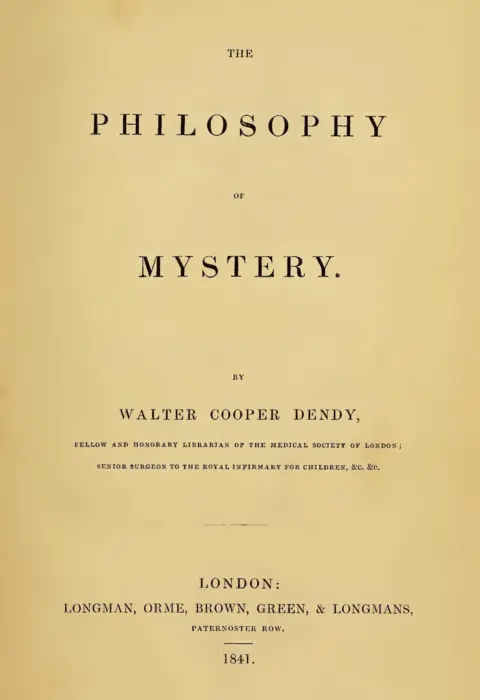
Walter Cooper Dendy
THE CLASSIC COLLECTION · 1841
"The Philosophy of Mystery" by Walter Cooper Dendy is a philosophical treatise examining the nature and implications of the supernatural, particularly focusing on ghosts, spirits, and their representations throughout history. Written in the early 19th century, it combines elements of philosophy, psychology, and anecdotal narrative to explore belief in the supernatural and the motivations behind such beliefs. The text likely appeals to readers interested in metaphysical discussions and the intersection of literature and philosophy. The beginning of the book introduces a scene set on the Wye River, featuring two young women and a thoughtful bachelor named Astrophel, who delves into ghostly phenomena and the pursuit of wisdom regarding the supernatural. As they discuss the existence of spirits, the dialogue reflects the contrasting beliefs about ghosts and the philosophical inquiries surrounding the nature of reality and illusion. The characters express a mixture of skepticism and curiosity, setting the stage for a philosophical exploration of mystery, belief, and the narratives that surround such spectral topics.
Introduction adapted from the source catalogue; source summaries may be automatically generated.
Free to read · English · 131,777 words · No account needed
MAKE TIME FOR A GOOD BOOK
On by default. Untick to stop anonymous reading totals. Each page counts after 10 seconds in view. How this works.
Anonymous counting is on unless you have switched it off.
And again, in the tale of the “Nonnes Preest:”
“Swevenes (dreams) engendren of repletions, And oft of fume and of complexions, When humours ben to habundant in a wight. Of other humours cou’d I telle also, That werken many a man in slepe moch wo,” &c.
EV. I sit reproved, fair lady. Herodotus also says, the Atlantes never dream; which Montaigne refers to their never eating anything which has died of itself. And Burton thus sums up his precepts of prevention:
“Against fearful and troublesome dreams, incubus, and inconveniences wherewith melancholy men are molested, the best remedy is to eat a light supper and of such meats as are easie of digestion, no hare, venison, beef, &c.; not to lie on his back,” &c.
Dryden, to ensure his brilliant visions of poesy, ate raw flesh; and Mrs. Radcliffe, I am told, adopted the same plan. We know that green tea and coffee, if we do sleep, induce dreaming; and Baptista Porta, for procuring quiet rest and pleasing dreams, swallowed horse-tongue after supper.
Indigestion, and that condition which is termed a weak or irritable stomach, constitute a most fruitful source of visions. The immediate or direct influence of repletion, in totally altering the sensations and the disposition in waking moments, is a proof of its power to derange the circulation of the brain and the mental faculties in sleep.
“Somnus ut sit levis, sit tibi cœna brevis.”
The influence of the great sympathetic nerve in this respect is very important. With many persons, a meal is usually followed by feelings of depression, impaired memory, unusual timidity, despondency, and other illusive characteristics of hysteria and hypochondriasis. And events will appear of the greatest moment, which, after the lapse of some hours, will be considered mere trifles. So that, after all, there is some truth in the idea of that archæus, or great spirit, asserted, by Van Helmont, to sit at the cardia of the stomach, and regulate almost all the other organs.
The posture of supination will unavoidably induce that increased flow of blood to the brain which, under certain states of this fluid, is so essential to the production of brilliant waking thoughts; an end, indeed, attained so often by another mode—the swallowing of opium.
A gentleman of high attainment was constantly haunted by a spectre when he retired to rest, which seemed to attempt his life. When he raised himself in bed, the phantom vanished, but reappeared as he resumed the recumbent posture.
Your reading position is saved on this browser. Take it to another device with a library code. Reading pages adapt to text, rather than matching a printed edition.
Walter Cooper Dendy
BEHIND THE BOOK
This eBook is for the use of anyone anywhere in the United States and most other parts of the world at no cost and with almost no restrictions whatsoever. You may copy it, give it away or re-use it under the terms of the Project Gutenberg License included with this eBook or online at www.gutenberg.org. If you are not located in the United States, you will have to check the laws of the country where you are located before using this eBook. Read the source licence.
The original source file, including credits and licence, is retained by this library. Request an original-format copy at no charge. Please include the book title and Project Gutenberg identifier #56822.
KEEP YOUR CURIOSITY GOING

David Patterson (Spirit) Hatch
Coulson Kernahan

Ralph Waldo Emerson
Frances Wright

Edwin Abbott Abbott

Joseph Droz