The Islets of the Channel
Walter Cooper Dendy
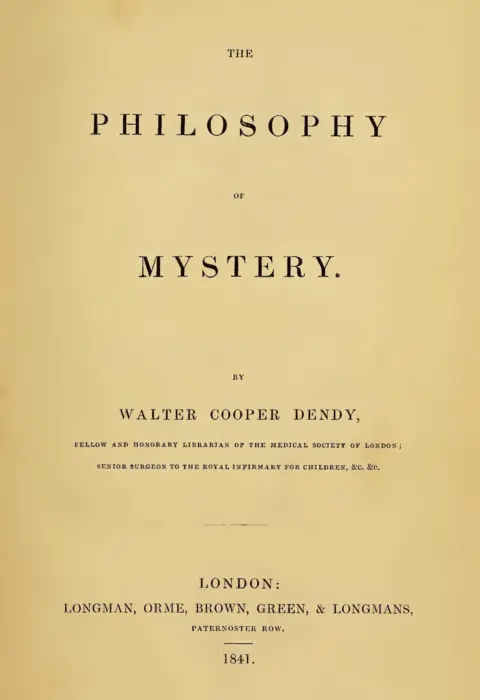
THE CLASSIC COLLECTION · 1841
"The Philosophy of Mystery" by Walter Cooper Dendy is a philosophical treatise examining the nature and implications of the supernatural, particularly focusing on ghosts, spirits, and their representations throughout history. Written in the early 19th century, it combines elements of philosophy, psychology, and anecdotal narrative to explore belief in the supernatural and the motivations behind such beliefs. The text likely appeals to readers interested in metaphysical discussions and the intersection of literature and philosophy. The beginning of the book introduces a scene set on the Wye River, featuring two young women and a thoughtful bachelor named Astrophel, who delves into ghostly phenomena and the pursuit of wisdom regarding the supernatural. As they discuss the existence of spirits, the dialogue reflects the contrasting beliefs about ghosts and the philosophical inquiries surrounding the nature of reality and illusion. The characters express a mixture of skepticism and curiosity, setting the stage for a philosophical exploration of mystery, belief, and the narratives that surround such spectral topics.
Introduction adapted from the source catalogue; source summaries may be automatically generated.
Free to read · English · 131,777 words · No account needed
MAKE TIME FOR A GOOD BOOK
On by default. Untick to stop anonymous reading totals. Each page counts after 10 seconds in view. How this works.
Anonymous counting is on unless you have switched it off.
EV. By similitude. I may even remind you with devout veneration, of the dreams of a prophet, to prove the brain highly sensitive when these visions are before it. Listen to the words of Daniel, to whom “God gave knowledge and skill in all learning and wisdom.”
“I, Daniel, was grieved in my spirit, in the midst of my body, and the visions of my head troubled me.”
“And I, Daniel, fainted and was sick certain days.”
Even here, may we not believe, that the Creator did not alter his law?
It was Dr. Cullen who first drew a parallel between insanity and dreams. As some proof of his insight, we read in Lode of a man who never dreamed until he fell into a fever in the twenty-fifth year;—in Beattie, of a young friend who never dreamt unless his health was deranged.
And Mr. Locke thus writes: “I once knew a man who was bred a scholar, and had no bad memory, who told me that he had never dreamed in his life until he had fever.”
This immunity from dreams is also most marked in savages, unless during disorder or at the dying moment. Ulloa, Humboldt, and La Condamine, all agree as to the character of indolence and absence of thought and fancy in the native Americans, and it is as sure that they seldom dream.
Now whatever influence tends to arrest or derange the upper circulation of the blood in its return to the heart, or to detain it in the vessels of the brain, or which presses on an important nerve, so as to disturb the function of the brain or spinal cord, by continuous sympathy, may be the remote cause of the phenomena of dreaming.
Such are the results of repletion, dyspepsia, the supine position, &c.
&c.
And here, Astrophel, I meet your metaphysician.
Galen, and indeed the ancients generally, attributed dreams chiefly to indigestion; but referred their immediate excitement to fumes and vapours, instead of to nervous influence, or cerebral congestion from interrupted circulation.
CAST. And here, Evelyn, courtesy might have prompted you to meet my poets. Let me see, is it not Dryden who writes of—
“——rising fumes of undigested food, And noxious humours that disturb the blood?”
And in a poem believed to have been written by Chaucer, there is this passage: can I remember his quaintness?
“I supposed yt to have been some noxiall fantasy, As fallyth in dremes, in parties of the nyght, Which cometh of joy or grievous malady; Or of robuste metes which causeth grete myght; Overmoche replet obscuryth the syght Of natural reasonne, and causyth idyll thowght, Makyth the body hevy where hyt was lyght.”
Your reading position is saved on this browser. Take it to another device with a library code. Reading pages adapt to text, rather than matching a printed edition.
Walter Cooper Dendy
BEHIND THE BOOK
This eBook is for the use of anyone anywhere in the United States and most other parts of the world at no cost and with almost no restrictions whatsoever. You may copy it, give it away or re-use it under the terms of the Project Gutenberg License included with this eBook or online at www.gutenberg.org. If you are not located in the United States, you will have to check the laws of the country where you are located before using this eBook. Read the source licence.
The original source file, including credits and licence, is retained by this library. Request an original-format copy at no charge. Please include the book title and Project Gutenberg identifier #56822.
KEEP YOUR CURIOSITY GOING

David Patterson (Spirit) Hatch
Coulson Kernahan

Ralph Waldo Emerson
Frances Wright

Edwin Abbott Abbott

Joseph Droz