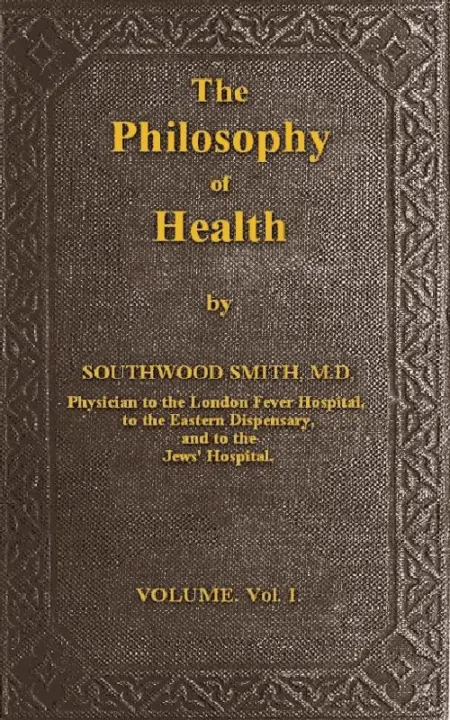
The Philosophy of Health; Volume 1 (of 2) or, an exposition of the physical and mental constitution of man
Southwood Smith
THE CLASSIC COLLECTION · 1836
"The Philosophy of Health; Volume 2" by Southwood Smith is a scientific publication written in the mid-19th century. This work is a continuation of the exploration of human health, emphasizing the physical and mental constitution of individuals as a means to promote longevity and happiness. The book delves into various bodily functions, particularly focusing on respiration and its vital role in maintaining health. The opening of the second volume begins with a detailed examination of respiration, comparing its processes in both plants and animals. Smith discusses the apparatus involved in respiration, including the trachea, bronchi, and lungs, and outlines the mechanics of inspiration and expiration. He highlights the significance of air in sustaining life, noting that while organisms can survive without food for extended periods, they cannot endure without air. The intricacies of how respiration affects blood and air interactions are introduced, setting the stage for an in-depth scientific analysis of these essential biological functions throughout the volume.
Introduction adapted from the source catalogue; source summaries may be automatically generated.
Free to read · English · 96,440 words · No account needed
MAKE TIME FOR A GOOD BOOK
On by default. Untick to stop anonymous reading totals. Each page counts after 10 seconds in view. How this works.
Anonymous counting is on unless you have switched it off.
Bulk in Weight in cubic inches. grains troy. Given out undecomposed as before 665,646 205,758.833 Recomposed carbonic acid gas 38,268 18,130.147 Azote liberated 165,927 50,027.405 Vapour of water as before 2,219 428.726 ——————— ——————————- Total 872,060 274,345.111
weighing as before, but less in bulk by 446¼ pints: so that for every 100,000 inches expired there were inspired 101,774 cubic inches.
457. When from the weight of
carbonic acid gas thus expired, viz., 18,130.147
we deduct the small portion inhaled
in solution with the air 105.130 —————————— The remainder is 18,025.017
The constituent parts of which are, oxygen derived from the air 13,109.104 —————————— And pure carbon derived from the blood being the difference 4,915.913
Thus in the compass of twenty-four hours the blood has produced 10 ounces and 116 grains very nearly of pure carbon.
458. Now, from the oxygen consumed Grains. in twenty-four hours as above 15,757.913
Deduct the weight restored in the form of carbonic acid gas 13,109.104 —————————— The remainder must have been absorbed into the blood 2,648.809
But the weight of carbon given out being as above 4,915.913 ————————— There is still an excess given outweighing 2,267.104
459. Some azote, however, is absorbed into the blood (439) as well as the above ascertained quantity of oxygen.
The weight of azote so absorbed must
be precisely 2,267.104
if the theory be true, that equal weights
are expired and inspired. In
which case, as the weight of the
azote of the air inspired was, as
shown above 52,294.509
While the azote expired could only have weighed 50,027.405 —————————- The difference would have been absorbed 2,267.104
And thus the weight of carbon discharged by the blood is precisely compensated by the united weight of the oxygen and azote which it has absorbed.
460. Since it appears to be a general truth that one quarter of the air respired is decomposed, and that the volume of air continually present in the lungs is sufficient for that consumption of oxygen which is requisite in 160 seconds of time, if that volume be, as is apparent, 48 times the quantity decomposed out of a single respiration, no error in the quantity of oxygen consumed in the twenty-four hours, which we have assumed, will affect the time of 160 seconds. For there being 18 × 60 × 24 respirations, and 60 × 60 × 24 seconds of time in the twenty-four hours, the 48th part of the first, and the 160th part of the last product is equally the 540th part of the whole, whatever it may be.
Your reading position is saved on this browser. Take it to another device with a library code. Reading pages adapt to text, rather than matching a printed edition.
BEHIND THE BOOK
This eBook is for the use of anyone anywhere in the United States and most other parts of the world at no cost and with almost no restrictions whatsoever. You may copy it, give it away or re-use it under the terms of the Project Gutenberg License included with this eBook or online at www.gutenberg.org. If you are not located in the United States, you will have to check the laws of the country where you are located before using this eBook. Read the source licence.
The original source file, including credits and licence, is retained by this library. Request an original-format copy at no charge. Please include the book title and Project Gutenberg identifier #60937.
KEEP YOUR CURIOSITY GOING

John Muir

Asa Gray
Asa Gray

Florence Nightingale
Elizabeth Robins Pennell
Denison Olmsted