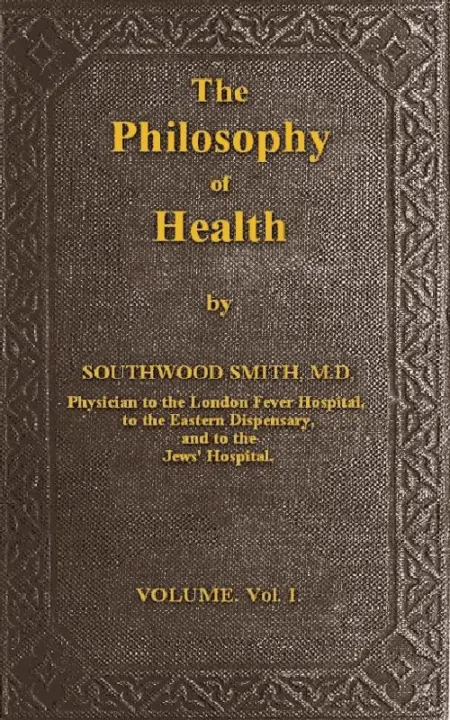
The Philosophy of Health; Volume 1 (of 2) or, an exposition of the physical and mental constitution of man
Southwood Smith
THE CLASSIC COLLECTION · 1836
"The Philosophy of Health; Volume 2" by Southwood Smith is a scientific publication written in the mid-19th century. This work is a continuation of the exploration of human health, emphasizing the physical and mental constitution of individuals as a means to promote longevity and happiness. The book delves into various bodily functions, particularly focusing on respiration and its vital role in maintaining health. The opening of the second volume begins with a detailed examination of respiration, comparing its processes in both plants and animals. Smith discusses the apparatus involved in respiration, including the trachea, bronchi, and lungs, and outlines the mechanics of inspiration and expiration. He highlights the significance of air in sustaining life, noting that while organisms can survive without food for extended periods, they cannot endure without air. The intricacies of how respiration affects blood and air interactions are introduced, setting the stage for an in-depth scientific analysis of these essential biological functions throughout the volume.
Introduction adapted from the source catalogue; source summaries may be automatically generated.
Free to read · English · 96,440 words · No account needed
MAKE TIME FOR A GOOD BOOK
On by default. Untick to stop anonymous reading totals. Each page counts after 10 seconds in view. How this works.
Anonymous counting is on unless you have switched it off.
441. It was formerly estimated that the weight of pure atmospheric air is 305,000 grains troy for one million of cubic inches; but the latest authorities assign it to be 310,117 grains. Of this weight of one million of cubic inches of pure air,
The weight of the oxygen is 71,809.3 The weight of the azote is 238,307.7 ————————— Total 310,117.0
442. But common atmospheric air in its ordinary state contains in 1000
cubic inches,
Of pure air 989
Of the vapour of water 10
Of carbonic acid gas 1
Ten inches of pure air are equal in weight to nine of oxygen.
Eight inches of azote are equal in weight to seven of oxygen.
The specific gravity of carbonic acid is to pure air at the rate of
15,277 to 10,000.
The specific gravity of the vapour of water is to pure air as 6,230 to 10,000. It follows that a million of cubic inches of air in its ordinary state weigh 309,111½ grains.
Carbonic acid gas is composed of oxygen and pure carbon in the proportion of eight grains of oxygen to three of carbon out of every eleven grains of carbonic acid.
443. Though during particular portions in the twenty-four hours, under circumstances which influence variously the actions of life (437 and 438), the quantity of the oxygen consumed, of carbonic acid generated, and of azote absorbed, vary (436 to 439), yet it is probable that the daily consumption, reproduction, and absorption of these gases, is pretty much the same one day with another. The experiments of Dr. Edwards clearly show that while these quantities vary to such an extent, when the observation embraces only a short interval, as to be scarcely ever the same hour by hour, yet that they lessen as the interval extends, until at length a nearly exact equilibrium is established.
444. Experimental philosophers have not obtained precisely the same results as to the quantities consumed and reproduced of these respective gases. At present, therefore, we can only approximate to the exact amount by taking the average of their observations. The following are the results of the principal experiments which have been instituted. The quantity of oxygen consumed by an adult man in twenty-four hours is, according to
Menzes 51,840
Lavoisier 46,048
Davy 45,504
Allen and Pepys 39,534
The mean of all which is, 45,731.5 inches.
445. In like manner the quantity of carbonic acid generated in the same
time is, according to
Davy 38,304 cubic inches. Allen and Pepys 38,232 “ The mean of which is, 38,268 “
The weight of 38,268 inches of carbonic acid gas is 18,130.1474 grains troy; and the weight of 45,731½ inches of oxygen is 15,757.9131 grains troy.
Now this weight of oxygen must have been derived from the decomposition of 221,882 cubic inches of common atmospheric air.
Your reading position is saved on this browser. Take it to another device with a library code. Reading pages adapt to text, rather than matching a printed edition.
BEHIND THE BOOK
This eBook is for the use of anyone anywhere in the United States and most other parts of the world at no cost and with almost no restrictions whatsoever. You may copy it, give it away or re-use it under the terms of the Project Gutenberg License included with this eBook or online at www.gutenberg.org. If you are not located in the United States, you will have to check the laws of the country where you are located before using this eBook. Read the source licence.
The original source file, including credits and licence, is retained by this library. Request an original-format copy at no charge. Please include the book title and Project Gutenberg identifier #60937.
KEEP YOUR CURIOSITY GOING

John Muir

Asa Gray
Asa Gray

Florence Nightingale
Elizabeth Robins Pennell
Denison Olmsted