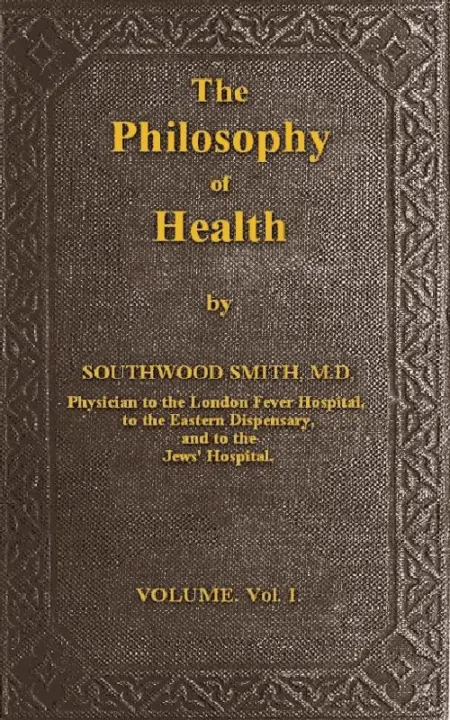
The Philosophy of Health; Volume 1 (of 2) or, an exposition of the physical and mental constitution of man
Southwood Smith
THE CLASSIC COLLECTION · 1836
"The Philosophy of Health; Volume 2" by Southwood Smith is a scientific publication written in the mid-19th century. This work is a continuation of the exploration of human health, emphasizing the physical and mental constitution of individuals as a means to promote longevity and happiness. The book delves into various bodily functions, particularly focusing on respiration and its vital role in maintaining health. The opening of the second volume begins with a detailed examination of respiration, comparing its processes in both plants and animals. Smith discusses the apparatus involved in respiration, including the trachea, bronchi, and lungs, and outlines the mechanics of inspiration and expiration. He highlights the significance of air in sustaining life, noting that while organisms can survive without food for extended periods, they cannot endure without air. The intricacies of how respiration affects blood and air interactions are introduced, setting the stage for an in-depth scientific analysis of these essential biological functions throughout the volume.
Introduction adapted from the source catalogue; source summaries may be automatically generated.
Free to read · English · 96,440 words · No account needed
MAKE TIME FOR A GOOD BOOK
On by default. Untick to stop anonymous reading totals. Each page counts after 10 seconds in view. How this works.
Anonymous counting is on unless you have switched it off.
727. By his superior method of injecting, Ruysh conceived that he was able completely to disprove Malpighi’s doctrine. He maintained that the bodies which Malpighi mistook for sacs or follicles are in reality convoluted vessels; that these vessels are capable of being completely unravelled; that, when unfolded, their continuity with the excretory duct is perfectly demonstrated; that secretion is performed by the capillary artery itself, without the intervention of any other organ; and that when the secreted substance is duly prepared, it is poured by the capillary directly into the excretory duct.
728. Modern research has demonstrated that the opinion of Malpighi approaches nearer the truth than that of Ruysh, who appears to have mistaken the secreting canals for the ultimate division of the arterial vessels. Malpighi, indeed, did not succeed in discovering the elementary bodies of which the secreting apparatus is composed; but he arrived at the very verge of the truth. Profiting by the art which Ruysh brought to so much perfection, by the facts which Malpighi disclosed, and, above all, by the improved structure of the microscope, and the increased skill which has been acquired in the manipulation of the instrument, the modern physiologist is enabled to see what was formerly beyond the cognizance of sense, and to demonstrate what before could only be matter of conjecture. Availing himself of these advantages with consummate skill, and applying himself to the task with indefatigable industry, Professor Müller, of Berlin, has investigated the structure of the secreting apparatus in the whole animal kingdom, and has traced the progressive development of the several secreting organs through the entire animal series, from their simplest form in the lowest animal, to their most complex in the highest.
729. From the researches of this physiologist, and from the labours of others, his countrymen and contemporaries, who have engaged in the investigation with an ardour second only to his own, it is demonstrated that the secreting apparatus of the animal body is disposed in one or other of the elementary forms which have been described. The blood-vessels are distributed upon the walls of these elementary bodies, whether simple cryptæ follicles, cæca, or tubuli, or whether these bodies are accumulated and combined into the largest and most complex series of secreting canals, just as the branches of the pulmonary artery are distributed upon the walls of the air-vesicles in the rete mirabile of the lungs. The air-vesicles of the lungs are secreting organs, and afford an excellent example of the mode in which the blood-vessels are distributed upon the walls of the elementary secreting bodies. The arteries do not form continuous tubes with the secreting bodies or their excretory ducts, as was maintained by Ruysh; neither is the secreting body interposed between the termination of the artery and the commencement of the excretory duct, as was thought by Malpighi; but the ultimate divisions of the arteries are spread out upon the walls of the secreting bodies, where they terminate in veins by a delicate vascular net-work (fig. CLXXXVII. 2). The minutest branch of the artery is always smaller than the minutest secreting body on the walls of which it is distributed. According to Müller, the arteries, spread out upon the walls of the secreting bodies, form a distinct and peculiar system of vessels visible under the microscope. In the more complex secreting organs, immediately before reaching their distribution upon the walls of the secreting canals, the ultimate divisions of the arteries form an intricate and delicate net-work (fig. CLXXXVII. 2). When at length they reach the secreting canals the arteries no longer divide and subdivide, but are always of the same uniform size in the same secreting organ, though their magnitude is different in every different kind of secreting organ. These ultimate divisions of the arteries are the proper capillary arteries. It is in these arteries that the changes are wrought upon the blood which it is the object of the various processes of secretion to effect. In the walls of these arteries there are visible no pores, no apertures, no open extremities by which the secreted fluid, when formed from the blood, is conveyed into the cavity of the secreting canals; it probably passes through the walls of the vessels into the secreting canals by the process of endosmose (804).
Your reading position is saved on this browser. Take it to another device with a library code. Reading pages adapt to text, rather than matching a printed edition.
BEHIND THE BOOK
This eBook is for the use of anyone anywhere in the United States and most other parts of the world at no cost and with almost no restrictions whatsoever. You may copy it, give it away or re-use it under the terms of the Project Gutenberg License included with this eBook or online at www.gutenberg.org. If you are not located in the United States, you will have to check the laws of the country where you are located before using this eBook. Read the source licence.
The original source file, including credits and licence, is retained by this library. Request an original-format copy at no charge. Please include the book title and Project Gutenberg identifier #60937.
KEEP YOUR CURIOSITY GOING

John Muir

Asa Gray
Asa Gray

Florence Nightingale
Elizabeth Robins Pennell
Denison Olmsted