The Philosophy of Health; Volume 2 (of 2) or, an exposition of the physical and mental constitution of man
Southwood Smith
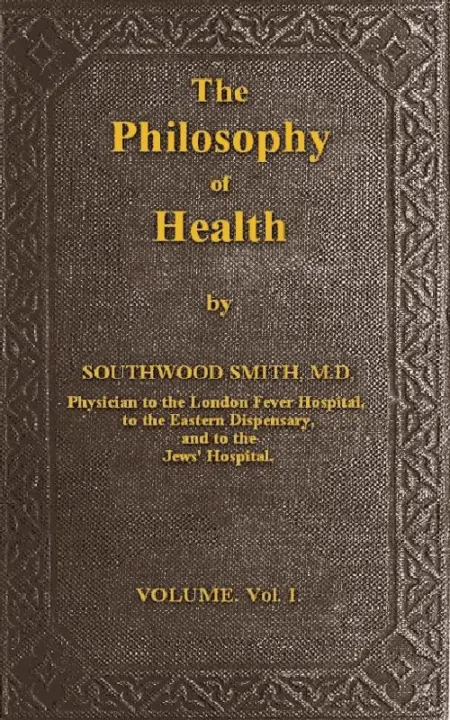
THE CLASSIC COLLECTION · 1836
"The Philosophy of Health; Volume 1" by Southwood Smith is a scientific publication written in the mid-19th century. This work offers an in-depth exploration of human physiology, focusing on the physical and mental constitution of individuals while aiming to promote longevity and happiness. The book delves into the connection between bodily functions and mental well-being, providing a comprehensive look at how understanding these principles can lead to a healthier and more fulfilling life. The opening of this volume introduces the reader to the fundamental aspects of life, distinguishing living beings from inorganic bodies and outlining the essential functions that characterize plants and animals. Smith elaborates on the complex organization of living organisms, highlighting the necessity of both organic and animal actions in sustaining life. He emphasizes the interconnectedness of physical health and mental awareness, arguing that knowledge of one’s body is crucial for maintaining a sound state of health. The introduction sets the stage for a structured exploration of how awareness and understanding of physiological processes can empower individuals to take charge of their health and wellness.
Introduction adapted from the source catalogue; source summaries may be automatically generated.
Free to read · English · 80,175 words · No account needed
MAKE TIME FOR A GOOD BOOK
On by default. Untick to stop anonymous reading totals. Each page counts after 10 seconds in view. How this works.
Anonymous counting is on unless you have switched it off.
But if to every human being occasions must continually occur, when knowledge of this kind would be useful, the possession of it seems peculiarly necessary to those who have the exclusive care of infancy, almost the entire care of childhood, a great part of the care of the sick, and whose ignorance, not the less mischievous because its activity is induced by affection, constantly endangers, and often defeats, the best concerted measures of the physician.
The bodily organization and the mental powers of the child depend mainly on the management of the infant; and the intellectual and moral aptitudes and qualities of the man have their origin in the predominant states of sensation, at a period far earlier in the history of the human being than is commonly imagined. The period of infancy is divided by physiologists into two epochs; the first, commencing from birth, extends to the seventh month: the second, commencing from the seventh month, extends to the end of the second year, at which time the period of infancy ceases, and that of childhood begins. The first epoch of infancy is remarkable for the rapidity of the development of the organs of the body: the processes of growth are in extreme activity; the formative predominates over the sentient life, the chief object of the action of the former being to prepare the apparatus of the latter. The second epoch of infancy is remarkable for the development of the perceptive powers. The physical organization of the brain, which still advances with rapidity, is now capable of a greater energy, and a wider range of function. Sensation becomes more exact and varied; the intellectual faculties are in almost constant operation; speech commences, the sign, and, to a certain extent, the cause of the growing strength of the mental powers; the capacity of voluntary locomotion is acquired, while passion, emotion, affection, come into play with such constancy and energy, as to exert over the whole economy of the now irritable and plastic creature a prodigious influence for good or evil. If it be, indeed, possible to make correct moral perception, feeling, and conduct, a part of human nature, as much a part of it as any sensation or propensity—if this be possible for every individual of the human race, without exception, to an extent which would render all more eminently and consistently virtuous than any are at present (and of the possibility of this, the conviction is the strongest in the acutest minds which have studied this subject the most profoundly), preparation for the accomplishment of this object must be commenced at this epoch. But if preparation for this object be really commenced, it implies, on the part of those who engage in the undertaking, some degree of knowledge; knowledge of the physical and mental constitution of the individual to be influenced; knowledge of the mode, in which circumstances must be so modified in adaptation to the nature of the individual being, as to produce upon it, with uniformity and certainty, a given result. The theory of human society, according to its present institutions, supposes that this knowledge is possessed by the mother; and it supposes, further, that this adaptation will actually take place in the domestic circle through her agency. Hence the presumed advantage of having the eye of the mother always upon the child; hence the apprehension of evil so general, I had almost said instinctive, whenever it is proposed to take the infant, for the purpose of systematic physical and mental discipline, from beyond the sphere of maternal influence. But society, which thus presumes that the mother will possess the power and the disposition to do this, what expedients has it devised to endow her with the former, and to secure the formation of the latter? I appeal to every woman whose eye may rest on these pages. I ask of you, what has ever been done for you to enable you to understand the physical and mental constitution of that human nature, the care of which is imposed upon you? In what part of the course of your education was instruction of this kind introduced? Over how large a portion of your education did it extend? Who were your teachers? What have you profited by their lessons? What progress have you made in the acquisition of the requisite information? Were you at this moment to undertake the guidance of a new-born infant to health, knowledge, goodness, and happiness, how would you set about the task? How would you regulate the influence of external agents upon its delicate, tender, and highly-irritable organs, in such a manner as to obtain from them healthful stimulation, and avoid destructive excitement? What natural and moral objects would you select as the best adapted to exercise and develope its opening faculties? What feelings would you check, and what cherish? How would you excite aims; how would you apply motives? How would you avail yourself of pleasure as a final end, or as the means to some further end? And how would you deal with the no less formidable instrument of pain? What is your own physical, intellectual, and moral state, as specially fitting you for this office? What is the measure of your own self-control, without a large portion of which no human being ever yet exerted over the infant mind any considerable influence for good? There is no philosopher, however profound his knowledge, no instructor, however varied and extended his experience, who would not enter upon this task with an apprehension proportioned to his knowledge and experience; but knowledge which men acquire only after years of study, habits which are generated in men only as the result of long-continued discipline, are expected to come to you spontaneously, to be born with you, to require on your part no culture, and to need no sustaining influence.
Your reading position is saved on this browser. Take it to another device with a library code. Reading pages adapt to text, rather than matching a printed edition.
BEHIND THE BOOK
This eBook is for the use of anyone anywhere in the United States and most other parts of the world at no cost and with almost no restrictions whatsoever. You may copy it, give it away or re-use it under the terms of the Project Gutenberg License included with this eBook or online at www.gutenberg.org. If you are not located in the United States, you will have to check the laws of the country where you are located before using this eBook. Read the source licence.
The original source file, including credits and licence, is retained by this library. Request an original-format copy at no charge. Please include the book title and Project Gutenberg identifier #60773.
KEEP YOUR CURIOSITY GOING

David Patterson (Spirit) Hatch
Coulson Kernahan

Ralph Waldo Emerson
Frances Wright

Edwin Abbott Abbott

Joseph Droz