The Philosophy of Health; Volume 2 (of 2) or, an exposition of the physical and mental constitution of man
Southwood Smith
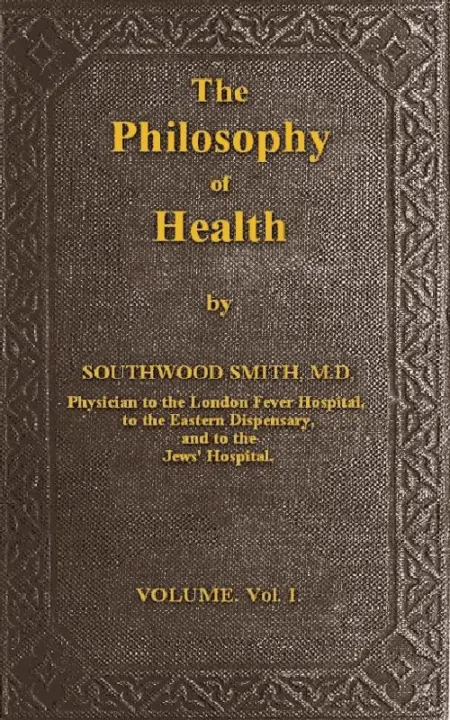
THE CLASSIC COLLECTION · 1836
"The Philosophy of Health; Volume 1" by Southwood Smith is a scientific publication written in the mid-19th century. This work offers an in-depth exploration of human physiology, focusing on the physical and mental constitution of individuals while aiming to promote longevity and happiness. The book delves into the connection between bodily functions and mental well-being, providing a comprehensive look at how understanding these principles can lead to a healthier and more fulfilling life. The opening of this volume introduces the reader to the fundamental aspects of life, distinguishing living beings from inorganic bodies and outlining the essential functions that characterize plants and animals. Smith elaborates on the complex organization of living organisms, highlighting the necessity of both organic and animal actions in sustaining life. He emphasizes the interconnectedness of physical health and mental awareness, arguing that knowledge of one’s body is crucial for maintaining a sound state of health. The introduction sets the stage for a structured exploration of how awareness and understanding of physiological processes can empower individuals to take charge of their health and wellness.
Introduction adapted from the source catalogue; source summaries may be automatically generated.
Free to read · English · 80,175 words · No account needed
MAKE TIME FOR A GOOD BOOK
On by default. Untick to stop anonymous reading totals. Each page counts after 10 seconds in view. How this works.
Anonymous counting is on unless you have switched it off.
Ultimate elements of which the body is composed—Proximate principles—Fluids and solids—Primary tissues—Combinations—Results—Organs, systems, apparatus—Form of the body—Division into head, trunk, and extremities—Structure and function of each—Regions—Seats of the more important internal organs.
1. The ultimate elements of which the human body is composed are azote, oxygen, and hydrogen (gaseous fluids); and carbon, phosphorus, calcium, sulphur, sodium, potassium, magnesium, and iron (solid substances). These bodies are called elementary and ultimate, because they are capable of being resolved by no known process into more simple substances.
2. These elementary bodies unite with each other in different proportions, and thus form compound substances. A certain proportion of azote uniting with a certain proportion of oxygen, hydrogen, and carbon, forms a compound substance possessing certain properties. Another proportion of azote uniting with a different proportion of oxygen, hydrogen, and carbon, forms another compound substance possessing properties different from the former. Oxygen, hydrogen, and carbon, uniting in still different proportions without any admixture of azote, form a third compound possessing properties different from either of the preceding. The compounds thus formed by the primary combinations of the elementary substances with each other are called PROXIMATE PRINCIPLES.
3. Each proximate principle constitutes a distinct form of animal matter, of which the most important are named gelatin, albumen, fibrin, oily or fatty matter, mucus, urea, pichromel, osmazome, resin, and sugar.
4. By chemical analysis it is ascertained that all the proximate principles of the body, however they may differ from each other in appearance and in properties, are composed of the same ultimate elements. Gelatin, for example, consists (in 100 parts) of azote 16-988/1000, oxygen 27-207/1000, hydrogen 7-914/1000, carbon 47-881/1000 parts. The elementary bodies uniting in the above proportions form an animal substance, soft, tremulous, solid, soluble in water, especially when heated, and on cooling, which may be considered as its distinctive property, separating from its solution in water into the same solid substance, without undergoing any change in its chemical constitution.
5. Again, albumen consists of azote 15-705/1000, oxygen 23-872/1000, hydrogen 7-540/1000, carbon 52-888/1000, parts. The elementary bodies uniting in these different proportions, there results a second proximate principle, an adhesive fluid, transparent, destitute of smell and taste, miscible in water, but when subjected to a temperature of about 165°, converted into a solid substance no longer capable of being dissolved in water. This conversion of albumen from a fluid, which is its natural state, into a solid, by the application of heat, is called coagulation. It is a process familiar to every one. The white of egg is nearly pure albumen, naturally a glary and adhesive fluid: by boiling, it is coagulated into a white and firm solid.
Your reading position is saved on this browser. Take it to another device with a library code. Reading pages adapt to text, rather than matching a printed edition.
BEHIND THE BOOK
This eBook is for the use of anyone anywhere in the United States and most other parts of the world at no cost and with almost no restrictions whatsoever. You may copy it, give it away or re-use it under the terms of the Project Gutenberg License included with this eBook or online at www.gutenberg.org. If you are not located in the United States, you will have to check the laws of the country where you are located before using this eBook. Read the source licence.
The original source file, including credits and licence, is retained by this library. Request an original-format copy at no charge. Please include the book title and Project Gutenberg identifier #60773.
KEEP YOUR CURIOSITY GOING

David Patterson (Spirit) Hatch
Coulson Kernahan

Ralph Waldo Emerson
Frances Wright

Edwin Abbott Abbott

Joseph Droz