The Philosophy of Health; Volume 2 (of 2) or, an exposition of the physical and mental constitution of man
Southwood Smith
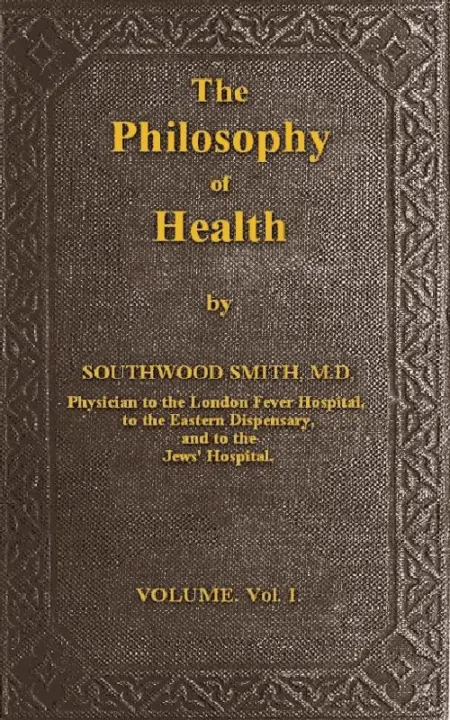
THE CLASSIC COLLECTION · 1836
"The Philosophy of Health; Volume 1" by Southwood Smith is a scientific publication written in the mid-19th century. This work offers an in-depth exploration of human physiology, focusing on the physical and mental constitution of individuals while aiming to promote longevity and happiness. The book delves into the connection between bodily functions and mental well-being, providing a comprehensive look at how understanding these principles can lead to a healthier and more fulfilling life. The opening of this volume introduces the reader to the fundamental aspects of life, distinguishing living beings from inorganic bodies and outlining the essential functions that characterize plants and animals. Smith elaborates on the complex organization of living organisms, highlighting the necessity of both organic and animal actions in sustaining life. He emphasizes the interconnectedness of physical health and mental awareness, arguing that knowledge of one’s body is crucial for maintaining a sound state of health. The introduction sets the stage for a structured exploration of how awareness and understanding of physiological processes can empower individuals to take charge of their health and wellness.
Introduction adapted from the source catalogue; source summaries may be automatically generated.
Free to read · English · 80,175 words · No account needed
MAKE TIME FOR A GOOD BOOK
On by default. Untick to stop anonymous reading totals. Each page counts after 10 seconds in view. How this works.
Anonymous counting is on unless you have switched it off.
If the accuracy of these statements could be relied on, they would not only afford striking illustrations of the well-known fact that extraordinary differences prevail in the rate of mortality in different places, at different periods, and under different circumstances; but they would further prove that, during the last century, a steady and progressive diminution of mortality has taken place in all the countries of Europe. But of the truth of this there is much more certain evidence than can be derived from calculations, the trustworthiness of the data of which is not established, and the correctness of the calculators not known. Both the fluctuations of mortality and the increase in the value of life in the different countries of Europe, from the earliest period when statistical facts began to be collected and compared, are exhibited in a striking point of view in the following table, drawn up by Mr. Finlaison. The facts relating to selected lives and to the mass of the people are distinguished from each other, in order that they may be contrasted. The data are derived from the most authentic sources, and the calculations are made by men of the highest authority.
Let it be conceived, that at each 50 55 60 65 70 75 80 85 of the following ages, viz. Yrs.Yrs.Yrs.Yrs.Yrs.Yrs.Yrs.Yrs.
The average duration of Human
Life of both sexes collectively
may thenceforward be assumed at
a maximum of[2] 23 19 16 13 11 8 6 3
By how many weeks does the
average duration which results
from the most authentic Tables
at present known fall short of
the maximum Term thus assumed?
Among the higher classes of people exclusively.
Answer. Name of the
Observer. Wks. Wks. Wks. Wks. Wks. Wks. Wks. Wks.
In England—
Among the Government
Annuitants, between
1775 and 1822
John Finlaison. 35 1 7 10 47 11 14 53
Among the Lives assured
at the Equitable Office,
between 1760 and 1834
Arthur Morgan. 119 83 87 81 96 33 10 27
Among the Nominees of
the Tontine of 1693--
between that year
and 1775
John Finlaison. 269 195 170 141 157 110 90 89
In France--
Among the Nominees of
the Tontine of 1693--
between that year and
1745 M. de Parcieux. 133 88 87 86 118 70 55 65
In Holland--
Among the Public
Annuitants, between
1615 and 1740
M. Kersseboom. 186 118 104 75 96 61 48 84
In regard to the mass of the people.
In Breslau in Silesia,
between 1700 and 1725,
Dr. Halley. 275 211 181 150 166 100 36 137
In Sweden,
between 1775
and 1795, M. Nicander,
and Mr. Milne. 207 161 164 146 156 94 60 60
In Northampton,
in England, between
1735 and 1780,
Dr. Price. 209 178 145 110 125 76 65 85
In Carlisle,
in England, between
1779 and 1787, Dr. Heysham,
and Mr. Milne. 98 74 86 63 94 52 26 46
In all England and
Wales, between
1811 and 1831,
John Finlaison. 100 59 65 58 87 48 37 49
In the town of Ostend,
in Flanders, between
1805 and 1832,
John Finlaison. 276 210 184 146 143 76 50 75
In all Belgium, between
1725 and 1832,
M. Quetelet. 183 133 133 117 112 84 50 61
Your reading position is saved on this browser. Take it to another device with a library code. Reading pages adapt to text, rather than matching a printed edition.
BEHIND THE BOOK
This eBook is for the use of anyone anywhere in the United States and most other parts of the world at no cost and with almost no restrictions whatsoever. You may copy it, give it away or re-use it under the terms of the Project Gutenberg License included with this eBook or online at www.gutenberg.org. If you are not located in the United States, you will have to check the laws of the country where you are located before using this eBook. Read the source licence.
The original source file, including credits and licence, is retained by this library. Request an original-format copy at no charge. Please include the book title and Project Gutenberg identifier #60773.
KEEP YOUR CURIOSITY GOING

David Patterson (Spirit) Hatch
Coulson Kernahan

Ralph Waldo Emerson
Frances Wright

Edwin Abbott Abbott

Joseph Droz