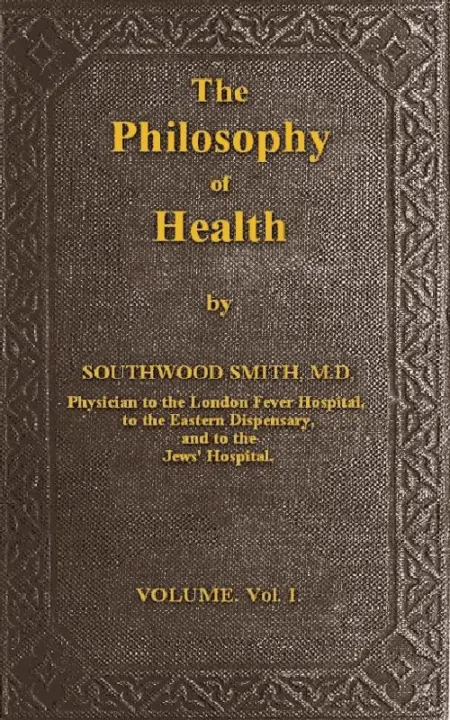
The Philosophy of Health; Volume 2 (of 2) or, an exposition of the physical and mental constitution of man
Southwood Smith
THE CLASSIC COLLECTION · 1836
"The Philosophy of Health; Volume 1" by Southwood Smith is a scientific publication written in the mid-19th century. This work offers an in-depth exploration of human physiology, focusing on the physical and mental constitution of individuals while aiming to promote longevity and happiness. The book delves into the connection between bodily functions and mental well-being, providing a comprehensive look at how understanding these principles can lead to a healthier and more fulfilling life. The opening of this volume introduces the reader to the fundamental aspects of life, distinguishing living beings from inorganic bodies and outlining the essential functions that characterize plants and animals. Smith elaborates on the complex organization of living organisms, highlighting the necessity of both organic and animal actions in sustaining life. He emphasizes the interconnectedness of physical health and mental awareness, arguing that knowledge of one’s body is crucial for maintaining a sound state of health. The introduction sets the stage for a structured exploration of how awareness and understanding of physiological processes can empower individuals to take charge of their health and wellness.
Introduction adapted from the source catalogue; source summaries may be automatically generated.
Free to read · English · 80,175 words · No account needed
MAKE TIME FOR A GOOD BOOK
On by default. Untick to stop anonymous reading totals. Each page counts after 10 seconds in view. How this works.
Anonymous counting is on unless you have switched it off.
During the first year of infancy, as has been shown, the mortality out of a million is 180,492. At the extreme age of eighty-four, it is 178,130, very nearly the same as in the first year of infancy. Greatly as the mortality of all the other epochs of life is affected by country, by station, by a multitude of influences arising out of these and similar circumstances; yet the concurrent evidence of all observation shows that at this and the like advanced ages the mean term of existence is nearly the same in all countries, at all periods, and among all classes of society. Thus, among the nobility and gentry of England, the expectation of life at eighty-four is four years; among the poor fishermen of Ostend, it is precisely the same. M. De Parcieux, who wrote just ninety years ago, establishes the expectation of life at that time in France, at the same age, to have been three and a half years; and Halley, who wrote 120 years ago, and whose observations are derived from documents which go back to the end of the seventeenth century, states the expectation of life at eighty-four to be two years and nine months.
From these statements, then, it is obvious, that from the termination of infancy at three years of age, a decade of years brings childhood to a close, during which the mortality, steadily decreasing, comes to its minimum. Another decade terminates the period of adolescence, during which the mortality as steadily advances. A third decade changes the young adult into a perfect man, and during this period, the golden decade of human life, the mortality again diminishes; while, during another decade and a half, the mortality slowly rises, and returns at the close of the period to the precise point at which it stood at adult age. Thus the interval between the period of birth and that of adult age includes a term of twenty-three years. The interval between the period of adult age and that when life just begins to decline from its meridian, includes a term of twenty-four years: consequently, a period more than equal to all the other epochs of life from birth to adult age is enjoyed, during which mortality makes no advance whatever. Now the term of years included in the several epochs that intervene between birth and adult age is rigidly fixed. Thus the period of infancy includes precisely three years, that of childhood ten years, and that of adolescence ten years. Within the space of time comprehended in these intervals, physiological changes take place, on which depend every thing that is peculiar to the epochs. These changes cannot be anticipated, cannot be retarded, except in a very slight degree. In all countries, among all classes, they take place in the same order and nearly in the same space of time. In like manner, in extreme old age, or the age of decrepitude, which may be safely assumed to commence at the period when the mortality equals that of the first year of infancy, namely, the age of eighty-four, physiological changes take place, which, within a given space of time, inevitably bring life to a close. That space of time, in all countries, in all ranks, in all ages, or rather as far back as any records enable us to trace the facts, appears to be the same. As within a given time the boy must ripen into manhood, so within a given time the man of extreme old age must be the victim of death. Consequently, it is the interval between the adult age and the age of decrepitude, and only this, that is capable of extension. During the interval between adult age and the perfect meridian of life, comprehending at present, as we have seen, a period of twenty-four years, the constitution remains stationary, mortality making no sensible inroad upon it. But there is no known reason why this stationary or mature period of life should, like the determinate epochs, be limited to a fixed term of years. On the contrary, we do in fact know that it is not fixed; for we know that the physiological changes on which age depends are, in some cases, greatly anticipated, and in others, proportionately postponed; so that some persons are younger at sixty, and even at seventy, than others are at fifty; whereas, an analogous anticipation or postponement of the other epochs of life is never witnessed. So complete is the proof, that the extension of human life can consist in the protraction neither of the period of juvenility, nor in that of senility, but only in that of maturity.
Your reading position is saved on this browser. Take it to another device with a library code. Reading pages adapt to text, rather than matching a printed edition.
BEHIND THE BOOK
This eBook is for the use of anyone anywhere in the United States and most other parts of the world at no cost and with almost no restrictions whatsoever. You may copy it, give it away or re-use it under the terms of the Project Gutenberg License included with this eBook or online at www.gutenberg.org. If you are not located in the United States, you will have to check the laws of the country where you are located before using this eBook. Read the source licence.
The original source file, including credits and licence, is retained by this library. Request an original-format copy at no charge. Please include the book title and Project Gutenberg identifier #60773.
KEEP YOUR CURIOSITY GOING

David Patterson (Spirit) Hatch
Coulson Kernahan

Ralph Waldo Emerson
Frances Wright

Edwin Abbott Abbott

Joseph Droz