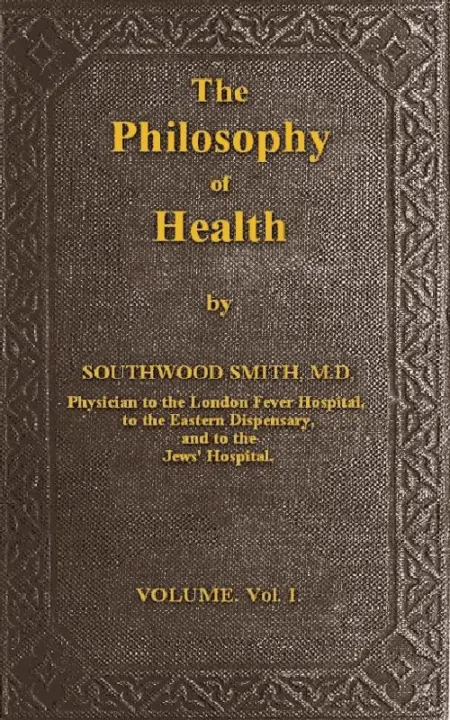
The Philosophy of Health; Volume 2 (of 2) or, an exposition of the physical and mental constitution of man
Southwood Smith
THE CLASSIC COLLECTION · 1836
"The Philosophy of Health; Volume 1" by Southwood Smith is a scientific publication written in the mid-19th century. This work offers an in-depth exploration of human physiology, focusing on the physical and mental constitution of individuals while aiming to promote longevity and happiness. The book delves into the connection between bodily functions and mental well-being, providing a comprehensive look at how understanding these principles can lead to a healthier and more fulfilling life. The opening of this volume introduces the reader to the fundamental aspects of life, distinguishing living beings from inorganic bodies and outlining the essential functions that characterize plants and animals. Smith elaborates on the complex organization of living organisms, highlighting the necessity of both organic and animal actions in sustaining life. He emphasizes the interconnectedness of physical health and mental awareness, arguing that knowledge of one’s body is crucial for maintaining a sound state of health. The introduction sets the stage for a structured exploration of how awareness and understanding of physiological processes can empower individuals to take charge of their health and wellness.
Introduction adapted from the source catalogue; source summaries may be automatically generated.
Free to read · English · 80,175 words · No account needed
MAKE TIME FOR A GOOD BOOK
On by default. Untick to stop anonymous reading totals. Each page counts after 10 seconds in view. How this works.
Anonymous counting is on unless you have switched it off.
But the sympathetic pleasures, out of which grow the social, are of a still higher order even than the intellectual. The pleasures that result from the action of the organic organs, from the exercise of the several senses, and from the operation of the intellectual faculties, like the sensations in which they arise, belong exclusively to the individual being that experiences them, and cannot be communicated to another. Similar sensations and pleasures may be felt by beings similarly constituted; but the actual sensations and pleasures afforded by the exercise of a person's own organs and faculties are no more capable of becoming another's than his existence. These, then, are strictly the selfish pleasures; and the provision that has been made for securing them has been shown.
But there are pleasures of another class, pleasures having no relation whatever to a person's own sensation or happiness; pleasures springing from the perception of the enjoyment of others. The sight of pleasure not its own affects the human heart, provided its state of feeling be natural and sound, just as it would be affected were it its own. Not more real is the pleasure arising from the gratification of appetite, the exercise of sense, and the operation of intellect, than that arising from the consciousness that another sentient being is happy. Pleasures of this class are called sympathetic, in contradistinction to those of the former class, which are termed selfish.
There are then two principles in continual operation in the human being, the selfish and the sympathetic. The selfish is productive of pleasure of a certain kind; the sympathetic is productive of pleasure of another kind. The selfish is primary and essential; the sympathetic, arising out of the selfish, is superadded to it. And so precisely what the animal life is to the organic, the sympathetic principle is to the selfish; and just what the organic life gains by its union with the animal, the mental constitution gains by the addition of the sympathetic to the selfish affection. The analogy between the combination in both cases is in every respect complete. As the organic life produces and sustains the animal, so the sympathetic principle is produced and sustained by the selfish. As the organic life is conservative of the entire organization of the body, so the selfish principle is conservative of the entire being. As the animal life is superadded to the organic, extending, exalting, and perfecting it, so the sympathetic principle is superadded to the selfish, equally extending, exalting, and perfecting it. The animal life is nobler than the organic, whence the organic is subservient to the animal; but there is not only no opposition, hostility, or antagonism between them, but the strictest possible connexion, dependence, and subservience. The sympathetic principle is nobler than the selfish, whence the selfish is subservient to the sympathetic; but there is not only no opposition, hostility, or antagonism between them, but the strictest possible connexion, dependence, and subservience. Whatever is conducive to the perfection of the organic, is equally conducive to the perfection of the animal life; and whatever is conducive to the attainment of the true end of the selfish is equally conducive to the attainment of the true end of the sympathetic principle. The perfection of the animal life cannot be promoted at the expense of the organic, nor that of the organic at the expense of the animal; neither can the ultimate end of the selfish principle be secured by the sacrifice of the sympathetic, nor that of the sympathetic by the sacrifice of the selfish. Any attempt to exalt the animal life beyond what is compatible with the healthy state of the organic, instead of accomplishing that end, only produces bodily disease. Any attempt to extend the selfish principle beyond what is compatible with the perfection of the sympathetic, or the sympathetic beyond what is compatible with the perfection of the selfish, instead of accomplishing the end in view, only produces mental disease. Opposing and jarring actions, antagonizing and mutually destructive powers, are combined in no other work of nature; and it would be wonderful indeed were the only instance of it found in man, the noblest of her works, and in the mind of man, the noblest part of her noblest work.
Your reading position is saved on this browser. Take it to another device with a library code. Reading pages adapt to text, rather than matching a printed edition.
BEHIND THE BOOK
This eBook is for the use of anyone anywhere in the United States and most other parts of the world at no cost and with almost no restrictions whatsoever. You may copy it, give it away or re-use it under the terms of the Project Gutenberg License included with this eBook or online at www.gutenberg.org. If you are not located in the United States, you will have to check the laws of the country where you are located before using this eBook. Read the source licence.
The original source file, including credits and licence, is retained by this library. Request an original-format copy at no charge. Please include the book title and Project Gutenberg identifier #60773.
KEEP YOUR CURIOSITY GOING

David Patterson (Spirit) Hatch
Coulson Kernahan

Ralph Waldo Emerson
Frances Wright

Edwin Abbott Abbott

Joseph Droz