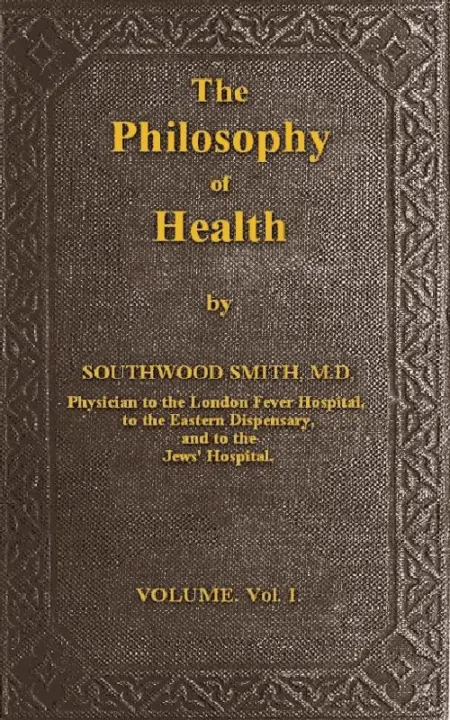
The Philosophy of Health; Volume 2 (of 2) or, an exposition of the physical and mental constitution of man
Southwood Smith
THE CLASSIC COLLECTION · 1836
"The Philosophy of Health; Volume 1" by Southwood Smith is a scientific publication written in the mid-19th century. This work offers an in-depth exploration of human physiology, focusing on the physical and mental constitution of individuals while aiming to promote longevity and happiness. The book delves into the connection between bodily functions and mental well-being, providing a comprehensive look at how understanding these principles can lead to a healthier and more fulfilling life. The opening of this volume introduces the reader to the fundamental aspects of life, distinguishing living beings from inorganic bodies and outlining the essential functions that characterize plants and animals. Smith elaborates on the complex organization of living organisms, highlighting the necessity of both organic and animal actions in sustaining life. He emphasizes the interconnectedness of physical health and mental awareness, arguing that knowledge of one’s body is crucial for maintaining a sound state of health. The introduction sets the stage for a structured exploration of how awareness and understanding of physiological processes can empower individuals to take charge of their health and wellness.
Introduction adapted from the source catalogue; source summaries may be automatically generated.
Free to read · English · 80,175 words · No account needed
MAKE TIME FOR A GOOD BOOK
On by default. Untick to stop anonymous reading totals. Each page counts after 10 seconds in view. How this works.
Anonymous counting is on unless you have switched it off.
2. In general, the apparatus of the organic life is placed in the interior of the body, while that of the animal life is placed on the external surface. The organic organs are the instruments by which life is maintained. There is no action of any one of them that can be suspended even for a short space of time without the inevitable extinction of life. But the animal organs are not so much instruments of life as means by which a certain relation is established between the living being and external objects. And this difference in their office is the reason of the difference in their position. Existence depending on the action of the organic organs, they are placed in the interior of the body; they are fixed firmly in their situation in order that they may not be disturbed by the movements of locomotion; they are enveloped in membranes, covered by muscles, placed under the shelter of bones, and every possible care is taken to secure them from accident and to shield them from violence. Existence not being immediately dependent on the action of the organs of the animal life, they do not need to be protected from the contact of external objects with extraordinary care, but it is necessary to the performance of their functions that they should be placed at the exterior of the body. And there they are placed, and so placed as to afford an effectual defence to the organic organs. Thus the groundwork of the animal is made the bulwark of the organic life. The muscles, the immediate agents by which voluntary motion is effected, and the bones, the fixed points and the levers by which that motion acquires the nicest precision and the most prodigious rapidity and power, are so disposed that, while the latter accomplish, in the most perfect manner, their primary and essential office in relation to the muscles, they serve a secondary but scarcely less important office in relation to the internal viscera. As we advance in our subject, we shall see that a beautiful illustration of this is afforded in the structure and action of the trunk; that the trunk is moveable; that it is composed of powerful muscles, and of firm and compact bones; and that while its movements are effected by the action of the muscles which are attached to the bones, these bones enclose a cavity, in which are placed the lungs, the heart, the great trunks of the venous system, the great trunks of the arterial system, and the main trunk of the thoracic duct, the vessel by which the digested aliment is carried into the blood. (Chap. 5.) Thus, by these strong and firm bones, together with the thick and powerful muscles that rest upon them, is formed a secure shelter for a main portion of the apparatus of the organic functions of respiration, circulation, and digestion. The bones and muscles of the thorax, themselves performing an important part in the function of respiration, afford to the lungs the chief organ of this function, composed of tender and delicate tissues, easily injured, and the slightest injury perilling life, a free and secure place to act in. The fragile part of the apparatus is defended by the osseous portion of it, the play of the latter being equally essential to the function as that of the former. In like manner the tender and delicate substance of the brain and spinal cord, the central seat of the animal life, with which all the senses are in intimate communion, is protected by bones and muscles which perform important voluntary movements while the organs of sense which put us in connexion with the external world, which render us susceptible of pleasure, and which give us notice of the approach of objects capable of exciting pain, are placed where external bodies may be brought most conveniently and completely into contact with them; and where alone they can be efficient as the sentinels of the system. For this reason, with the exception of the sense of touch, which, though placed especially at the extremities of the fingers, is also diffused over the whole external surface of the frame, all the senses have their several seats in the head, the most elevated part of the body, of an ovoid figure, capable of moving independently of the rest of the fabric, and which, being supported on a pivot, is enabled to describe at least two-thirds of a circle.
Your reading position is saved on this browser. Take it to another device with a library code. Reading pages adapt to text, rather than matching a printed edition.
BEHIND THE BOOK
This eBook is for the use of anyone anywhere in the United States and most other parts of the world at no cost and with almost no restrictions whatsoever. You may copy it, give it away or re-use it under the terms of the Project Gutenberg License included with this eBook or online at www.gutenberg.org. If you are not located in the United States, you will have to check the laws of the country where you are located before using this eBook. Read the source licence.
The original source file, including credits and licence, is retained by this library. Request an original-format copy at no charge. Please include the book title and Project Gutenberg identifier #60773.
KEEP YOUR CURIOSITY GOING

David Patterson (Spirit) Hatch
Coulson Kernahan

Ralph Waldo Emerson
Frances Wright

Edwin Abbott Abbott

Joseph Droz