
Last letters from the living dead man
David Patterson (Spirit) Hatch
THE CLASSIC COLLECTION · 1914
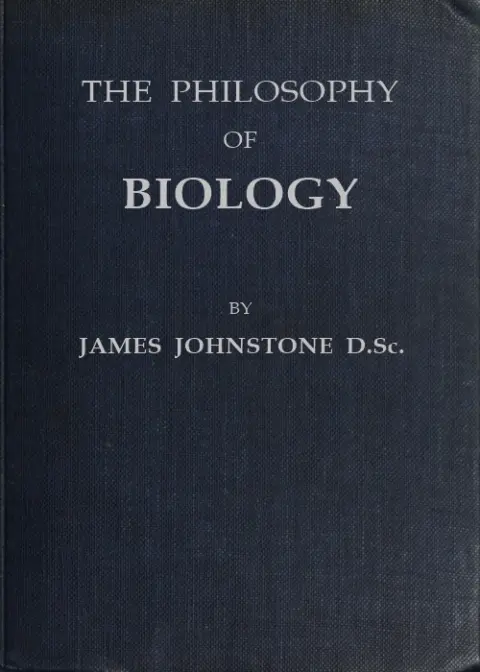
"The Philosophy of Biology" by James Johnstone is a scientific publication written in the early 20th century. This work explores the philosophical implications and foundations of biological science, particularly focusing on concepts like consciousness, perception, and the nature of living organisms. Johnstone aims to develop a deeper understanding of biology through the lens of philosophy, suggesting that current biological theories may need to reassess their foundational philosophies as scientific knowledge evolves. At the start of the text, the author introduces the interplay between perception and the understanding of the biological organism's existence, arguing that consciousness shapes how organisms perceive and interact with their environment. Johnstone discusses the limitations of purely mechanistic explanations in biology, emphasizing that biological functions cannot be fully understood through the same frameworks that apply to physical phenomena. He sets the stage for a philosophical discussion on the nature of life, suggesting that much like physics evolved, biology too must evolve to grasp the complexities of life beyond mechanistic interpretations.
Introduction adapted from the source catalogue; source summaries may be automatically generated.
Free to read · English · 115,308 words · No account needed
MAKE TIME FOR A GOOD BOOK
On by default. Untick to stop anonymous reading totals. Each page counts after 10 seconds in view. How this works.
Anonymous counting is on unless you have switched it off.
Growth law of, in the organism, 172;
by accretion, 169;
by ecdysis, 276;
geometrical, 169;
physical, 167;
of crystals, 167;
and differentiation, 170;
variability of, 172.
Haeckel, the Gastrea-Theorie, 177, 254.
Harmonic analysis, 11.
Harvey, and the circulation of the blood, 121.
Heat, flow of, 117;
production of, in physical changes, 114.
Heliotropism, 144.
Heredity, 181.
Hertzian waves, 355.
Homoiothermic animals, 67.
Hormones, 225.
Human activity, tends to arrest dissipation of energy, 312.
Huxley, 84;
and mechanistic biology, 127;
and the physical basis of life, 113;
and mechanism, 106;
and universal mathematics, 215.
Hybrids, Mendelian, 196;
infertility of, 195;
between Linnean species, 194.
Hydra, regeneration of, 162.
Idants, 183.
Idealism founded on pure reasoning, 45;
of Berkeley, 45.
Ids, 183.
Immunity, 35.
Individual, 162;
definition of, 167.
Individuality, orders of, 163;
physical concept of, 165;
morphologically an artificial concept, 166;
in societies, 171.
Inertia, 354.
Infinity, a definition of, 342.
Inorganic happening abolishes diversity, 310.
Instinct, a problem for naturalists, 283;
an inheritable adaptation of behaviour, 287.
Instinct and intelligence, 283;
distinction not absolute, 294;
may coexist, 306.
Instinct and functioning, 286.
Instinctive actions not necessarily unconscious, 283;
not learned, 286;
not necessarily perfect, 284;
effective from the first, 285;
capable of improvement, 285.
Intelligent actions, non-inheritable adaptations of behaviour, 287;
involve deliberation, 50, 287;
involve conscious relations with the environment, 288;
involve use of tools, 284.
Intensity-factors, 61.
Intensive multiplicity, 303.
Irreversibility, 62.
Irritability, 100.
Isothermal changes, 361.
James, William (and academic philosophies), 80.
Jennings, and physiological states, 154;
behaviour of Protozoa, 293;
animal movements, 149;
the avoiding reaction, 149.
Katabolism, 90.
Kinases, 92.
Kinematographic analysis, 316.
Lamarck, hypotheses of evolution, 220.
Lamarckian inheritance, an inadequate cause of transformism, 227.
Lankester, acquired characters not inherited, 221.
Laplace, and universal mathematics, 215.
Laplacian mind, 299.
Larval stages, 170.
Latency (of characters), 195.
Lavoisier, and chemistry of the organism, 127.
Life and adaptation to physical conditions, 338;
and reversibility, 339;
a direction of energies, 341;
defined energetically, 337;
cosmic origin of, 338;
physical conditions for, 338;
limited in power, 306;
sparsity of, on the earth, 306;
tends to arrest dissipation of energy, 314;
its origin a pseudo-problem, 337.
Life-substance, the primitive, 301.
Locomotion, 258.
Loeb and the associative memory, 155;
and artificial parthenogenesis, 176;
mechanism and life, 127;
stereotropism, 19;
theory of tropisms, 144;
tropistic movements, 146;
theories of heredity, 181.
Limit, the mathematical, 346.
Limits to perceptual activity, 23.
Links, missing, 252.
Linnean species, 201.
Manifoldness, intensive, 302.
Mass, 353.
Mass action, 140.
Materialism, 85.
Mathematics, evades consideration of time, 35.
Matter, 353;
inert, 375;
notion of is an intuitive one, 352.
Maxwell, and sorting demons, 116, 377.
Mayow, and chemical physiology, 126.
Mechanical work, done by the animal, 67;
not done by the plant, 71.
Mechanism, organic and inorganic, 78;
the thermodynamic, 66;
radical, 215;
in life, 121.
Membranes, semi-permeable, 95.
Memory, 39;
a possible cerebral mechanism of, 158;
mechanistic hypotheses impossible, 157.
Mendelism, 196;
a logical hypothesis, 199;
terminology is a symbolism, 198;
analogy of unit characters with chemical radicles, 197;
transmission of characters of, 230.
Mesoderm, 177;
origin of, 255.
Metabolism, 37, 88, 209;
analytic, 269;
of animals, 65, 67;
constructive, 269;
destructive, 269;
direction of, 69;
in green plant, 70, 75;
intra-cellular, 99;
integration of its activities, 111;
rôle of oxygen in, 105;
specialisation of during evolution, 305;
synthetic, 269.
Metaphysics of science, 45.
Metazoan animals, 162.
Mitosis, 182.
Mobility, organic, 269;
structural adaptations tending to, 275.
Modifications of structure adaptive and non-adaptive, 251.
Molecules, 353;
size of, 116;
in a gas, 115;
aggregations of, 108.
Molluscs, morphology of, 249.
Morgan, and physico-chemical mechanisms, 128, 143.
Morphogenesis, 257.
Morphological evolution, tendencies of, 295.
Your reading position is saved on this browser. Take it to another device with a library code. Reading pages adapt to text, rather than matching a printed edition.
BEHIND THE BOOK
This eBook is for the use of anyone anywhere in the United States and most other parts of the world at no cost and with almost no restrictions whatsoever. You may copy it, give it away or re-use it under the terms of the Project Gutenberg License included with this eBook or online at www.gutenberg.org. If you are not located in the United States, you will have to check the laws of the country where you are located before using this eBook. Read the source licence.
The original source file, including credits and licence, is retained by this library. Request an original-format copy at no charge. Please include the book title and Project Gutenberg identifier #61663.
KEEP YOUR CURIOSITY GOING
David Patterson (Spirit) Hatch
Coulson Kernahan

Ralph Waldo Emerson
Frances Wright

Edwin Abbott Abbott

Joseph Droz