
Last letters from the living dead man
David Patterson (Spirit) Hatch
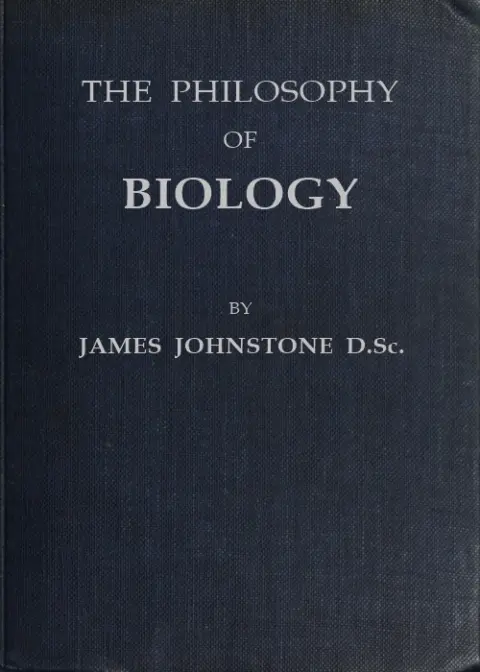
THE CLASSIC COLLECTION · 1914
"The Philosophy of Biology" by James Johnstone is a scientific publication written in the early 20th century. This work explores the philosophical implications and foundations of biological science, particularly focusing on concepts like consciousness, perception, and the nature of living organisms. Johnstone aims to develop a deeper understanding of biology through the lens of philosophy, suggesting that current biological theories may need to reassess their foundational philosophies as scientific knowledge evolves. At the start of the text, the author introduces the interplay between perception and the understanding of the biological organism's existence, arguing that consciousness shapes how organisms perceive and interact with their environment. Johnstone discusses the limitations of purely mechanistic explanations in biology, emphasizing that biological functions cannot be fully understood through the same frameworks that apply to physical phenomena. He sets the stage for a philosophical discussion on the nature of life, suggesting that much like physics evolved, biology too must evolve to grasp the complexities of life beyond mechanistic interpretations.
Introduction adapted from the source catalogue; source summaries may be automatically generated.
Free to read · English · 115,308 words · No account needed
MAKE TIME FOR A GOOD BOOK
On by default. Untick to stop anonymous reading totals. Each page counts after 10 seconds in view. How this works.
Anonymous counting is on unless you have switched it off.
Determinants in embryology, 132, 183;
arrangement of, 184;
latent in regenerative processes, 142.
Development, organisation in, 128;
parthenogenetic, 176;
reverses inorganic tendencies, 324;
impossibility of chemical hypotheses, 141;
is the assumption of a mosaic structure, 301;
blastula stage in, 129;
gastrula stage in, 130;
pluteus stage in, 140;
individual, 300.
Developmental systems prospective value of, 138;
prospective potency of, 138.
Diatoms, 163;
distribution of, 260.
Differential elements, 115.
Differentiation in development, 170.
Diffusion in the animal body, 95.
Digestion, 67;
chemistry of, 72.
Dinosaurs, an unsuccessful line of evolution, 275.
Dissipation of energy, 114;
in physical mechanisms, 59;
by the organism, 68, 79.
Distribution of organisms, 262;
limits to, 259;
indicative of dominance, 258.
Diversity, physical, 54;
effective and ineffective, 115.
Dominance in geological time, 258;
implies long geological history, 261;
Mendelian, 196.
Dominant organisms, 258, 259, 264.
Driesch natural selection, 229;
analytical definition of the organism, 331;
entelechy, 318;
experimental embryology, 134;
historical basis of reacting, 154;
logical proof of vitalism, 136;
proof of vitalism from behaviour, 153;
theory of the absolute, 47.
Duration, 28;
duration and time illustrated, 30;
illustrated by immunity, 35;
more than memory, 155;
a factor in responding, 155.
Ecdysis, 276.
Echinoderms, morphology of, 248.
Ectoderm, 177.
Effector organs, 158, 271.
Élan vital, 161.
Electromagnetism, 355.
Electrons, 304, 355.
Elimination, natural, 229.
Embryological stages compared with physical phases, 308.
Embryology, 127;
hypotheses of, 128;
physical hypotheses fail, 128;
experimental, 128;
suggests phylogenetic history, 213.
Emulsoids, 108.
Endoskeleton, 177, 276.
Energetics, first law of, 51;
second law of, 113.
Energy, 356;
available and unavailable, 55;
biotic, 325;
chemical, 61;
and causation, 54;
degradation of, 63;
dissipation of, 53;
electrical, 61;
forms of, 325;
kinetic, 52, 357;
mechanical, 60, 61;
potential, 53, 358;
of position, 360.
Energy-transformations, 54, 371;
anabolic, 89;
in the animal, 70;
compensatory, 88;
compensatory organic, 268;
irreversible, 59;
in physical mechanisms, 58;
in the plant, 71.
Engelmann, and the artificial muscle, 105.
Entelechy, 161, 318;
not energy, 329;
is power of direction, 329;
not spatial but acts into space, 330;
an intensive manifoldness, 330;
is arrangement, 323;
involves regulations, 323;
arrests inorganic happening, 327;
initiates chemical happening, 327;
compared with enzyme action, 327;
illustrated by analogy, 322.
Entropy, 54;
augmentation of, 75;
and Carnot engine, 369.
Environment, does not select variations, 235;
made by the organism, 236.
Enzymes, 90;
nature of, 92;
pancreatic, 93;
reversible, 93;
activation of, 92.
Enzyme activity, 93.
Epigenesis in development, 129.
Equilibrium, chemical, 102.
false, 86, 151.
Ether of space, 46, 304, 361;
potential energy resides in, 361.
Evolution tendencies of, 252, 264, 276, 295;
separation of tendencies, 296;
a transformation of intensive into extensive manifoldness, 309;
a dissociation of tendencies originally coalescent, 305;
increases diversity, 310;
segregates energy, 311;
compared with permutations and combinations, 301;
a series of phases in a transforming system, 298;
a logical hypothesis, 214;
parallel processes in, 234;
geological time inadequate for, 237;
side paths in, 262;
mechanistic hypotheses inadequate, 237;
cosmic, 214, 297, 314;
of the crust of the earth, 264.
Excretory products, 269.
Exoskeleton, 276.
Exothermic reactions, 86.
Experience and duration, 156.
Experimental biology proves evolution, 246.
Explosive reactions, 101.
Extension in space, 18.
Extinct groups, 263.
Fats, digestion of, 93.
Fecundity of animals, 179, 239.
Ferments, 92.
Fertilisation (in reproduction), 176.
Finalism, 216.
Fishes, distribution of, 261.
Fluctuating variations, 200.
Food-stuffs, absorption of, 89.
Force, 354.
Form, accidental and essential, 167, 353;
geological, 168;
crystalline, 168.
Frequency distributions, 22, 187, 350.
Frog, development of egg of, 131.
Functionality, 343;
in physical systems, 307.
Galvanotropism, 145.
Gases, compression of, 362;
kinetic theory of, 117, 361.
Gastrea-theory, 177;
illustrated, 255;
limitations of, 256.
Genera, stability of, 186.
Geometry, Cartesian, 25;
Euclidean, 19, 25;
perceptual and conceptual limits, 21.
Geotropism, 144.
Germ-cells, 175;
and soma, 179.
Germinal selection, 241.
Germ-layers, 177;
theory of, 256.
Germ-plasm, a mixture, 240;
stability of, 240.
Givenness, 47.
Gonads, 179.
Your reading position is saved on this browser. Take it to another device with a library code. Reading pages adapt to text, rather than matching a printed edition.
BEHIND THE BOOK
This eBook is for the use of anyone anywhere in the United States and most other parts of the world at no cost and with almost no restrictions whatsoever. You may copy it, give it away or re-use it under the terms of the Project Gutenberg License included with this eBook or online at www.gutenberg.org. If you are not located in the United States, you will have to check the laws of the country where you are located before using this eBook. Read the source licence.
The original source file, including credits and licence, is retained by this library. Request an original-format copy at no charge. Please include the book title and Project Gutenberg identifier #61663.
KEEP YOUR CURIOSITY GOING
David Patterson (Spirit) Hatch
Coulson Kernahan

Ralph Waldo Emerson
Frances Wright

Edwin Abbott Abbott

Joseph Droz