THE CLASSIC COLLECTION✦An outlaw’s diary: the CommuneCLASSIC FREE BOOKS
An outlaw’s diary: the Commune
Cécile Tormay
THE CLASSIC COLLECTION · 1866
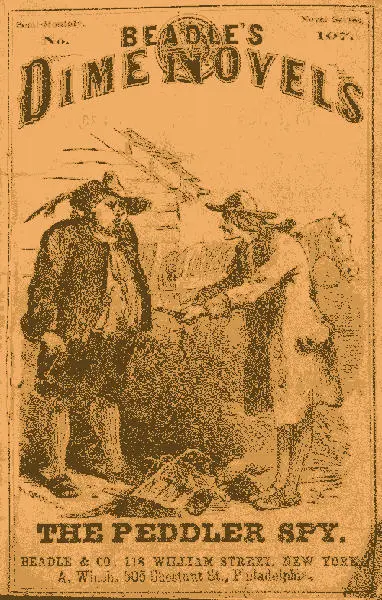
"The Peddler Spy; or, Dutchmen and Yankees. A Tale of the Capture of Good Hope" by W. J. Hamilton is a historical novel written in the mid-19th century. The story explores early colonial tensions between Dutch settlers and English Yankees along the Connecticut River, particularly surrounding a fort known as "The House of Good Hope." The main character, Boston Bainbridge, is a crafty hawker who navigates these cultural clashes, engaging in clever trades while collecting intel that could have deeper implications for the conflict between the two groups. The opening of the narrative introduces readers to the historical setting and the rivalry between the Dutch and the Yankees through a blend of humor and sharp observation of character traits. Bainbridge arrives at Good Hope, eager to peddle his wares to the unsuspecting Dutchmen, who are easily outsmarted in their dealings with him. The narrative describes various interactions showcasing Bainbridge's shrewdness as he sells subpar merchandise while hinting at underlying tensions that could lead to conflict. This backdrop sets the stage for the unfolding drama as tensions escalate and alliances are tested, particularly through romantic entanglements involving female characters, suggesting the personal stakes amidst the larger cultural clash.
Introduction adapted from the source catalogue; source summaries may be automatically generated.
Free to read · English · 33,688 words · No account needed
MAKE TIME FOR A GOOD BOOK
On by default. Untick to stop anonymous reading totals. Each page counts after 10 seconds in view. How this works.
Anonymous counting is on unless you have switched it off.
Passing around the house to escape from the rear, the two girls suddenly came upon two men, whom, in the darkness, they conceived to be Van Zandt and Carl.
Theresa, in the excitement of the moment, lifted her sword in her hand and pointed it at the breast of the nearest, who rushed toward her.
“Stand back,” she cried; “I will not be taken alive.”
“Theresa!”
“Willie!”
The strength which had sustained her until this moment gave way, and she sunk into the arms of her lover.
“Let us away,” said Willie. “Come, Robert, you are slow.”
Robert Holmes dropped the bar with which he had been prying open the window, and came forward, saying:
“Our work is taken out of our hands. Katrine, have you no greeting for me, now that I am no longer Boston Bainbridge, but Robert Holmes?”
His voice broke the spell; she was in his arms in a moment, sobbing. “They told me you were dead. I thought I knew your voice.”
“Let us get out of this, Robert,” said Willie. “You had better carry Katrine. How much they must have endured.”
“Preserve the sword, Willie,” whispered Theresa, “it has saved me.”
Keeping in the rear of the house, they stole out of the postern gate through which they had entered, and soon placed the girls in safety in the house which was first taken. This done, the young men went back to their duty. Van Curter was there.
“Have you succeeded?” he cried, taking his cue from their happy faces.
“Yes, thank God, the girls are out of that villain’s power, and we have nothing to restrain us from an attack upon the house. Give me that white scarf, and I will speak to them.”
“Be careful, Robert,” said his brother; “they are desperate men, and may not respect the flag.”
“Robert took a ramrod, and fastened the white scarf upon it. Ordering his men to cease firing, the young man passed into the parade and called to Van Zandt.
“Why are you here again?” he demanded, angrily.
“To ask you to yield. Why should we shed blood, when nothing can be gained? Open your doors and let us enter.”
“You ask in vain,” was the stern answer; “you want the girls, I suppose; but you shall never see the face of Katrine, and Theresa has bid good-by forever to your friend Barlow. So away with you if you would save them trouble.”
“If you could look into the room where you placed the girls, you would see a broken casement and an empty cage. The girls are safe in our hands.”
“A Yankee horse-trader’s lie.”
“Go and see.”
Your reading position is saved on this browser. Take it to another device with a library code. Reading pages adapt to text, rather than matching a printed edition.
BEHIND THE BOOK
This eBook is for the use of anyone anywhere in the United States and most other parts of the world at no cost and with almost no restrictions whatsoever. You may copy it, give it away or re-use it under the terms of the Project Gutenberg License included with this eBook or online at www.gutenberg.org. If you are not located in the United States, you will have to check the laws of the country where you are located before using this eBook. Read the source licence.
The original source file, including credits and licence, is retained by this library. Request an original-format copy at no charge. Please include the book title and Project Gutenberg identifier #55772.
KEEP YOUR CURIOSITY GOING
Cécile Tormay

Moritz Busch
Coulson Kernahan
John L. Ransom

Maurice Baring
Frances Wright