THE CLASSIC COLLECTION✦An outlaw’s diary: the CommuneCLASSIC FREE BOOKS
An outlaw’s diary: the Commune
Cécile Tormay
THE CLASSIC COLLECTION · 1866
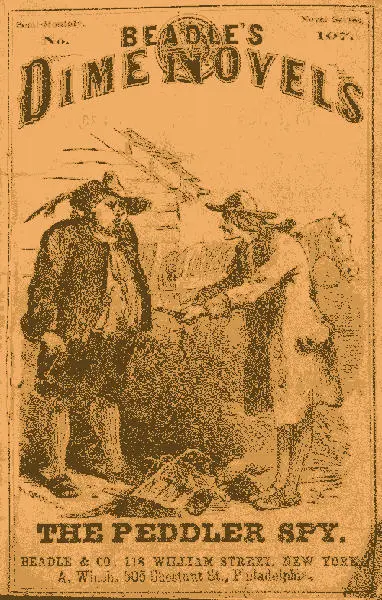
"The Peddler Spy; or, Dutchmen and Yankees. A Tale of the Capture of Good Hope" by W. J. Hamilton is a historical novel written in the mid-19th century. The story explores early colonial tensions between Dutch settlers and English Yankees along the Connecticut River, particularly surrounding a fort known as "The House of Good Hope." The main character, Boston Bainbridge, is a crafty hawker who navigates these cultural clashes, engaging in clever trades while collecting intel that could have deeper implications for the conflict between the two groups. The opening of the narrative introduces readers to the historical setting and the rivalry between the Dutch and the Yankees through a blend of humor and sharp observation of character traits. Bainbridge arrives at Good Hope, eager to peddle his wares to the unsuspecting Dutchmen, who are easily outsmarted in their dealings with him. The narrative describes various interactions showcasing Bainbridge's shrewdness as he sells subpar merchandise while hinting at underlying tensions that could lead to conflict. This backdrop sets the stage for the unfolding drama as tensions escalate and alliances are tested, particularly through romantic entanglements involving female characters, suggesting the personal stakes amidst the larger cultural clash.
Introduction adapted from the source catalogue; source summaries may be automatically generated.
Free to read · English · 33,688 words · No account needed
MAKE TIME FOR A GOOD BOOK
On by default. Untick to stop anonymous reading totals. Each page counts after 10 seconds in view. How this works.
Anonymous counting is on unless you have switched it off.
“If knives are sharp or bullets dig deep—if water can drown or fire burn, when we meet he shall die.”
“You are a friend indeed,” cried Joseph, grasping his hand. “Go out upon your duty, with my thanks for your kindness. And remember, that in me you always have a friend.”
They shook hands and parted, the young man riding swiftly forward upon his way, along the bank of the “Happy River,” while Joseph went back to the camp. On the way, he met Van Curter, who asked him to go with him to secure the horse of Ten Eyck.
That worthy was reposing in front of his house, smoking a pipe in great enjoyment. He greeted the approach of the two dignitaries with a nod of recognition, thinking in his heart how he would crow over Paul Swedlepipe, who could not boast of the honor of such a visit.
“Good-day, mynheer, good-day,” said Van Curter. “We have agreed to go out against Windsor to-day, and, after considerable discussion, my friend the captain and myself have agreed upon a person to take command of Good Hope during our absence.”
“Who is it?” asked Ten Eyck, watching the puff of smoke which ascended in spiral rings from his fair, long pipe.
“What would you say to Paul Swedlepipe?” asked the captain, with a touch of mischievous humor. “Would he be a good man for the place?”
“What! Paul Swedlepipe? Do you insult me? I would suggest that you go and get Hans Drinker’s boy, Jacob, and give him command, before you take Paul Swedlepipe. To be sure, little Jacob is a fool; but what of that? Paul is a fool, too.”
“Then you don’t think Paul would do?”
“Nix, no, NO!” he cried using all the negatives at his command.
“Well, we concluded, after due discussion, not to take Paul. What do you say to Hans Drinker?”
“He is a bigger fool than Jacob!”
“Then he won’t do; and, in fact, we didn’t think of having him. The man we have in our mind is one Ten Eyck!”
“Ha!” said he, without moving a muscle of his face, “that is sensible! Oh, Saint Nicholas,” he thought, “won’t I crow over that Paul Swedlepipe after this!” Then he added aloud: “How many men do you leave with us?”
“Five. You won’t need many, as our expedition must be kept secret. Mind that, and don’t blab.”
Ten Eyck nodded his head vigorously, and the captain came to the principal object of the visit. “You bought a horse yesterday?”
“Yaw,” said he.
“What did you give for him?”
“One hundred and fifty guilders.”
Your reading position is saved on this browser. Take it to another device with a library code. Reading pages adapt to text, rather than matching a printed edition.
BEHIND THE BOOK
This eBook is for the use of anyone anywhere in the United States and most other parts of the world at no cost and with almost no restrictions whatsoever. You may copy it, give it away or re-use it under the terms of the Project Gutenberg License included with this eBook or online at www.gutenberg.org. If you are not located in the United States, you will have to check the laws of the country where you are located before using this eBook. Read the source licence.
The original source file, including credits and licence, is retained by this library. Request an original-format copy at no charge. Please include the book title and Project Gutenberg identifier #55772.
KEEP YOUR CURIOSITY GOING
Cécile Tormay

Moritz Busch
Coulson Kernahan
John L. Ransom

Maurice Baring
Frances Wright