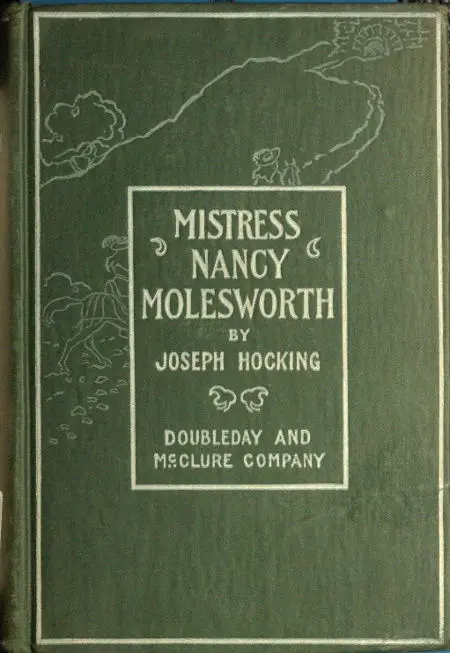
Mistress Nancy Molesworth: A Tale of Adventure
Joseph Hocking
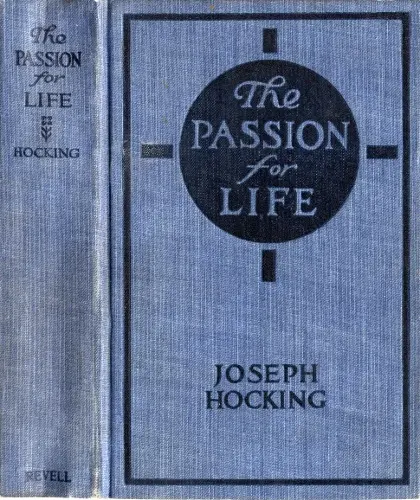
THE CLASSIC COLLECTION · 1916
"The Passion for Life" by Joseph Hocking is a novel written in the early 20th century. The story revolves around Francis Erskine, a barrister who, after receiving a terminal diagnosis, decides to retreat to a wooden hut in the seaside village of St. Issey, Cornwall, to live out his last days. Throughout the book, themes of life and death, the search for meaning, and the contrast between light and shadow in existence are explored. The opening of the novel introduces us to Francis Erskine's restless state of mind as he contemplates his life and impending death. After receiving the distressing news from his doctor, he resolves to abandon his London life and relocate to Cornwall for a more peaceful existence. Accompanied by his loyal servant, Simpson, he arrives at St. Issey, where he begins to reflect on his thoughts and encounters the local atmosphere. As he explores his new surroundings and wrestles with profound questions about life and spirituality, a series of visitors—local residents and a vicar—bring him into the fold of village life while hinting at an intriguing mystery surrounding the place he now calls home.
Introduction adapted from the source catalogue; source summaries may be automatically generated.
Free to read · English · 111,335 words · No account needed
MAKE TIME FOR A GOOD BOOK
On by default. Untick to stop anonymous reading totals. Each page counts after 10 seconds in view. How this works.
Anonymous counting is on unless you have switched it off.
We joined the ladies shortly after, and our conversation, I am afraid, was of a very uninteresting nature. I noticed all the time we were talking, too, that Mr. Lethbridge was paying no attention whatever. He seemed to be thinking deeply about something else. Presently, while his wife was engaged in a long harangue about the inferiority of girls, comparing them with what she used to be when she was a girl, Mr. Lethbridge broke in suddenly.
"Yes, Mr. Erskine," he said, "you may be right in what you were saying--that is, up to a point--but you don't go deep enough."
"I am afraid I never do go very deep," was my reply. "The deeper one goes, as a rule, the greater the muddle."
"Not in this case," and he spoke quite eagerly. "Why, the whole life of the county is what John Wesley and Methodism have made it. People, as a whole, may seem to have discarded his teachings, but they are in the very air we breathe; the people's thoughts, the people's lives, are what they are to-day because of the work he did."
"I dare say," I replied, for, to tell the truth, I was anxious to avoid anything like a theological discussion.
"Yes, don't you see? In the background of people's minds there is the impress of his work; his influence is felt everywhere. Even the people who never enter a place of worship have been shaped and moulded by Methodism."
"In what way?" asked Hugh.
"Well, take such a question as war," replied Mr. Lethbridge. "John Wesley killed the very possibility of war."
"I wish I could see it," I could not help exclaiming.
"It is plain enough," he replied. "Methodism and war cannot go together. The love of peace has entered into the very essence of people's lives. Is not that something to be thankful for?"
"I am not so sure," replied Isabella Lethbridge. "May not war be a very
good thing?"
"A good thing!" cried her father--"a good thing! Why, it's hellish! I would rather see a son of mine dead than a soldier! And that is the feeling Methodism has created throughout the county. You scarcely ever find a conscientious Methodist becoming a soldier. A soldier in this county is looked upon as a kind of legalized murderer."
"Surely," I said, "it is not so bad as that?"
"It amounts to that," was his reply. "For my own part, I have an utter abhorrence of anything which savors of militarism, and I know it is because of the impressions I received as a boy."
"But supposing war were to break out?" I said.
Your reading position is saved on this browser. Take it to another device with a library code. Reading pages adapt to text, rather than matching a printed edition.
Joseph Hocking
Joseph Hocking
Joseph Hocking
Joseph Hocking
BEHIND THE BOOK
This eBook is for the use of anyone anywhere in the United States and most other parts of the world at no cost and with almost no restrictions whatsoever. You may copy it, give it away or re-use it under the terms of the Project Gutenberg License included with this eBook or online at www.gutenberg.org. If you are not located in the United States, you will have to check the laws of the country where you are located before using this eBook. Read the source licence.
The original source file, including credits and licence, is retained by this library. Request an original-format copy at no charge. Please include the book title and Project Gutenberg identifier #40102.
KEEP YOUR CURIOSITY GOING
Coulson Kernahan

Maurice Baring
Frances Wright
Cécile Tormay

Frederic Jesup Stimson

W. H. P. (William Henry Pope) Jarvis