
Last letters from the living dead man
David Patterson (Spirit) Hatch
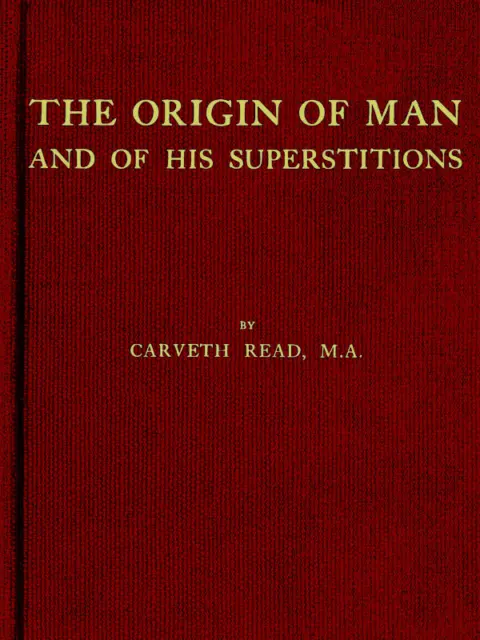
THE CLASSIC COLLECTION · 1920
"The Origin of Man and of His Superstitions" by Carveth Read is a scientific publication written in the early 20th century. The work presents a hypothesis regarding the evolutionary development of humans from ape-like ancestors and explores the subsequent emergence of superstitions and magical beliefs as social constructs. Read aims to connect human evolution, particularly through hunting practices, with the psychological and sociocultural evolution leading to superstitions. The opening of the work delivers a comprehensive explanation of the author's hypothesis regarding human ancestry linked to ape-like stocks, highlighting the pivotal role of adopting a hunting lifestyle. Read outlines how this shift not only transformed human physical attributes—such as erect posture and specialized hands—but also shaped social cooperation and early mental capacities. He discusses the implications of transitioning from a frugivorous diet to a carnivorous one and the essential changes in human behavior, cognition, and society that arose as a consequence of social hunting, setting the stage for exploring the development of superstitions in later chapters.
Introduction adapted from the source catalogue; source summaries may be automatically generated.
Free to read · English · 131,342 words · No account needed
MAKE TIME FOR A GOOD BOOK
On by default. Untick to stop anonymous reading totals. Each page counts after 10 seconds in view. How this works.
Anonymous counting is on unless you have switched it off.
[28] See The Antiquity of Man, by Arthur Keith.
[29] Malay Archipelago, pp. 46-7.
[30] According to R. L. Garner, however, both gorillas and chimpanzees are polygamous. See Gorillas and Chimpanzees, pp. 54 and 214.
[31] This view is not opposed to the suggestion I have somewhere seen that the collecting activities of women, whilst men hunted, may, at some stage, have led to property and domestication of plants and animals. Again, the pastoral and agricultural states are not necessarily successive: it depends upon local conditions. For an excellent survey of the gradual rise of primitive culture and the difficulties it encountered, see H. Spencer’s Industrial Institutions, Principles of Sociology, Vol. III.
[32] It is certainly believed by fox-hunters that a fox feeds his vixen when she is occupied with their family, and that “if the vixen is killed he will bring up the family by himself.”—Thomas F. Dale, The Fox, pp. 12, 13.
Nothing incredible in this—nor of wolves. Can the vixen provide for herself and litter alone? If not, the dog must do it: else there could be no foxes or wolves.
However, de Canteleu denies that the he-wolf takes any part in rearing the young (La Chasse du Loup, p. 30).
[33] W. P. Pycraft, in his entertaining Courtship of Animals, after assuming that Man became a hunter for the sake of the excitement such a life afforded, goes on (p. 23): “A little later the advantages of neighbourliness were borne in on him, largely for the sake of the greater ease wherewith the animals of the chase could be captured by their combined efforts; but this begat comradeship and some of the graces that follow therefrom.”
[34] Descent of Man, ch. xx.
[35] See above, footnote on p. 32.
[36] Avebury, Prehistoric Times, 7th ed., p. 580.
[37] Inquiries into Human Faculty, p. 262.
[38] Hunting Trips in North America, p. 349.
[39] G. W. Stone, Native Races of South Africa, p. 91.
[40] The Arctic Prairies, p. 20.
[41] La Chasse du Loup, p. 21.
[42] Life Histories of Northern Animals, p. 755.
[43] Wild Beasts of India, pp. 275-6. Cf. Casserly, Life on an Indian Outpost, pp. 94-5. Brehm says, in Thierleben, that in Russia wolves attack and kill the bear.
[44] Life Histories of Northern Animals, p. 754.
[45] Naturalist in La Plata, p. 346.
[46] Outdoor Pastimes of an American Hunter, p. 70.
[47] Op. cit., pp. 336-7.
[48] Hiram S. Maxim, My Life, p. 57.
[49] Spencer and Gillen, Across Australia, p. 388.
[50] Op. cit., pp. 6-7.
[51] Op. cit., p. 78.
[52] Malay Archipelago, p. 43.
[53] See the Report of the British Association, 1900, pp. 711-30. The author has since then revised his estimates, assigning much greater depth to the Pliocene and Miocene deposits and proportionally more time for their formation. See the Quarterly Journal of the Geological Society, LXV. (1909).
Your reading position is saved on this browser. Take it to another device with a library code. Reading pages adapt to text, rather than matching a printed edition.
BEHIND THE BOOK
This eBook is for the use of anyone anywhere in the United States and most other parts of the world at no cost and with almost no restrictions whatsoever. You may copy it, give it away or re-use it under the terms of the Project Gutenberg License included with this eBook or online at www.gutenberg.org. If you are not located in the United States, you will have to check the laws of the country where you are located before using this eBook. Read the source licence.
The original source file, including credits and licence, is retained by this library. Request an original-format copy at no charge. Please include the book title and Project Gutenberg identifier #46884.
KEEP YOUR CURIOSITY GOING
David Patterson (Spirit) Hatch
Coulson Kernahan

Ralph Waldo Emerson
Frances Wright

Edwin Abbott Abbott

Joseph Droz