
Last letters from the living dead man
David Patterson (Spirit) Hatch
THE CLASSIC COLLECTION · 1920
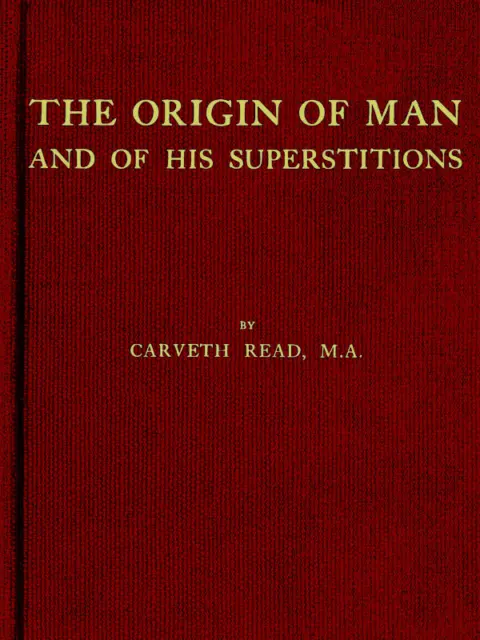
"The Origin of Man and of His Superstitions" by Carveth Read is a scientific publication written in the early 20th century. The work presents a hypothesis regarding the evolutionary development of humans from ape-like ancestors and explores the subsequent emergence of superstitions and magical beliefs as social constructs. Read aims to connect human evolution, particularly through hunting practices, with the psychological and sociocultural evolution leading to superstitions. The opening of the work delivers a comprehensive explanation of the author's hypothesis regarding human ancestry linked to ape-like stocks, highlighting the pivotal role of adopting a hunting lifestyle. Read outlines how this shift not only transformed human physical attributes—such as erect posture and specialized hands—but also shaped social cooperation and early mental capacities. He discusses the implications of transitioning from a frugivorous diet to a carnivorous one and the essential changes in human behavior, cognition, and society that arose as a consequence of social hunting, setting the stage for exploring the development of superstitions in later chapters.
Introduction adapted from the source catalogue; source summaries may be automatically generated.
Free to read · English · 131,342 words · No account needed
MAKE TIME FOR A GOOD BOOK
On by default. Untick to stop anonymous reading totals. Each page counts after 10 seconds in view. How this works.
Anonymous counting is on unless you have switched it off.
Prof. MacBride, in his popular introduction to Zoology (p. 84), also traces the specialisation of Man to the hunting life.
My friend Mr. Thomas Whittaker has sent me the following extract from Comte’s Politique Positive, I. pp. 604-5: “L’obligation de se nourrir d’une proie qu’il faut atteindre et vaincre, perfectionne à la fois tous les attributs animaux, tant intérieurs qu’extérieurs. Son influence envers les sens et les muscles est trop évidente pour exiger ici aucun examen. Par sa réaction habituelle sur les plus hautes fonctions du cerveau, elle développe également l’intelligence et l’activité, dont le premier essor lui est toujours dû, même chez notre espèce. A tous ces tîtres, cette nécessité modifie aussi les races qui en sont victimes, d’après les efforts moins énergiques, mais plus continus, qu’elle y provoque pour leur défense. Dans les deux cas, et surtout quant à l’attaque, elle détermine même les prémières habitudes de co-opération active, au moins temporaire. Bornées à la simple famille chez les espèces insociables, ces ligues peuvent ailleurs embrasser quelquefois de nombreuses troupes. Ainsi commencent, parmi les animaux, des impulsions et des aptitudes qui ne pouvaient se développer que d’après la continuité propre à la race la plus sociable et la plus intelligente. Enfin, la condition carnassière doit aussi être appreciée dans sa réaction organique. Une plus forte excitation, une digestion moins laborieuse et plus rapide, une assimilation plus complète produisant un sang plus stimulant: telles sont ses propriétés physiologiques. Toutes concourent à développer les fonctions supérieures, soit en augmentant l’énergie de leurs organes, soit en procurant plus de temps pour leur exercice.”
[4] F. Wood Jones, Arboreal Man, pp. 117-22.
[5] On these paragraphs—(3), (4), (5), (6), (7)—see Darwin’s Descent of Man, 2nd ed., pp. 49-54: whence, of course, I have freely borrowed.
[6] Numerous references might be given, from which I select Hagenbeck,
Beasts and Men, p. 63.
[7] R. L. Garner, Gorillas and Chimpanzees, ch. vi.: where mention is made of such meanings as “food,” “calling to some one,” “affection,” “good” (said, I suppose, of food), “warning cries,” “cold or discomfort,” “drink,” “illness,” “dead”: the entire vocabulary, perhaps, not more than twenty signs. The value of Garner’s work is disputed.
[8] Natural Selection, p. 193.
[9] Avebury, Prehistoric Times, 7th ed., p. 578.
[10] Spencer and Gillen, Northern Tribes of Central Australia, p. 619.
[11] Turner’s Samoa, p. 285.
[12] Op. cit., p. 579.
[13] Primitive Marriage, ch. ii.
[14] Descent of Man, 2nd ed., pp. 595-604.
[15] Parerga and Paralipomena, B. II, Kap. 27.
[16] A Naturalist in Nicaragua, ch. xi.
[17] Op. cit., p. 57.
[18] Natural Selection, pp. 195-7.
Your reading position is saved on this browser. Take it to another device with a library code. Reading pages adapt to text, rather than matching a printed edition.
BEHIND THE BOOK
This eBook is for the use of anyone anywhere in the United States and most other parts of the world at no cost and with almost no restrictions whatsoever. You may copy it, give it away or re-use it under the terms of the Project Gutenberg License included with this eBook or online at www.gutenberg.org. If you are not located in the United States, you will have to check the laws of the country where you are located before using this eBook. Read the source licence.
The original source file, including credits and licence, is retained by this library. Request an original-format copy at no charge. Please include the book title and Project Gutenberg identifier #46884.
KEEP YOUR CURIOSITY GOING
David Patterson (Spirit) Hatch
Coulson Kernahan

Ralph Waldo Emerson
Frances Wright

Edwin Abbott Abbott

Joseph Droz