
Last letters from the living dead man
David Patterson (Spirit) Hatch
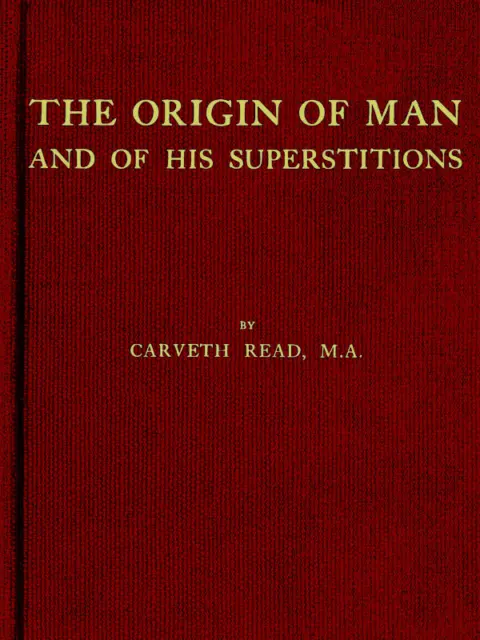
THE CLASSIC COLLECTION · 1920
"The Origin of Man and of His Superstitions" by Carveth Read is a scientific publication written in the early 20th century. The work presents a hypothesis regarding the evolutionary development of humans from ape-like ancestors and explores the subsequent emergence of superstitions and magical beliefs as social constructs. Read aims to connect human evolution, particularly through hunting practices, with the psychological and sociocultural evolution leading to superstitions. The opening of the work delivers a comprehensive explanation of the author's hypothesis regarding human ancestry linked to ape-like stocks, highlighting the pivotal role of adopting a hunting lifestyle. Read outlines how this shift not only transformed human physical attributes—such as erect posture and specialized hands—but also shaped social cooperation and early mental capacities. He discusses the implications of transitioning from a frugivorous diet to a carnivorous one and the essential changes in human behavior, cognition, and society that arose as a consequence of social hunting, setting the stage for exploring the development of superstitions in later chapters.
Introduction adapted from the source catalogue; source summaries may be automatically generated.
Free to read · English · 131,342 words · No account needed
MAKE TIME FOR A GOOD BOOK
On by default. Untick to stop anonymous reading totals. Each page counts after 10 seconds in view. How this works.
Anonymous counting is on unless you have switched it off.
Any one who anxiously desires to foresee the future of our race is in a position to sympathise with the ancients. Go, inquire at Delphi or Dodona; or sleep in Stonehenge, or at the tomb of Merlin, or by the barrows at Upsala, and dream of things to come; or consult the stars, cast the nativity of Lycopithecus, and read in heaven the fate of his posterity. If these methods are not very hopeful, any one of them is as good as guessing. The only safe reflection is that he who lives longest will see most.
[560] “Ethnology of the Ungava District,” Am. B. of Ethn., XI. p. 195. Other examples ante, ch. viii. § 3.
[561] Anatomy of Melancholy, Part II. Sec. IV. Mem. 1, Subsec. 3.
[562] Pliny, XXV. c. 6.
[563] J. Mooney, “Sacred Formulas of the Cherokees,” Am. B. of Ethn.,
VII. pp. 323-39.
[564] J. Mooney, op. cit.
[565] Pliny, XXV. c. 11.
[566] Ibid., XXV. c. 59.
[567] A. W. Howitt, Native Tribes of South-East Australia, p. 384.
[568] Spencer and Gillen, Across Australia, p. 339.
[569] Native Tribes of South-East Australia, p. 381.
[570] The Melanesians, p. 199.
[571] For Proclus’ defence of Astrology see Whewell’s History of the Inductive Sciences, Book IV. ch. iii., 1st ed., pp. 298-300.
[572] Dudley Kidd, The Essential Kafir, p. 114.
[573] A. W. Howitt, Native Tribes of South-East Australia, pp. 397-9.
[574] I do not mean that Magic is always a direct derivative of Common-sense: we have seen (ch. vi. § 5) that it sometimes comes from Animism by retrogradation, and (elsewhere) often from coincidences.
[575] Dudley Kidd, The Essential Kafir, pp. 134-5.
[576] Hose and McDougall, Pagan Tribes of Borneo, I. p. 106.
[577] Ante, ch. vi. § 3.
Abstract and general ideas in lower culture, 99-102, 163-4;
personified, 168
Actor and Wizard, 272-3
Adaptation, 30, 67
Affection for the dead, 179
Aggressiveness, 43
Agriculture, neolithic, 50;
as affecting natural selection, 64
Allen, Grant, on plant-spirits, 167
Analogy, 97-8
Animals give Omens, 236
Animatism, 120, 149, 151, 157
Animism, 35;
evil effects of, 67;
good effects, 69;
Chap. V. (145-86), see Contents;
and Magic and Common-sense, 110;
extended to plants and lifeless things, 150-3;
development of, 183-4;
deception in, 185;
how related to Magic, Chap. VI. (187-284), see Contents;
political advantage over Magic, 255;
and Totemism, 319-25;
and Science, 341;
and Fine Art, 341;
and Philosophy, 342
Anthropoids, habitat of, 5;
mentality and habits, 31-2;
skull capacity, 50;
character, 61
Apperceptive mass of Science and Common-sense, 81;
of Magic and Animism, 82, 126
Arbitrary Magic, 133, 142;
taboos, 133;
myths, 168
Archer, W., Masks and Faces, 273 n.
Asia, southern, probable locus of Man’s origin, 23-4
Astrology, 239, 242, 335
Atkinson, J. J., on Primal Law, 38, 306
Avebury on making fire, 11;
baking clay, 13;
omens and Magic, 233 n.
Your reading position is saved on this browser. Take it to another device with a library code. Reading pages adapt to text, rather than matching a printed edition.
BEHIND THE BOOK
This eBook is for the use of anyone anywhere in the United States and most other parts of the world at no cost and with almost no restrictions whatsoever. You may copy it, give it away or re-use it under the terms of the Project Gutenberg License included with this eBook or online at www.gutenberg.org. If you are not located in the United States, you will have to check the laws of the country where you are located before using this eBook. Read the source licence.
The original source file, including credits and licence, is retained by this library. Request an original-format copy at no charge. Please include the book title and Project Gutenberg identifier #46884.
KEEP YOUR CURIOSITY GOING
David Patterson (Spirit) Hatch
Coulson Kernahan

Ralph Waldo Emerson
Frances Wright

Edwin Abbott Abbott

Joseph Droz