
Last letters from the living dead man
David Patterson (Spirit) Hatch
THE CLASSIC COLLECTION · 1920
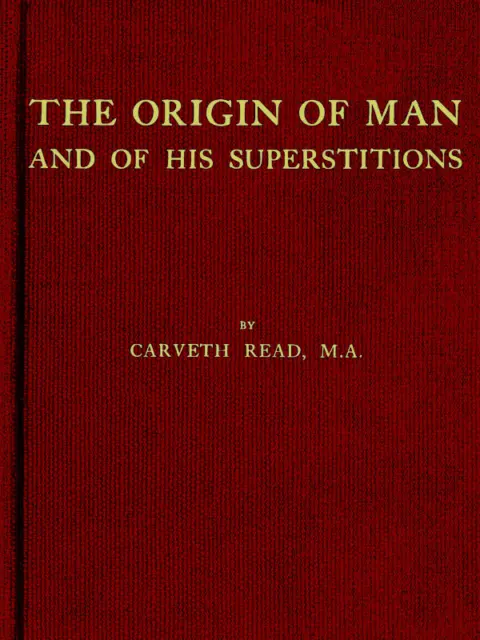
"The Origin of Man and of His Superstitions" by Carveth Read is a scientific publication written in the early 20th century. The work presents a hypothesis regarding the evolutionary development of humans from ape-like ancestors and explores the subsequent emergence of superstitions and magical beliefs as social constructs. Read aims to connect human evolution, particularly through hunting practices, with the psychological and sociocultural evolution leading to superstitions. The opening of the work delivers a comprehensive explanation of the author's hypothesis regarding human ancestry linked to ape-like stocks, highlighting the pivotal role of adopting a hunting lifestyle. Read outlines how this shift not only transformed human physical attributes—such as erect posture and specialized hands—but also shaped social cooperation and early mental capacities. He discusses the implications of transitioning from a frugivorous diet to a carnivorous one and the essential changes in human behavior, cognition, and society that arose as a consequence of social hunting, setting the stage for exploring the development of superstitions in later chapters.
Introduction adapted from the source catalogue; source summaries may be automatically generated.
Free to read · English · 131,342 words · No account needed
MAKE TIME FOR A GOOD BOOK
On by default. Untick to stop anonymous reading totals. Each page counts after 10 seconds in view. How this works.
Anonymous counting is on unless you have switched it off.
Nor, further, has the prohibition to slay, injure or eat the Totem in the first place any magical significance; for it merely puts the Totem in the position of a clansman. But the situation, being strange and mysterious, acquires a magical atmosphere; and the enforcement of the taboo by penalties is unmistakably magical. The Untmajera (North Central Australia) have a legend of a Beetle-Grub man of former times who ate beetle-grubs, and thereupon broke out in sores, wasted away and died. Or one’s hair may turn grey; or, according to the Samoan belief (not strictly totemistic), the forbidden food may grow inside one into the whole animal or plant to the destruction of its host. Such beliefs, resting on the analogy of poisons and their physiological consequences, are magical imaginations: the taboo has the same character as a conditional curse.
Similarly, the prohibition of marriage within the Totem-clan, if it originated (as I have supposed) with the fusion of Totemism and Exogamy in the customs of various early groups of men and women, is not based on Magic; but the penalties for breaking the taboo are magical. Thus amongst the Euahlayi and their neighbours men and women of the Iguana clan cannot intermarry, though coming from different parts of the country and without any traceable consanguinity; because, if they did, their children, inasmuch as their ancestors on both sides were the same animal, would “throw back” to the form or attributes of the iguana.[538] A grotesque anticipation of scientific ideas.
But the most remarkable connexion between Totemism and Magic occurs in those rites by which clansmen in several parts of the world, but especially in Australia, believe themselves able to influence their Totems: when these are edible, to multiply them; when noxious, to drive away or destroy them; or, as with the wind and rain, to control them for the general good. Spencer and Gillen[539] give astonishing descriptions of the rites of multiplication (or Intichiuma), carefully prepared and regulated, including disguisings of clansmen in the likeness of the Totems, drawings of the Totems on the ground, dances, incantations and ceremonies, sometimes representing traditional history—by which the tribesmen discharge this function of theirs. They rely chiefly on mimetic (exemplary) Magic which, by dramatising some natural process, brings it into real operation. In identifying themselves with the Totem, they exert their imaginations to the utmost, and to this end may eat a little of the Totem, at other times forbidden. This assumption that by eating a little of any animal, plant or human being, you become one with it, or acquire its qualities, or, further, that two men by eating together of the same food become allied (which is in a manner materially true, but absurdly interpreted), is another of those notions simpler than, and antecedent to, Magic, which provide a base for magical operations.[540] These solemnities last for months, and are carried out with conscientious diligence and earnestness: the infatuation is profound and universal. Here, as at most of the higher stages of culture, we find the most intense emotions of which men are capable excited by participation in communal imaginative exercises that have directly, in relation to their expectations, absolutely no result. Indeed, pre-occupation with vain employments tends to exclude all ideas that might be useful, that might lead (e. g.) to the increasing of food by the cultivation of plants or domestication of animals. Sir James Frazer has pointed out that a passage of the rites of the Grass-seed clan, in which grass-seeds are scattered about upon the ground, might have led to cultivation: but the mental state of the clan is unfavourable to cool observation. As for animals, it is some excuse for the backwardness of Australian culture that the Marsupialia do not comprise a single species that would repay domestication. Indirectly and undesignedly these performances have very useful consequences: they annually restore the unity of the tribe assembled from all parts for the great occasion; promote mutual good-will and a spirit of co-operation, for which they afford the chief opportunity; maintain the social organisation and the tradition of customs by increasing the influence of the Headmen, who have a leading part in everything that happens, and on whose authority all order and discipline depend; interrupt the monotony of savage life with variety of interests; stimulate ingenuity, and fill up the time, that might else be wasted in idleness or quarrelling, with artistic and dramatic recreation.
Your reading position is saved on this browser. Take it to another device with a library code. Reading pages adapt to text, rather than matching a printed edition.
BEHIND THE BOOK
This eBook is for the use of anyone anywhere in the United States and most other parts of the world at no cost and with almost no restrictions whatsoever. You may copy it, give it away or re-use it under the terms of the Project Gutenberg License included with this eBook or online at www.gutenberg.org. If you are not located in the United States, you will have to check the laws of the country where you are located before using this eBook. Read the source licence.
The original source file, including credits and licence, is retained by this library. Request an original-format copy at no charge. Please include the book title and Project Gutenberg identifier #46884.
KEEP YOUR CURIOSITY GOING
David Patterson (Spirit) Hatch
Coulson Kernahan

Ralph Waldo Emerson
Frances Wright

Edwin Abbott Abbott

Joseph Droz