
Last letters from the living dead man
David Patterson (Spirit) Hatch
THE CLASSIC COLLECTION · 1920
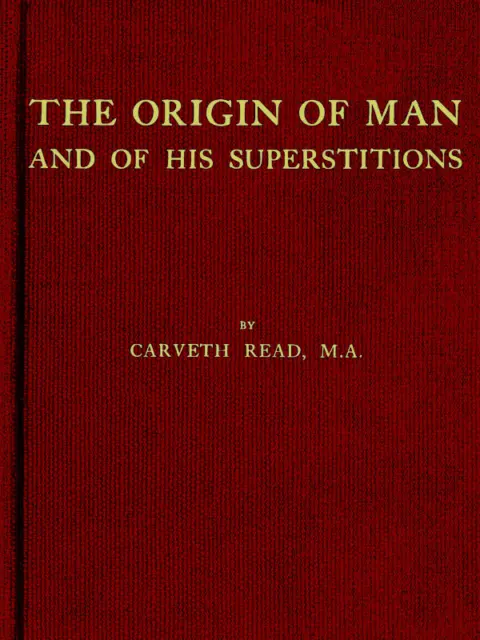
"The Origin of Man and of His Superstitions" by Carveth Read is a scientific publication written in the early 20th century. The work presents a hypothesis regarding the evolutionary development of humans from ape-like ancestors and explores the subsequent emergence of superstitions and magical beliefs as social constructs. Read aims to connect human evolution, particularly through hunting practices, with the psychological and sociocultural evolution leading to superstitions. The opening of the work delivers a comprehensive explanation of the author's hypothesis regarding human ancestry linked to ape-like stocks, highlighting the pivotal role of adopting a hunting lifestyle. Read outlines how this shift not only transformed human physical attributes—such as erect posture and specialized hands—but also shaped social cooperation and early mental capacities. He discusses the implications of transitioning from a frugivorous diet to a carnivorous one and the essential changes in human behavior, cognition, and society that arose as a consequence of social hunting, setting the stage for exploring the development of superstitions in later chapters.
Introduction adapted from the source catalogue; source summaries may be automatically generated.
Free to read · English · 131,342 words · No account needed
MAKE TIME FOR A GOOD BOOK
On by default. Untick to stop anonymous reading totals. Each page counts after 10 seconds in view. How this works.
Anonymous counting is on unless you have switched it off.
To explain the possibility of some men being sincere in witchcraft is not to palliate the profession, much less the anti-social practices of witchcraft. For the most part those practices are deceitful. They are not the invention of savage society; society invents nothing; only the individual invents. They are the invention and tradition of wizards, who keep the secret so far as it is to their advantage: of wizards growing more and more professional, and trading upon the fears and hopes, the anxiety and credulity of their fellows. The spirit of superstition is common to the tribe, but its professional exploitation is the work of those who profit by it.
Observing with satisfaction that, even amongst savages, the positive mind can sometimes free itself from popular superstitions and penetrate the disguise of mystery-mongers, one asks why Nature could not produce whole tribes of men so minded, and spare the folly and horror and iniquity which take up so much space in the retrospect of human life. Because common sense is only related to actual experience, and could not appreciate the necessity of government and social co-ordination as the condition of all improvement in human life, until it already existed. Such co-ordination had, therefore, to grow up without being understood; and it did grow up under the protection of certain beliefs that induced the tribes of men to hold together and subordinate themselves to leaders: amongst which beliefs the superstitions exploited by wizards had no small part.
[389] Ling Roth, The Aborigines of Tasmania, p. 65.
[390] Spencer and Gillen, Across Australia, p. 336.
[391] Czaplicka, Aboriginal Siberia, p. 177.
[392] The political importance of the wizard seems to have been first noticed by Spencer, Principles of Sociology, II. p. 178 (§ 474).
[393] Bellamy, quoted by Seligman, Melanesians of British North
Guinea, p. 694.
[394] Religion of the Amazulu, p. 40.
[395] Dudley Kidd, The Essential Kafir, p. 114.
[396] Czaplicka, Aboriginal Siberia, p. 191.
[397] E. Westermarck, The Origin and Development of Moral Ideas, ch.
xlix.
[398] The Sacred Shrine.
[399] Report of the Cambridge Expedition to Torres Straits, V. pp.
322-3.
[400] Rivers, History of Melanesian Sociology.
[401] Am. B. of Ethn., VII., “Ojibway Medicine,” by W. J. Hoffman; XI., “The Sia,” by M. C. Stevenson; XIV., “The Menomini Indians,” by W. Hoffman. For a collection of the facts see Frazer, Totemism and Exogamy, IV. ch. xix; and Hutton Webster, Primitive Secret Societies.
[402] Report of the Cambridge Expedition to Torres Straits, VI. p.
200.
[403] Op. cit., p. 278.
[404] Among Congo Cannibals, p. 251.
[405] Spencer and Gillen, Across Australia, p. 326.
[406] Book VII. The witch, imitated from Circe and Medea by Ariosto, Tasso, Spenser, became a traditionary, romantic motive.
[407] Howitt, Native Tribes of South-East Australia, p. 388.
[408] Stefánson, op. cit., p. 403.
[409] Czaplicka, op. cit., p. 240.
[410] Across Australia, p. 51.
[411] Op. cit., p. 184.
Your reading position is saved on this browser. Take it to another device with a library code. Reading pages adapt to text, rather than matching a printed edition.
BEHIND THE BOOK
This eBook is for the use of anyone anywhere in the United States and most other parts of the world at no cost and with almost no restrictions whatsoever. You may copy it, give it away or re-use it under the terms of the Project Gutenberg License included with this eBook or online at www.gutenberg.org. If you are not located in the United States, you will have to check the laws of the country where you are located before using this eBook. Read the source licence.
The original source file, including credits and licence, is retained by this library. Request an original-format copy at no charge. Please include the book title and Project Gutenberg identifier #46884.
KEEP YOUR CURIOSITY GOING
David Patterson (Spirit) Hatch
Coulson Kernahan

Ralph Waldo Emerson
Frances Wright

Edwin Abbott Abbott

Joseph Droz