
Last letters from the living dead man
David Patterson (Spirit) Hatch
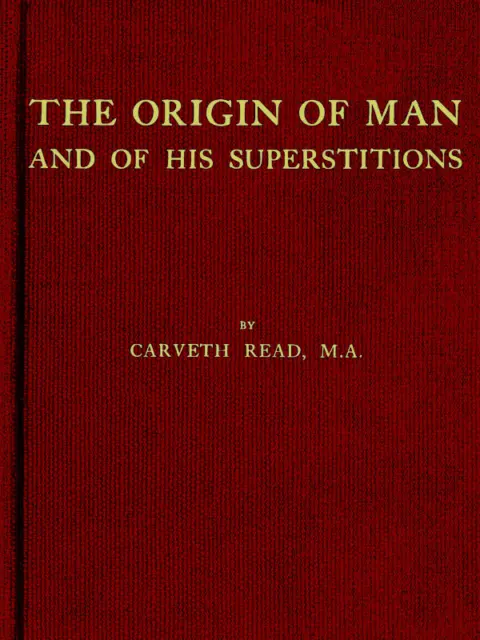
THE CLASSIC COLLECTION · 1920
"The Origin of Man and of His Superstitions" by Carveth Read is a scientific publication written in the early 20th century. The work presents a hypothesis regarding the evolutionary development of humans from ape-like ancestors and explores the subsequent emergence of superstitions and magical beliefs as social constructs. Read aims to connect human evolution, particularly through hunting practices, with the psychological and sociocultural evolution leading to superstitions. The opening of the work delivers a comprehensive explanation of the author's hypothesis regarding human ancestry linked to ape-like stocks, highlighting the pivotal role of adopting a hunting lifestyle. Read outlines how this shift not only transformed human physical attributes—such as erect posture and specialized hands—but also shaped social cooperation and early mental capacities. He discusses the implications of transitioning from a frugivorous diet to a carnivorous one and the essential changes in human behavior, cognition, and society that arose as a consequence of social hunting, setting the stage for exploring the development of superstitions in later chapters.
Introduction adapted from the source catalogue; source summaries may be automatically generated.
Free to read · English · 131,342 words · No account needed
MAKE TIME FOR A GOOD BOOK
On by default. Untick to stop anonymous reading totals. Each page counts after 10 seconds in view. How this works.
Anonymous counting is on unless you have switched it off.
Parallel with the development of Religion, a change takes place in the emotions connected with Animism. As the gods emerge from the shadow of night and the grave, and are cleansed from the savour of corruption, and withdraw to the summit of the world, they are no longer regarded with the shuddering fear that ghosts excite; as they acquire the rank of chiefs and kings, the sentiments of attachment, awe, duty, dependence, loyalty, proper to the service of such superiors, are directed to them; and since their power far exceeds that of kings, and implies the total dependence of man and nature upon their support and guidance, these sentiments—often amazingly strong toward earthly rulers—may toward the gods attain to the intensest heat of fanaticism. Extolled by priests and poets, the attributes of the gods are exaggerated, until difficulties occur to a reflective mind as to how any other powers can exist contrary to, or even apart from, them: so that philosophical problems arise as to the existence of evil and responsibility, and the doctors reason high—
“Of providence, foreknowledge, will and fate, Fixed fate, free will, foreknowledge absolute, And find no end, in wandering mazes lost.”
This is one cause of the dissolution of Animism: the power that comprehends all powers ceases to be an object, and becomes the immanence of all things, good and evil. Another cause is the complexity of theogonies, or of spiritual kingdoms with their orders and degrees: found too fanciful, when hierarchic despotisms, that furnished the analogues, give place to the simpler social structure of democracies; or, to a certain type of democrat, even insulting, a provocative disparagement of the sovereignty of the people. And Animism has other enemies in the growth of Positivism, and sometimes in the resurgence of Magic.
[155] The Veddas, pp. 126-7.
[156] Northern Tribes of Central Australia, p. 170.
[157] The Land of Zing, p. 219.
[158] J. O. Dorsey, American Bureau of Ethnology, 1889-90, XI. p. 419.
[159] Mariner’s Tonga, p. 105.
[160] Myth, Ritual and Religion, p. 48.
[161] African Game Trails, p. 333.
[162] Outdoor Pastimes, p. 77.
[163] Frazer, Spirits of the Corn and the Wild, I. p. 183.
[164] The Melanesians, pp. 249 and 356.
[165] Pagan Races of the Malay Peninsula, II. p. 222.
[166] Pagan Tribes of Borneo, II. p. 3.
[167] Camp and Tramp in African Wilds, p. 174.
[168] The Primitive Bakongo, p. 283.
[169] Among Congo Cannibals, p. 275.
[170] Among the Indians of Guiana, p. 355.
[171] Two Years with the Natives of the West Pacific, p. 199. As to waterspouts and shooting stars, see the Reports of the Cambridge Expedition to Torres Straits, VI. p. 252.
[172] J. Hernell in the Quarterly Journal of the Mythical Society (Bangalore), IV. No. 4, p. 158.
[173] A. A. Macdonell, Sanskrit Literature, p. 112.
[174] J. Mooney in Reports of the American Bureau of Ethnology,
1885-6, VII. p. 341.
Your reading position is saved on this browser. Take it to another device with a library code. Reading pages adapt to text, rather than matching a printed edition.
BEHIND THE BOOK
This eBook is for the use of anyone anywhere in the United States and most other parts of the world at no cost and with almost no restrictions whatsoever. You may copy it, give it away or re-use it under the terms of the Project Gutenberg License included with this eBook or online at www.gutenberg.org. If you are not located in the United States, you will have to check the laws of the country where you are located before using this eBook. Read the source licence.
The original source file, including credits and licence, is retained by this library. Request an original-format copy at no charge. Please include the book title and Project Gutenberg identifier #46884.
KEEP YOUR CURIOSITY GOING
David Patterson (Spirit) Hatch
Coulson Kernahan

Ralph Waldo Emerson
Frances Wright

Edwin Abbott Abbott

Joseph Droz