
Last letters from the living dead man
David Patterson (Spirit) Hatch
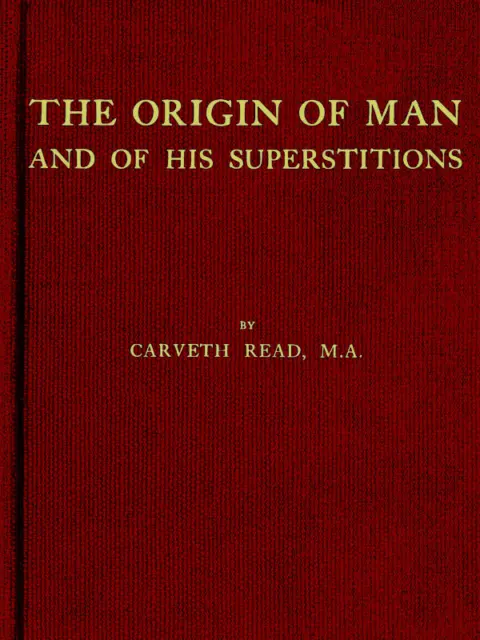
THE CLASSIC COLLECTION · 1920
"The Origin of Man and of His Superstitions" by Carveth Read is a scientific publication written in the early 20th century. The work presents a hypothesis regarding the evolutionary development of humans from ape-like ancestors and explores the subsequent emergence of superstitions and magical beliefs as social constructs. Read aims to connect human evolution, particularly through hunting practices, with the psychological and sociocultural evolution leading to superstitions. The opening of the work delivers a comprehensive explanation of the author's hypothesis regarding human ancestry linked to ape-like stocks, highlighting the pivotal role of adopting a hunting lifestyle. Read outlines how this shift not only transformed human physical attributes—such as erect posture and specialized hands—but also shaped social cooperation and early mental capacities. He discusses the implications of transitioning from a frugivorous diet to a carnivorous one and the essential changes in human behavior, cognition, and society that arose as a consequence of social hunting, setting the stage for exploring the development of superstitions in later chapters.
Introduction adapted from the source catalogue; source summaries may be automatically generated.
Free to read · English · 131,342 words · No account needed
MAKE TIME FOR A GOOD BOOK
On by default. Untick to stop anonymous reading totals. Each page counts after 10 seconds in view. How this works.
Anonymous counting is on unless you have switched it off.
[130] Turner, Ethnology of the Ungava District, Am. B. of Ethn., XI. p. 201; and Murdoch, Ethnology of Point Barrow, Am. B. of Ethn., IX. p. 434.
[131] W.M. Newton, On Palæological Figures of Flint, Journ. of B.
Arch. Ass., March 1913.
[132] The Song of Roland, done into English by C. Scott Moncrieff,
CLXXIII.
[133] T. C. Hodson, The Naga Tribes of Manipur, p. 88.
[134] Reports of the Cambridge Expedition to the Torres Straits, V.
p. 271.
[135] A. E. Crawley, J.A.I., XXIV. p. 123.
[136] Development of Moral Ideas, I, c. 26.
[137] Carl Lumholtz, New Trails in Mexico, p. 350.
[138] Life of a South African Tribe, p. 528.
[139] See the exhaustive treatment of this subject in Frazer’s Taboo and the Perils of the Soul.
[140] A “barn” is a small spindle-shaped stick, supposed to be thrown in a magical attack by wizards. Howitt, The Native Tribes of South-East Australia, p. 377.
[141] Hose and McDougall, Pagan Tribes of Borneo, I. p. 110.
[142] Quoted by Frazer, Spirits of the Corn and of the Wild, I. p.
105.
[143] The Sacred Shrine, pp. 33-9.
[144] Life of a South African Tribe, p. 340.
[145] Sioux Cults, Am. B. of Ethn., XI. p. 484.
[146] New Trails in Mexico, p. 61.
[147] Skeat, Malay Magic, p. 48.
[148] Quoted by Frazer, Belief in Immortality, p. 268.
[149] Reports of the Cambridge Expedition to the Torres Straits, V.
p. 325.
[150] W. Grube, Rel. u. K. d. Chinese, p. 153.
[151] In the B. of Am. Ethn., XIII. p. 374, F. H. Cushing, describing “Zuñi Creation Myths,” says the dramaturgic tendency is to suppose that Nature can be made to act by men, if “they do first what they wish the elements to do,” according “as these things were done or made to be done by the ancestral gods of creation.” The last clause is, perhaps, an animistic gloss of the Zuñis’, who were, of course, very far from primitive thought.
[152] The Psychological Study of Religion, p. 165.
[153] Cf. S. H. Ray, “People and Language of Lifu,” J.R.A.I. (XLVII.), p. 296, who says, a woman whose son or husband was away at war would place a piece of coral to represent him on a mat, move it about with her right hand as he might move in fight, and with her left brush away imaginary evils. This protected him (evidently by exemplary Magic).
[154] W. H. R. Rivers, The Disappearance of Useful Arts, also History of Melanesian Society, II. p. 445; and in Turner’s Samoa (p. 145) we are told that the practice of embalming died out with the family of embalmers.
Your reading position is saved on this browser. Take it to another device with a library code. Reading pages adapt to text, rather than matching a printed edition.
BEHIND THE BOOK
This eBook is for the use of anyone anywhere in the United States and most other parts of the world at no cost and with almost no restrictions whatsoever. You may copy it, give it away or re-use it under the terms of the Project Gutenberg License included with this eBook or online at www.gutenberg.org. If you are not located in the United States, you will have to check the laws of the country where you are located before using this eBook. Read the source licence.
The original source file, including credits and licence, is retained by this library. Request an original-format copy at no charge. Please include the book title and Project Gutenberg identifier #46884.
KEEP YOUR CURIOSITY GOING
David Patterson (Spirit) Hatch
Coulson Kernahan

Ralph Waldo Emerson
Frances Wright

Edwin Abbott Abbott

Joseph Droz