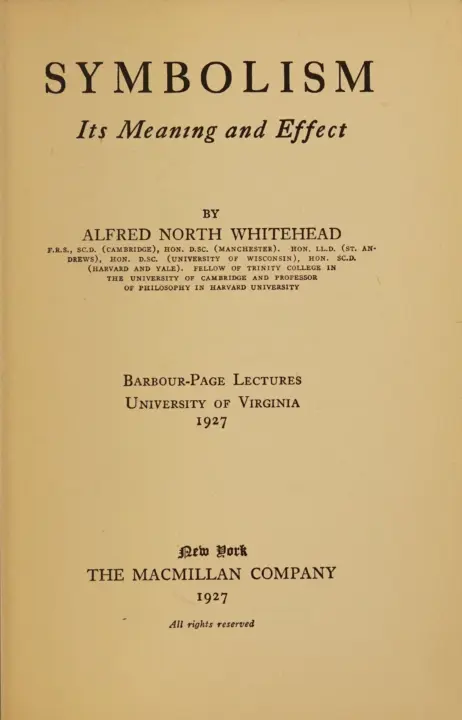
Symbolism, its meaning and effect
Alfred North Whitehead
THE CLASSIC COLLECTION · 1917
"The organisation of thought, educational and scientific" by Alfred North Whitehead is a collection of essays on education and the philosophy of science written in the early 20th century. It advocates a living, integrated approach to learning that unites theory with practice, rejects “inert ideas,” and reshapes curricula—especially mathematics and technical training—to cultivate judgment, creativity, and style. The volume likely moves from classroom reform and the social purpose of technical education to broader reflections on scientific concepts and how thought is organized. The opening of this volume sets its scope in a preface—first essays on education, then pieces on the philosophy of science—before launching, amid wartime urgency, a plea for reform. Chapter I lays down two rules (teach few subjects, teach them thoroughly), attacks inert information, argues that proof and use must go together, criticizes uniform external examinations, and defines education as cultivating culture, expertise, and “style,” closing with duty and reverence as its moral core. Chapter II reframes technical education as inherently liberal, insisting that joy in work, moral vision, and art power skilled labor, invention, and enterprise, and that manual craft, science, and literature must interpenetrate. It sketches three intertwined curricula (literary, scientific, technical), stresses hand–eye practice, proposes broad, non-narrow training linked to appropriate sciences, and treats literature as enjoyment rather than grammar. Chapter III, a prize-day address, praises perseverance in wartime, calls students to public service, and urges the Polytechnic to be a civic center where art, recreation, and craft elevate work—linking Southwark’s theatrical heritage to modern industry and casting the institute as an “arsenal for peace.” The start of Chapter IV argues that mathematics in general education should shed recondite detail for a small set of powerful ideas—number, quantity, and space—illustrated through experiments, graphs, simple calculus, statistics, and the history of ideas (for example, Euclid’s Book V).
Introduction adapted from the source catalogue; source summaries may be automatically generated.
Free to read · English · 50,795 words · No account needed
MAKE TIME FOR A GOOD BOOK
On by default. Untick to stop anonymous reading totals. Each page counts after 10 seconds in view. How this works.
Anonymous counting is on unless you have switched it off.
Recapitulation.--Relations of time and relations of space hold between sense-objects of perception. These sense-objects are distinguished as separate objects by the recognition of either (1) differences of sense-content, or (2) time-relations between them other than simultaneity, or (3) space-relations between them other than coincidence. Thus sense-objects arise from the recognition of contrast within the complete stream of sense-presentation, namely, from the recognition of the objects as related terms, by relations which contrast them. Differences of sense-content are infinitely complex in their variety. Their analysis under the heading of general ideas is the unending task of physical science. Time-relations and space-relations are comparatively simple, and the general ideas according to which their analysis should proceed are obvious.
This simplicity of time and space is perhaps the reason why thought chooses them as the permanent ground for objectival distinction, throwing the various sense-objects thus obtainable into one heap, as a first crude thought-object of perception, and thence, as described above, obtaining a thought-object of perception. Thus a thought-object of perception conceived as in the present of a short duration is a first crude thought-object of perception either actual or hypothetical. Such a thought-object of perception, confined within a short duration, takes on the space-relations of its component sense-objects within that same duration. Accordingly thought-objects of perception, conceived in their whole extents, have to each other the time-relationships of their complete existences, and within any small duration have to each other the space-relationships of their component sense-objects which lie within that duration.
Relations bind together: thus thought-objects of perception are connected in time and in space. The genesis of the objectival analysis of sense-presentation is the recognition of sense-objects as distinct terms in time-relations and space-relations: thus thought-objects of perception are separated by time and by space.
Whole and Part.--A sense-object is part of the complete stream of presentation. This concept of being a part is merely the statement of the relation of the sense-object to the complete sense-presentation for that consciousness. Also a sense-object can be part of another sense-object. It can be a part in two ways, namely, a part in time and a part in space. It seems probable that both these concepts of time-part and space-part are fundamental; that is, are concepts expressing relations which are directly presented to us, and are not concepts about concepts. In that case no further definition of the actual presentation is possible. It may even then be possible to define an adequate criterion of the occurrence of such a presentation. For example, adopting for the moment a realist metaphysic as to the existence of the physical world of molecules and electrons, the vision of a chair as occurring for some definite person at some definite time is essentially indefinable. It is his vision, though each of us guesses that it must be uncommonly like our vision under analogous circumstances. But the existence of the definable molecules and waves of light in certain definable relations to his bodily organs of sense, his body also being in a certain definable state, forms an adequate criterion of the occurrence of the vision, a criterion which is accepted in Courts of Law and for physical science is tacitly substituted for the vision.
Your reading position is saved on this browser. Take it to another device with a library code. Reading pages adapt to text, rather than matching a printed edition.
Alfred North Whitehead
Alfred North Whitehead
Alfred North Whitehead
BEHIND THE BOOK
This eBook is for the use of anyone anywhere in the United States and most other parts of the world at no cost and with almost no restrictions whatsoever. You may copy it, give it away or re-use it under the terms of the Project Gutenberg License included with this eBook or online at www.gutenberg.org. If you are not located in the United States, you will have to check the laws of the country where you are located before using this eBook. Read the source licence.
The original source file, including credits and licence, is retained by this library. Request an original-format copy at no charge. Please include the book title and Project Gutenberg identifier #77011.
KEEP YOUR CURIOSITY GOING

David Patterson (Spirit) Hatch

David Patterson (Spirit) Hatch

David Patterson (Spirit) Hatch
Coulson Kernahan

Ralph Waldo Emerson

Maurice Baring