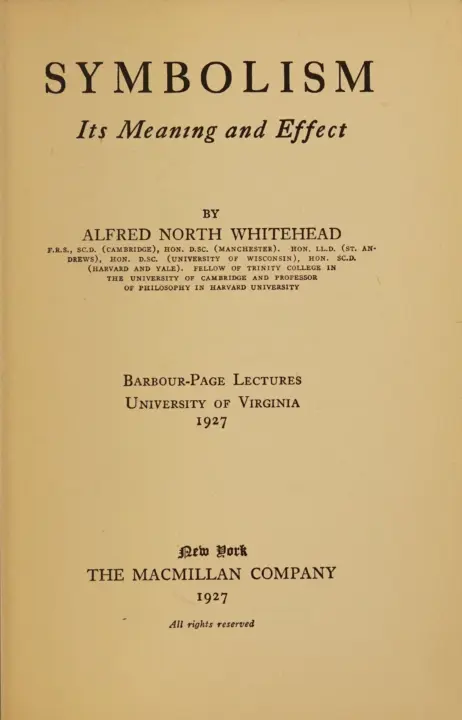
Symbolism, its meaning and effect
Alfred North Whitehead

THE CLASSIC COLLECTION · 1917
"The organisation of thought, educational and scientific" by Alfred North Whitehead is a collection of essays on education and the philosophy of science written in the early 20th century. It advocates a living, integrated approach to learning that unites theory with practice, rejects “inert ideas,” and reshapes curricula—especially mathematics and technical training—to cultivate judgment, creativity, and style. The volume likely moves from classroom reform and the social purpose of technical education to broader reflections on scientific concepts and how thought is organized. The opening of this volume sets its scope in a preface—first essays on education, then pieces on the philosophy of science—before launching, amid wartime urgency, a plea for reform. Chapter I lays down two rules (teach few subjects, teach them thoroughly), attacks inert information, argues that proof and use must go together, criticizes uniform external examinations, and defines education as cultivating culture, expertise, and “style,” closing with duty and reverence as its moral core. Chapter II reframes technical education as inherently liberal, insisting that joy in work, moral vision, and art power skilled labor, invention, and enterprise, and that manual craft, science, and literature must interpenetrate. It sketches three intertwined curricula (literary, scientific, technical), stresses hand–eye practice, proposes broad, non-narrow training linked to appropriate sciences, and treats literature as enjoyment rather than grammar. Chapter III, a prize-day address, praises perseverance in wartime, calls students to public service, and urges the Polytechnic to be a civic center where art, recreation, and craft elevate work—linking Southwark’s theatrical heritage to modern industry and casting the institute as an “arsenal for peace.” The start of Chapter IV argues that mathematics in general education should shed recondite detail for a small set of powerful ideas—number, quantity, and space—illustrated through experiments, graphs, simple calculus, statistics, and the history of ideas (for example, Euclid’s Book V).
Introduction adapted from the source catalogue; source summaries may be automatically generated.
Free to read · English · 50,795 words · No account needed
MAKE TIME FOR A GOOD BOOK
On by default. Untick to stop anonymous reading totals. Each page counts after 10 seconds in view. How this works.
Anonymous counting is on unless you have switched it off.
The importance, even in practice, of the theoretical side of science arises from the fact that action must be immediate, and takes place under circumstances which are excessively complicated. If we wait for the necessities of action before we commence to arrange our ideas, in peace we shall have lost our trade, and in war we shall have lost the battle. Success in practice depends on theorists who, led by other motives of exploration, have been there before, and by some good chance have hit upon the relevant ideas. By a theorist I do not mean a man who is up in the clouds, but a man whose motive for thought is the desire to formulate correctly the rules according to which events occur. A successful theorist should be excessively interested in immediate events, otherwise he is not at all likely to formulate correctly anything about them. Of course, both sources of science exist in all men.
Now, what is this thought organisation which we call science? The first aspect of modern science which struck thoughtful observers was its inductive character. The nature of induction, its importance, and the rules of inductive logic have been considered by a long series of thinkers, especially English thinkers: Bacon, Herschel, J. S. Mill, Venn, Jevons, and others. I am not going to plunge into an analysis of the process of induction. Induction is the machinery and not the product, and it is the product which I want to consider. When we understand the product we shall be in a stronger position to improve the machinery.
First, there is one point which it is necessary to emphasise. There is a tendency in analysing scientific processes to assume a given assemblage of concepts applying to nature, and to imagine that the discovery of laws of nature consists in selecting by means of inductive logic some one out of a definite set of possible alternative relations which may hold between the things in nature answering to these obvious concepts. In a sense this assumption is fairly correct, especially in regard to the earlier stages of science. Mankind found itself in possession of certain concepts respecting nature--for example, the concept of fairly permanent material bodies--and proceeded to determine laws which related the corresponding percepts in nature. But the formulation of laws changed the concepts, sometimes gently by an added precision, sometimes violently. At first this process was not much noticed, or at least was felt to be a process curbed within narrow bounds, not touching fundamental ideas. At the stage where we now are, the formulation of the concepts can be seen to be as important as the formulation of the empirical laws connecting the events in the universe as thus conceived by us. For example, the concepts of life, of heredity, of a material body, of a molecule, of an atom, of an electron, of energy, of space, of time, of quantity, and of number. I am not dogmatising about the best way of getting such ideas straight. Certainly it will only be done by those who have devoted themselves to a special study of the facts in question. Success is never absolute, and progress in the right direction is the result of a slow, gradual process of continual comparison of ideas with facts. The criterion of success is that we should be able to formulate empirical laws, that is, statements of relations, connecting the various parts of the universe as thus conceived, laws with the property that we can interpret the actual events of our lives as being our fragmentary knowledge of this conceived interrelated whole.
Your reading position is saved on this browser. Take it to another device with a library code. Reading pages adapt to text, rather than matching a printed edition.
Alfred North Whitehead
Alfred North Whitehead
Alfred North Whitehead
BEHIND THE BOOK
This eBook is for the use of anyone anywhere in the United States and most other parts of the world at no cost and with almost no restrictions whatsoever. You may copy it, give it away or re-use it under the terms of the Project Gutenberg License included with this eBook or online at www.gutenberg.org. If you are not located in the United States, you will have to check the laws of the country where you are located before using this eBook. Read the source licence.
The original source file, including credits and licence, is retained by this library. Request an original-format copy at no charge. Please include the book title and Project Gutenberg identifier #77011.
KEEP YOUR CURIOSITY GOING

David Patterson (Spirit) Hatch

David Patterson (Spirit) Hatch

David Patterson (Spirit) Hatch
Coulson Kernahan

Ralph Waldo Emerson

Maurice Baring