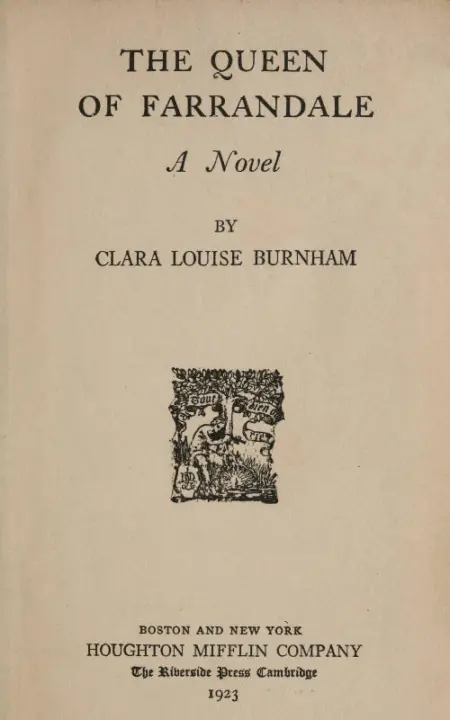
The Queen of Farrandale: A Novel
Clara Louise Burnham
THE CLASSIC COLLECTION · 1906
"The Opened Shutters: A Novel" by Clara Louise Burnham is a work of fiction written in the early 20th century. The narrative centers around a complicated family dynamic involving Judge Calvin Trent, his former love Martha Lacey, and the unexpected arrival of a young girl named Sylvia Lacey, who is the daughter of Martha's estranged brother. The story explores themes of duty, family estrangement, and the societal expectations placed on women during this period. At the start of the novel, we are introduced to Judge Trent and Martha Lacey in a small-town law office where their long-standing unease and history linger. The characters reflect on their past connection, with hints of regrets over choices made, particularly concerning love and responsibility. Martha is determined to take care of her brother’s daughter, Sylvia, who has come to Boston without a clear plan or support. As the chapter unfolds, it becomes evident that both the Judge and Martha are grappling with their feelings towards Sylvia as well as each other, which sets the stage for potential conflict and deeper exploration of their relationships. The tensions rise as both Aunt Martha and Judge Trent must confront not only their past but also their responsibilities to the young woman unexpectedly dropped into their lives.
Introduction adapted from the source catalogue; source summaries may be automatically generated.
Free to read · English · 85,424 words · No account needed
MAKE TIME FOR A GOOD BOOK
On by default. Untick to stop anonymous reading totals. Each page counts after 10 seconds in view. How this works.
Anonymous counting is on unless you have switched it off.
Upon Judge Trent's return to town John Dunham did not disappear in a cloud of dust to make his call on Miss Derwent. He took the precaution to telephone, and discovered that she was out of the city.
He felt considerable curiosity regarding his employer's experiences at the farm, but true to his new and safe policy he asked not a single question. Business required the judge's immediate attention upon his arrival, but as soon as affairs in the office quieted he remembered the promise he had made Dunham.
"Now then, boy," he said one morning, "there isn't any reason why you can't run along to-day and call on Miss Derwent."
"The bird has flown. I 'phoned to the house. She has gone to New York to be a bridesmaid. Isn't coming back till time to leave for Maine."
"H'm. Too bad," returned the judge absent-mindedly.
"Thank you. Don't let it depress you."
"Eh?" looking up; Dunham was bending over the morning mail.
"Ever been in that Casco Bay region?" went on the judge.
"Yes, I yachted along the coast from Bar Harbor to Portland one
summer."
"It's a fine, unspoiled part of the world," remarked the lawyer with unusual pensiveness, setting his hat farther back from his forehead and looking into space. "When I get a glimpse of it as I did this week, I'm tempted to hasten my retirement, to bid farewell to the squabbling world, and turn fisherman,--begin to spread nets for mackerel instead of my fellow men, and trap only such lobsters as will blush in a pot instead of in court."
"Hear, hear," said Dunham. "You must have had good weather up there,--or else," he added, "fallen in love with your niece."
Judge Trent still looked into space. "Yes," he went on slowly, "move my books to the Mill Farm, leave Hannah the house, but not my address, and begin rising at 4 A.M. for breakfast with Cap'n Lem. Then row out to my pound, take in the fish, and send them to Boston. What retaining fee could compare to the satisfaction of making money that way? Think of the sights and sounds, the peace of mind!"
"Yes," said John, "but consider the obstacles."
"There wouldn't be any. I'd leave the good will of the office to you."
"I'm very grateful, but you forget. What would any well-regulated fish say to afternoon dress at 4 A.M., and wouldn't the wind blow your hat off?"
"John, you're a frivolous youth," responded the judge thoughtfully; "but," in a warmer tone, "there are some things you do very well. I"--still more warmly--"I have a little commission for you this afternoon."
Dunham looked up suspiciously.
Your reading position is saved on this browser. Take it to another device with a library code. Reading pages adapt to text, rather than matching a printed edition.
Clara Louise Burnham
Clara Louise Burnham
Clara Louise Burnham
Clara Louise Burnham
BEHIND THE BOOK
This eBook is for the use of anyone anywhere in the United States and most other parts of the world at no cost and with almost no restrictions whatsoever. You may copy it, give it away or re-use it under the terms of the Project Gutenberg License included with this eBook or online at www.gutenberg.org. If you are not located in the United States, you will have to check the laws of the country where you are located before using this eBook. Read the source licence.
The original source file, including credits and licence, is retained by this library. Request an original-format copy at no charge. Please include the book title and Project Gutenberg identifier #25954.
KEEP YOUR CURIOSITY GOING
Coulson Kernahan

Maurice Baring
Frances Wright
Cécile Tormay

Frederic Jesup Stimson

W. H. P. (William Henry Pope) Jarvis