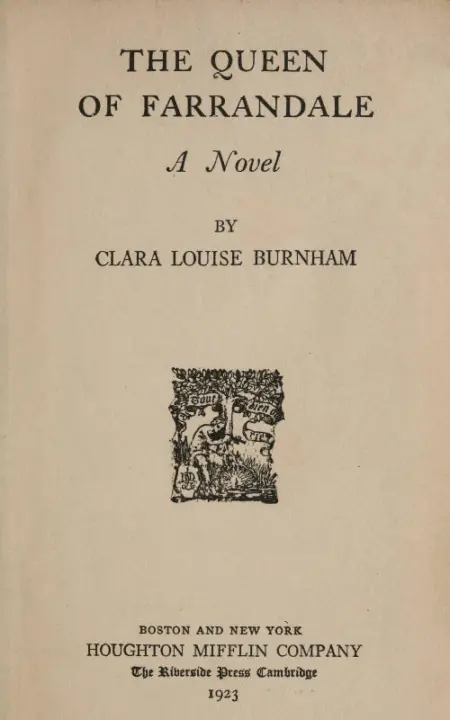
The Queen of Farrandale: A Novel
Clara Louise Burnham
THE CLASSIC COLLECTION · 1906
"The Opened Shutters: A Novel" by Clara Louise Burnham is a work of fiction written in the early 20th century. The narrative centers around a complicated family dynamic involving Judge Calvin Trent, his former love Martha Lacey, and the unexpected arrival of a young girl named Sylvia Lacey, who is the daughter of Martha's estranged brother. The story explores themes of duty, family estrangement, and the societal expectations placed on women during this period. At the start of the novel, we are introduced to Judge Trent and Martha Lacey in a small-town law office where their long-standing unease and history linger. The characters reflect on their past connection, with hints of regrets over choices made, particularly concerning love and responsibility. Martha is determined to take care of her brother’s daughter, Sylvia, who has come to Boston without a clear plan or support. As the chapter unfolds, it becomes evident that both the Judge and Martha are grappling with their feelings towards Sylvia as well as each other, which sets the stage for potential conflict and deeper exploration of their relationships. The tensions rise as both Aunt Martha and Judge Trent must confront not only their past but also their responsibilities to the young woman unexpectedly dropped into their lives.
Introduction adapted from the source catalogue; source summaries may be automatically generated.
Free to read · English · 85,424 words · No account needed
MAKE TIME FOR A GOOD BOOK
On by default. Untick to stop anonymous reading totals. Each page counts after 10 seconds in view. How this works.
Anonymous counting is on unless you have switched it off.
Minty's lean, strong arms had often rowed her about the little salt lake, but Sylvia was ambitious to be her own boatman; and this afternoon she was practicing by herself, catching crabs and splashing, laughing at her own awkwardness until, breathing fast, her pale cheeks pink from exertion, she pulled in her oars and floated on the blue ripples, looking at the full green of leafy boughs among the sombre richness of the evergreens, and listening to the spring gladness of the robin's songs.
It was all very lovely. The Tide Mill only refused to be cheered.
Silent, enduring, wrapped in memories, it stood gray and
unapproachable.
"Poor old thing," murmured Sylvia, addressing it. "You're not thinking right." She laughed softly, and ran her hands through her thick curls.
Instantly an oar glided off the boat. She jumped for it, but it was too late. Nearly capsizing, her heart beat as the boat rocked back into safety and she tried to scull after the runaway with the remaining oar. Her inexperience and the clumsiness of the boat baffled her. The floating oar rose and fell, gently increasing its distance, and splash as she might she could not gain upon it.
A curt voice suddenly called from the shore behind her, "Here, girl, girl! Stop that. Be quiet, and probably you'll float in."
She turned involuntarily, and beheld, standing on the verge, a small, elderly man wearing a silk hat and scowling while he motioned to her imperiously.
Obediently she ceased her ineffectual splashing, and the boat danced
and floated shoreward.
"Then why doesn't the oar float in, too?" she asked anxiously.
"Ask Neptune," returned the stranger curtly.
"I mustn't lose that oar," cried the girl.
"Why didn't you take care of it, then?" rejoined the judge, and the boat just then venturing near him and curtsying, he jumped aboard of her with an agility that astonished the passenger. The craft rocked in the shock.
"Sit still," commanded the judge, and Sylvia remained motionless while he seized the oar, and going to the end of the boat, began sculling with a practiced hand, which was at strange variance with his costume.
The trouble in Sylvia's eyes vanished, and two little stars danced therein as she saw by the steady approach of their craft that the lost was as good as found, and so had leisure to gaze furtively at her gondolier. The down-drawn corners of the judge's lips, his shaggy frown at the oar coquetting on the ripples with a breeze which was flapping the skirts of his formal frock coat, and the firm set forward of his high silk hat, formed an incongruous picture.
Your reading position is saved on this browser. Take it to another device with a library code. Reading pages adapt to text, rather than matching a printed edition.
Clara Louise Burnham
Clara Louise Burnham
Clara Louise Burnham
Clara Louise Burnham
BEHIND THE BOOK
This eBook is for the use of anyone anywhere in the United States and most other parts of the world at no cost and with almost no restrictions whatsoever. You may copy it, give it away or re-use it under the terms of the Project Gutenberg License included with this eBook or online at www.gutenberg.org. If you are not located in the United States, you will have to check the laws of the country where you are located before using this eBook. Read the source licence.
The original source file, including credits and licence, is retained by this library. Request an original-format copy at no charge. Please include the book title and Project Gutenberg identifier #25954.
KEEP YOUR CURIOSITY GOING
Coulson Kernahan

Maurice Baring
Frances Wright
Cécile Tormay

Frederic Jesup Stimson

W. H. P. (William Henry Pope) Jarvis