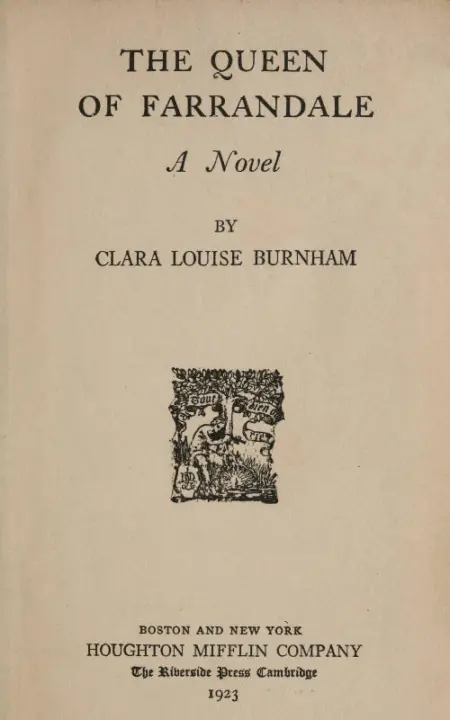
The Queen of Farrandale: A Novel
Clara Louise Burnham
THE CLASSIC COLLECTION · 1906
"The Opened Shutters: A Novel" by Clara Louise Burnham is a work of fiction written in the early 20th century. The narrative centers around a complicated family dynamic involving Judge Calvin Trent, his former love Martha Lacey, and the unexpected arrival of a young girl named Sylvia Lacey, who is the daughter of Martha's estranged brother. The story explores themes of duty, family estrangement, and the societal expectations placed on women during this period. At the start of the novel, we are introduced to Judge Trent and Martha Lacey in a small-town law office where their long-standing unease and history linger. The characters reflect on their past connection, with hints of regrets over choices made, particularly concerning love and responsibility. Martha is determined to take care of her brother’s daughter, Sylvia, who has come to Boston without a clear plan or support. As the chapter unfolds, it becomes evident that both the Judge and Martha are grappling with their feelings towards Sylvia as well as each other, which sets the stage for potential conflict and deeper exploration of their relationships. The tensions rise as both Aunt Martha and Judge Trent must confront not only their past but also their responsibilities to the young woman unexpectedly dropped into their lives.
Introduction adapted from the source catalogue; source summaries may be automatically generated.
Free to read · English · 85,424 words · No account needed
MAKE TIME FOR A GOOD BOOK
On by default. Untick to stop anonymous reading totals. Each page counts after 10 seconds in view. How this works.
Anonymous counting is on unless you have switched it off.
John speculated upon the information Judge Trent was receiving. Perhaps Sylvia had revolted against being immured on a New England farm and had escaped to Nat.
The judge dropped the letter and stared ahead of him. Thinkright's implied accusation nettled him more than all Miss Martha's tearful reproaches. For the first time his duty toward his niece presented itself as so reasonable as to be impossible of escape.
He looked at Dunham, who sedulously did not look at him. The young man was thinking of a mignonne face as he had last seen it with quivering lips, trying to smile in response to his encouraging parting words. At last the judge spoke:--
"Well, Thinkright took her up there."
"Ah?" responded Dunham. Whatever his curiosity, he determined that his conversation on this embarrassing subject should never exceed monosyllables.
"Sickly looking, is she?" pursued the lawyer after a pause.
"Yes," replied John; then memory reminding him that this was not strictly the case, he availed himself of the remainder of his vocabulary: "and no," he added.
"I should like to know what Thinkright means by her being starved,"
said Judge Trent irritably.
Silence from Dunham, frowning at his papers.
"I believe I'll send you up there," began the lawyer after a minute.
"I believe you won't," retorted his subordinate with surprising
promptness.
The older man stared. "I should like to know how the girl is carrying sail; how she eats, whether she seems contented. An eyewitness, now"--
"Not me," said John briefly.
"Lost your conceit, eh?" asked the judge, grinning.
"No more family parties for me," returned Dunham doggedly.
"Oh, come now, be good-natured and obliging."
"Never again while I live," was the response.
"I've never praised you half enough for your work on that job," said the judge ingratiatingly. "The more I think of it the more I wonder where we'd have brought up in the affair if it hadn't been for you."
"You might as well flatter the Sphinx," remarked John impersonally.
Judge Trent laughed. "Afraid of a little girl, eh?"
Dunham shrugged his shoulders. "I shouldn't be the first man. Why don't
you send Miss Lacey?"
"H'm," grunted the judge thoughtfully.
John smiled. "Provide her with a full suit of chain-armor and I fancy
she'd accept the detail."
"I'm going in town to-morrow," soliloquized the judge aloud. "I might
go and ask Edna Derwent."
"Who?" demanded Dunham, looking up with sudden alertness.
"Edna Derwent."
"Of Commonwealth Avenue?"
"Yes. What's the matter?"
"Nothing. I am only surprised that your calling list includes her."
"Well, now, why should you be?"
Your reading position is saved on this browser. Take it to another device with a library code. Reading pages adapt to text, rather than matching a printed edition.
Clara Louise Burnham
Clara Louise Burnham
Clara Louise Burnham
Clara Louise Burnham
BEHIND THE BOOK
This eBook is for the use of anyone anywhere in the United States and most other parts of the world at no cost and with almost no restrictions whatsoever. You may copy it, give it away or re-use it under the terms of the Project Gutenberg License included with this eBook or online at www.gutenberg.org. If you are not located in the United States, you will have to check the laws of the country where you are located before using this eBook. Read the source licence.
The original source file, including credits and licence, is retained by this library. Request an original-format copy at no charge. Please include the book title and Project Gutenberg identifier #25954.
KEEP YOUR CURIOSITY GOING
Coulson Kernahan

Maurice Baring
Frances Wright
Cécile Tormay

Frederic Jesup Stimson

W. H. P. (William Henry Pope) Jarvis