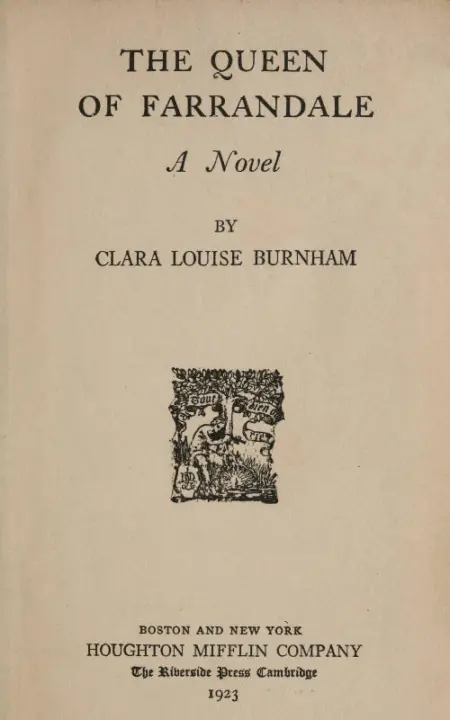
The Queen of Farrandale: A Novel
Clara Louise Burnham
THE CLASSIC COLLECTION · 1906
"The Opened Shutters: A Novel" by Clara Louise Burnham is a work of fiction written in the early 20th century. The narrative centers around a complicated family dynamic involving Judge Calvin Trent, his former love Martha Lacey, and the unexpected arrival of a young girl named Sylvia Lacey, who is the daughter of Martha's estranged brother. The story explores themes of duty, family estrangement, and the societal expectations placed on women during this period. At the start of the novel, we are introduced to Judge Trent and Martha Lacey in a small-town law office where their long-standing unease and history linger. The characters reflect on their past connection, with hints of regrets over choices made, particularly concerning love and responsibility. Martha is determined to take care of her brother’s daughter, Sylvia, who has come to Boston without a clear plan or support. As the chapter unfolds, it becomes evident that both the Judge and Martha are grappling with their feelings towards Sylvia as well as each other, which sets the stage for potential conflict and deeper exploration of their relationships. The tensions rise as both Aunt Martha and Judge Trent must confront not only their past but also their responsibilities to the young woman unexpectedly dropped into their lives.
Introduction adapted from the source catalogue; source summaries may be automatically generated.
Free to read · English · 85,424 words · No account needed
MAKE TIME FOR A GOOD BOOK
On by default. Untick to stop anonymous reading totals. Each page counts after 10 seconds in view. How this works.
Anonymous counting is on unless you have switched it off.
"No, and affairs piled up. I had too much to attend to to renew the attack. I didn't have time to smooth down her ruffled feathers, so--the result is that we've each flocked alone. Just as well, just as well," continued the speaker, musingly. "What I was thinking of just now was how many different lives we seem to live in one; how our tastes change; and at best how few illusions are left to lawyers regarding marriage."
"In other words, you're a confirmed old bachelor. What was it you asked me a minute ago--if I were in love?"
"Yes, or if you had been."
"Have been dozens of times,--am not," returned Dunham, with the smile
that his employer liked.
"Just so, just so," the latter answered quickly. "We change. Read First Corinthians, seventh chapter, and if you take Paul's advice and don't pass the Rubicon, then you 'll be free to change as often as you please."
Dunham looked up again. "Are you a Bible student, Judge Trent?"
"Student of everything," returned the lawyer, with a short wave of his
thin hand.
"All books except woman's looks, eh?" answered Dunham, returning to his
papers.
"I said I had no successors," remarked the judge, regarding his gaiters musingly. "I'm not at all sure of that. Miss--Martha was a very attractive woman. My impression is that in any case she preferred to concentrate all her faculties upon watching to see that I didn't get into mischief."
"That's faithfulness, I'm sure," returned Dunham. "The necessity for
building those kitchen fires wouldn't exist now," he added
suggestively.
"Young man, no levity," returned the judge.
There was silence for a few minutes, broken only by the turning of the crisp papers as Dunham continued his researches. At last the telephone bell rang and Dunham answered it. As he hung up the receiver Judge Trent spoke:--
"Just call up the railway station, will you, and secure a chair for me in the nine o'clock train for Boston Wednesday morning?"
John obeyed, and as he returned to his desk his employer continued:--
"I may need your advice on Wednesday's business, Dunham."
"My advice?" returned the young man, with interest. "Is it in the Evans
case?"
"No," dryly; "it isn't in the Evans case. It's a case of a girl." The judge scowled at his gaiters and pushed his hat askew. "Hang it, I don't know anything about girls."
The young lawyer waited, his elbows on his desk.
"Anything that I can do, of course," he said at last.
"Have you any sisters?"
"No."
"Confound you," returned the other impatiently. "What do you know about
it, then?"
Your reading position is saved on this browser. Take it to another device with a library code. Reading pages adapt to text, rather than matching a printed edition.
Clara Louise Burnham
Clara Louise Burnham
Clara Louise Burnham
Clara Louise Burnham
BEHIND THE BOOK
This eBook is for the use of anyone anywhere in the United States and most other parts of the world at no cost and with almost no restrictions whatsoever. You may copy it, give it away or re-use it under the terms of the Project Gutenberg License included with this eBook or online at www.gutenberg.org. If you are not located in the United States, you will have to check the laws of the country where you are located before using this eBook. Read the source licence.
The original source file, including credits and licence, is retained by this library. Request an original-format copy at no charge. Please include the book title and Project Gutenberg identifier #25954.
KEEP YOUR CURIOSITY GOING
Coulson Kernahan

Maurice Baring
Frances Wright
Cécile Tormay

Frederic Jesup Stimson

W. H. P. (William Henry Pope) Jarvis