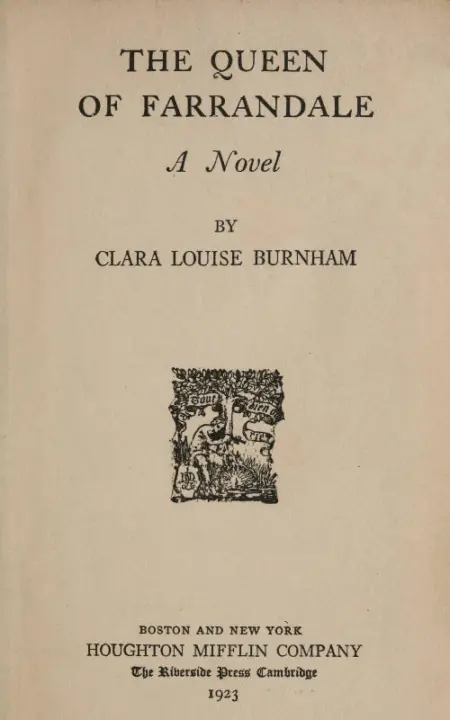
The Queen of Farrandale: A Novel
Clara Louise Burnham
THE CLASSIC COLLECTION · 1906
"The Opened Shutters: A Novel" by Clara Louise Burnham is a work of fiction written in the early 20th century. The narrative centers around a complicated family dynamic involving Judge Calvin Trent, his former love Martha Lacey, and the unexpected arrival of a young girl named Sylvia Lacey, who is the daughter of Martha's estranged brother. The story explores themes of duty, family estrangement, and the societal expectations placed on women during this period. At the start of the novel, we are introduced to Judge Trent and Martha Lacey in a small-town law office where their long-standing unease and history linger. The characters reflect on their past connection, with hints of regrets over choices made, particularly concerning love and responsibility. Martha is determined to take care of her brother’s daughter, Sylvia, who has come to Boston without a clear plan or support. As the chapter unfolds, it becomes evident that both the Judge and Martha are grappling with their feelings towards Sylvia as well as each other, which sets the stage for potential conflict and deeper exploration of their relationships. The tensions rise as both Aunt Martha and Judge Trent must confront not only their past but also their responsibilities to the young woman unexpectedly dropped into their lives.
Introduction adapted from the source catalogue; source summaries may be automatically generated.
Free to read · English · 85,424 words · No account needed
MAKE TIME FOR A GOOD BOOK
On by default. Untick to stop anonymous reading totals. Each page counts after 10 seconds in view. How this works.
Anonymous counting is on unless you have switched it off.
"It's a little place I have in Maine. A cousin of mine runs it for me. So you think, Martha, that I'm below criticism in this whole matter, do you? That's a rather bright thought of yours about Thinkright."
"But it comes too late," returned Martha excitedly. "How do you know that Sylvia won't take the night train for the West right off to join that horrible Nat?"
"Then you think she has money?"
"I don't know. I only know she spurned the idea of any help from us."
"Wouldn't take a cent, eh?" rejoined Judge Trent. He turned toward
Dunham. "I'll take that twenty-five then, Boy. It's pay-day for
Hannah."
Dunham started from his leaning posture by the mantelpiece, and the lawyer watched his embarrassed countenance as he began a search through his pockets. He succeeded in extracting bills from two.
"I've only eight dollars here, Judge," he said at last, avoiding the
other man's eyes.
"H'm. You and Miss Lacey must have painted the town," remarked Judge Trent, accepting the money. "Had a good appetite for dinner in spite of your troubles, hadn't you, Martha?"
"We didn't have luncheon together," returned Miss Martha, indignant at her friend's flippancy. "Do you suppose I cared whether I ever ate again or not?"
"The boy deserted you, did he? Didn't I tell you to take care of Miss
Lacey?"
Dunham caught Judge Trent's eye for a second, and looked away. "I think I took care of her," he replied coldly.
"Of course you did," said Miss Martha impatiently. "He had business to attend to. Now perhaps you'll choose some other time for joking, Calvin Trent, and tell me what you propose to do while valuable minutes are flying."
The judge drummed thoughtfully now on his desk. "That was a bright idea of yours concerning Thinkright," he remarked musingly.
"Then make it worth something!" responded Miss Lacey. His deliberate manner was driving her to frenzy. "Send a telegram if you can't send a detective. Say, 'News to your advantage coming,' or something like that. Anything to keep her there while we send for Thinkright."
"Send for him, eh?" mused the judge aloud.
"Why, of course!" responded Martha, in the very throes of impatience. "She wouldn't come with me, would she? She certainly wouldn't come with you!" The speaker brought out the last pronoun with a vicious satisfaction.
"Too bad of you to blacken me to her like that," remarked the judge. "I sent, as I supposed, an entirely capable representative. John admitted that he could carry off the affair with flying colors. How about that hand you had tied behind you, Boy?"
Your reading position is saved on this browser. Take it to another device with a library code. Reading pages adapt to text, rather than matching a printed edition.
Clara Louise Burnham
Clara Louise Burnham
Clara Louise Burnham
Clara Louise Burnham
BEHIND THE BOOK
This eBook is for the use of anyone anywhere in the United States and most other parts of the world at no cost and with almost no restrictions whatsoever. You may copy it, give it away or re-use it under the terms of the Project Gutenberg License included with this eBook or online at www.gutenberg.org. If you are not located in the United States, you will have to check the laws of the country where you are located before using this eBook. Read the source licence.
The original source file, including credits and licence, is retained by this library. Request an original-format copy at no charge. Please include the book title and Project Gutenberg identifier #25954.
KEEP YOUR CURIOSITY GOING
Coulson Kernahan

Maurice Baring
Frances Wright
Cécile Tormay

Frederic Jesup Stimson

W. H. P. (William Henry Pope) Jarvis