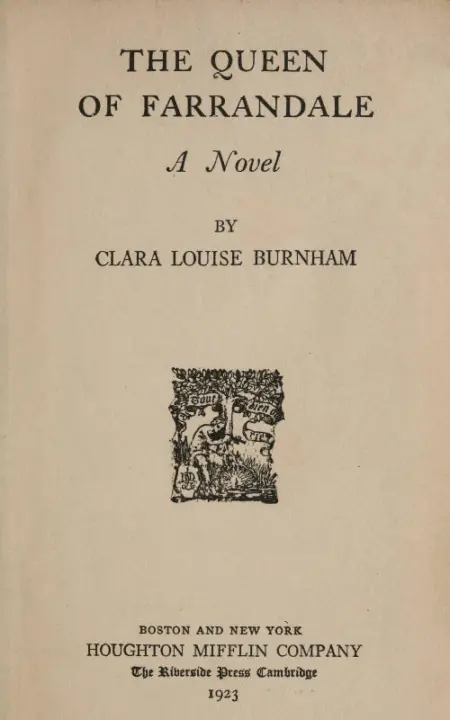
The Queen of Farrandale: A Novel
Clara Louise Burnham
THE CLASSIC COLLECTION · 1906
"The Opened Shutters: A Novel" by Clara Louise Burnham is a work of fiction written in the early 20th century. The narrative centers around a complicated family dynamic involving Judge Calvin Trent, his former love Martha Lacey, and the unexpected arrival of a young girl named Sylvia Lacey, who is the daughter of Martha's estranged brother. The story explores themes of duty, family estrangement, and the societal expectations placed on women during this period. At the start of the novel, we are introduced to Judge Trent and Martha Lacey in a small-town law office where their long-standing unease and history linger. The characters reflect on their past connection, with hints of regrets over choices made, particularly concerning love and responsibility. Martha is determined to take care of her brother’s daughter, Sylvia, who has come to Boston without a clear plan or support. As the chapter unfolds, it becomes evident that both the Judge and Martha are grappling with their feelings towards Sylvia as well as each other, which sets the stage for potential conflict and deeper exploration of their relationships. The tensions rise as both Aunt Martha and Judge Trent must confront not only their past but also their responsibilities to the young woman unexpectedly dropped into their lives.
Introduction adapted from the source catalogue; source summaries may be automatically generated.
Free to read · English · 85,424 words · No account needed
MAKE TIME FOR A GOOD BOOK
On by default. Untick to stop anonymous reading totals. Each page counts after 10 seconds in view. How this works.
Anonymous counting is on unless you have switched it off.
"I'm delighted," she answered, as the horses started, "for it means showers instead of a three days' rain. Here, let's take the calico tent," she added, "then we can both get under it."
She put her little umbrella under the rubber laprobe, and, raising the weather-beaten canopy, slipped her arm through Thinkright's.
"I'm going to paint such a lovely picture of you this summer, dear," she said, studying his face fondly.
"Of me? Oh, no."
"Oh, yes. I won't admit that any one else can paint such a likeness of
you as I can."
"I hear good reports of your work."
"My own reports?" she laughed.
"No. Calvin's, Edna's, Mr. Dunham's."
"John's, Mr. Dunham's?"
Thinkright's answer was rather slow in coming, she thought.
"Yes. We've had occasion for some correspondence on a matter of business, and he has mentioned your promise."
"My promise to what?" asked Sylvia, suddenly interested in the
fastening of the umbrella.
"The promise shown in your work," replied her companion, looking steadily between the horse's ears.
"Oh, yes," returned Sylvia in a small voice.
"You were a little mistaken about that match you had fixed up," said Thinkright, "between Edna and Mr. Dunham, weren't you?"
"Yes; and she's going to marry such a fine man, so worthy of her in every way!" Sylvia spoke with enthusiasm.
"You're better pleased than if it had been Dunham?" asked Thinkright.
It was his companion's turn to hesitate. "Oh, she didn't ask my advice," she replied at last, with elaborate lightness.
"It's rather easy to make mistakes about those matters," observed
Thinkright.
"Yes; and rather easy in avoiding Scylla to fall into Charybdis." She had spent her winter in endeavoring to avoid Charybdis. Just because it had not been Edna who was John's ideal was no sign that the Princess did not exist, either already selected, as Edna's lover had been, or else still to appear. An acquaintance with Boston, and the dozens of interesting people she had met, had cleared her provincial vision, until she was more than ever wary of believing that an interest in her personality and her work meant anything deeper. There were a number of men who had shown her more attention than had John Dunham, aside from those evenings he had spent with Edna and herself. She had kept her thought filled with healthful interest in her work, the effort to please her teachers, and to make the most of her uncle's generosity; and the winter had gone swiftly. She had spent Christmas with her aunt, and Judge Trent and Mr. Dunham had dined with them on the holiday. After dinner she had gone sleigh-riding with John, far into the frosty, sparkling country, despite Miss Lacey's protest that she couldn't see why they wouldn't rather stay by the fire. Miss Martha declared that for her part she would just as soon sit with her feet in a pail of ice water and ring a dinner-bell as to go sleighing. Upon which Judge Trent reminded her that she had not always felt so; a concession on his part to the past which furnished Miss Lacey with gratified sensations for some time to come; the more that, instead of making some excuse to leave, her old friend had taken with extraordinary grace to the role of fireside companion, and remained talking with her of Sylvia, and mutual acquaintances, until the young people's return.
Your reading position is saved on this browser. Take it to another device with a library code. Reading pages adapt to text, rather than matching a printed edition.
Clara Louise Burnham
Clara Louise Burnham
Clara Louise Burnham
Clara Louise Burnham
BEHIND THE BOOK
This eBook is for the use of anyone anywhere in the United States and most other parts of the world at no cost and with almost no restrictions whatsoever. You may copy it, give it away or re-use it under the terms of the Project Gutenberg License included with this eBook or online at www.gutenberg.org. If you are not located in the United States, you will have to check the laws of the country where you are located before using this eBook. Read the source licence.
The original source file, including credits and licence, is retained by this library. Request an original-format copy at no charge. Please include the book title and Project Gutenberg identifier #25954.
KEEP YOUR CURIOSITY GOING
Coulson Kernahan

Maurice Baring
Frances Wright
Cécile Tormay

Frederic Jesup Stimson

W. H. P. (William Henry Pope) Jarvis