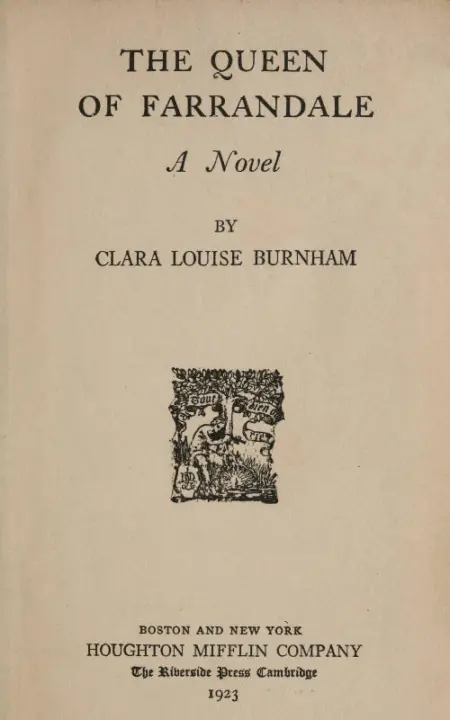
The Queen of Farrandale: A Novel
Clara Louise Burnham
THE CLASSIC COLLECTION · 1906
"The Opened Shutters: A Novel" by Clara Louise Burnham is a work of fiction written in the early 20th century. The narrative centers around a complicated family dynamic involving Judge Calvin Trent, his former love Martha Lacey, and the unexpected arrival of a young girl named Sylvia Lacey, who is the daughter of Martha's estranged brother. The story explores themes of duty, family estrangement, and the societal expectations placed on women during this period. At the start of the novel, we are introduced to Judge Trent and Martha Lacey in a small-town law office where their long-standing unease and history linger. The characters reflect on their past connection, with hints of regrets over choices made, particularly concerning love and responsibility. Martha is determined to take care of her brother’s daughter, Sylvia, who has come to Boston without a clear plan or support. As the chapter unfolds, it becomes evident that both the Judge and Martha are grappling with their feelings towards Sylvia as well as each other, which sets the stage for potential conflict and deeper exploration of their relationships. The tensions rise as both Aunt Martha and Judge Trent must confront not only their past but also their responsibilities to the young woman unexpectedly dropped into their lives.
Introduction adapted from the source catalogue; source summaries may be automatically generated.
Free to read · English · 85,424 words · No account needed
MAKE TIME FOR A GOOD BOOK
On by default. Untick to stop anonymous reading totals. Each page counts after 10 seconds in view. How this works.
Anonymous counting is on unless you have switched it off.
Dunham had scarcely recovered from this when another girl, a smart summer boarder who favored him with a stare of interest as she entered, approached the proprietor.
Mr. Frisk in his shirt sleeves was viewing a too precipitate world from
behind his counter. "I'd like some marshmallows, please," said the
girl.
"Ain't got any," was the response, given with entire amiability.
"Why," disappointedly, "you did have them last week."
"Ye-us, I know. I tried carryin' ma'shmallers quite a spell: but't wan't no use. Seems if everybody wanted 'em. I couldn't keep 'em in stock any time at all, so I give it up."
"Well, I do declare!" exclaimed the young woman. "And, Mr. Frisk, my mother is distressed because that cable message doesn't come from father. If it comes to-night"--
"Oh, that's so, there wus a telegram this noon. Ye-us, that's so. I remember now. 'Twus from yer pa."
"Where is it? Why didn't you send it up, then?" John could hear the vexation fairly crackling in the speaker's voice.
"Why, I see he got thar all right, so I didn't know as thar wus any
drive."
Some supporting sense of humor seemed to come to the girl, for John could hear her desperate chuckle as she went out with the cablegram.
"Handsome evenin', Mr. Dunham," remarked the unmoved postmaster.
"Bo't's late, ain't it?"
John assented, and a wizened old man passed him and approached the
counter.
"Howdy, Frisk," he mumbled. "Got to have some more terbacca. Gimme a package o' Peace and Good Will, will ye?"
The proprietor beamed sympathetically. "Ye'll have to try somethin' else this time, Uncle Ben," he drawled pleasantly. "I'm sorry, but the fact is my Peace and Good Will's mouldy."
Dunham smiled, and looked over his shoulder at Benny. He was still cracking his heels gently against the flour barrel. The evening boat must be in soon, and then the boy would be out on the dock, lost in the excitement of its arrival. Dunham strolled up to him. "Good-evening, Benny."
He was surprised at the unresponsive air with which the boy nodded. John was aware of having recently completed the capture of Benny's heart by replying to questions concerning the gold football on his fob; but to-night there was no lighting of the young sailor's face.
"Come outside, will you, Benny? I want to speak to you."
To John's further amazement, Benny, instead of bounding off the barrel, complied with reluctance; but they were finally out of doors in the velvet darkness that preceded the moonrise.
"I want to know where you left Miss Sylvia," said John Dunham
imperiously.
The boy hesitated a minute, then spoke grudgingly. "At the Tide Mill."
Your reading position is saved on this browser. Take it to another device with a library code. Reading pages adapt to text, rather than matching a printed edition.
Clara Louise Burnham
Clara Louise Burnham
Clara Louise Burnham
Clara Louise Burnham
BEHIND THE BOOK
This eBook is for the use of anyone anywhere in the United States and most other parts of the world at no cost and with almost no restrictions whatsoever. You may copy it, give it away or re-use it under the terms of the Project Gutenberg License included with this eBook or online at www.gutenberg.org. If you are not located in the United States, you will have to check the laws of the country where you are located before using this eBook. Read the source licence.
The original source file, including credits and licence, is retained by this library. Request an original-format copy at no charge. Please include the book title and Project Gutenberg identifier #25954.
KEEP YOUR CURIOSITY GOING
Coulson Kernahan

Maurice Baring
Frances Wright
Cécile Tormay

Frederic Jesup Stimson

W. H. P. (William Henry Pope) Jarvis