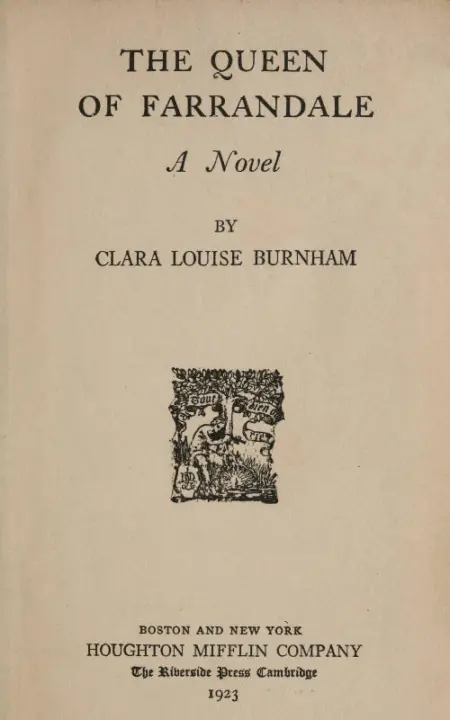
The Queen of Farrandale: A Novel
Clara Louise Burnham
THE CLASSIC COLLECTION · 1906
"The Opened Shutters: A Novel" by Clara Louise Burnham is a work of fiction written in the early 20th century. The narrative centers around a complicated family dynamic involving Judge Calvin Trent, his former love Martha Lacey, and the unexpected arrival of a young girl named Sylvia Lacey, who is the daughter of Martha's estranged brother. The story explores themes of duty, family estrangement, and the societal expectations placed on women during this period. At the start of the novel, we are introduced to Judge Trent and Martha Lacey in a small-town law office where their long-standing unease and history linger. The characters reflect on their past connection, with hints of regrets over choices made, particularly concerning love and responsibility. Martha is determined to take care of her brother’s daughter, Sylvia, who has come to Boston without a clear plan or support. As the chapter unfolds, it becomes evident that both the Judge and Martha are grappling with their feelings towards Sylvia as well as each other, which sets the stage for potential conflict and deeper exploration of their relationships. The tensions rise as both Aunt Martha and Judge Trent must confront not only their past but also their responsibilities to the young woman unexpectedly dropped into their lives.
Introduction adapted from the source catalogue; source summaries may be automatically generated.
Free to read · English · 85,424 words · No account needed
MAKE TIME FOR A GOOD BOOK
On by default. Untick to stop anonymous reading totals. Each page counts after 10 seconds in view. How this works.
Anonymous counting is on unless you have switched it off.
"Yes, I've no idea that Thinkright would leave the farm over night at this busy time, anyway," replied Sylvia. "Where is he? I must see him before I decide. I'm really not sure about going back. Perhaps, Uncle Calvin, it will be best for you and Mr. Dunham to go without me."
The lawyer's steely gaze was sunk in the soft blue depths of hers. In this mood she reminded him of his last parting with Laura. No woman since that day had clung to his arm.
He grunted a dissent. "John and I see enough of each other as it is,"
he returned.
"The idea of any one seeing enough of John!" was the thought that flashed through Sylvia's mind. What she said was, "Would you really rather I went too, Uncle Calvin?"
The sharp eyes under the visor saw the expression in Dunham's face at
the caressing tone.
"Oh, suit yourself, of course," he replied briefly, "suit yourself;" but he carefully made no motion of his rigid arm which should discourage Sylvia from leaning upon it, and the three moved off toward the house.
Minty Foster suddenly appeared, dragging herself shyly between the trees. "I seen yer comin' past the mill," she said. Her usually stolid face was so eloquent of satisfaction at meeting Sylvia again that the girl dropped her uncle's arm, and, stooping, kissed the red cheek.
"Don't you want to go and see if Benny won't give you a sail while he's waiting for us, Minty?" she suggested.
"Y' ain't goin' back, are yer?" protested the child, round-eyed.
"I'm not quite sure," replied Sylvia. Each new, trifling incident reassured her, and went to lighten her heart. Here was home and welcome, whatever had been her mistakes abroad.
Minty ran on to the waterside, and the three resumed their walk. The chime of little joy-bells and the silvery flourish of melody continued to come from woodland depths.
"What a pity we haven't time to find that darling hermit!" said the girl. "He must be near. Once I succeeded in discovering him, and I sat so quietly he didn't mind me, even if he saw. He was on the very topmost twig of a pine, so little and so brown against the vast blue. Uncle Calvin, I'm so glad you bought the Mill Farm!"
"Well, so am I," replied the judge.
"Some time," said Sylvia, "when you get very--unexpectedly--rich, I wish you'd buy the Tide Mill."
"You do?" grunted the lawyer. "What for, pray? Want to see a bonfire on
the water?"
"Oh, dear, no!" Sylvia glanced around at Dunham. "Wouldn't it be tragic, after all its troubles, to see it burned at the stake?"
Your reading position is saved on this browser. Take it to another device with a library code. Reading pages adapt to text, rather than matching a printed edition.
Clara Louise Burnham
Clara Louise Burnham
Clara Louise Burnham
Clara Louise Burnham
BEHIND THE BOOK
This eBook is for the use of anyone anywhere in the United States and most other parts of the world at no cost and with almost no restrictions whatsoever. You may copy it, give it away or re-use it under the terms of the Project Gutenberg License included with this eBook or online at www.gutenberg.org. If you are not located in the United States, you will have to check the laws of the country where you are located before using this eBook. Read the source licence.
The original source file, including credits and licence, is retained by this library. Request an original-format copy at no charge. Please include the book title and Project Gutenberg identifier #25954.
KEEP YOUR CURIOSITY GOING
Coulson Kernahan

Maurice Baring
Frances Wright
Cécile Tormay

Frederic Jesup Stimson

W. H. P. (William Henry Pope) Jarvis