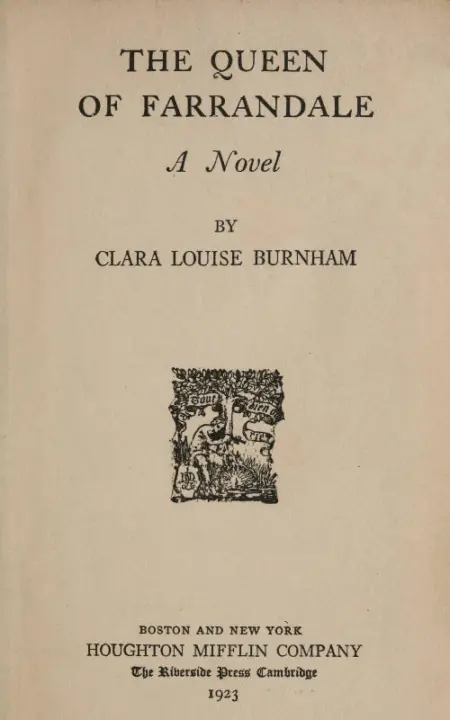
The Queen of Farrandale: A Novel
Clara Louise Burnham
THE CLASSIC COLLECTION · 1906
"The Opened Shutters: A Novel" by Clara Louise Burnham is a work of fiction written in the early 20th century. The narrative centers around a complicated family dynamic involving Judge Calvin Trent, his former love Martha Lacey, and the unexpected arrival of a young girl named Sylvia Lacey, who is the daughter of Martha's estranged brother. The story explores themes of duty, family estrangement, and the societal expectations placed on women during this period. At the start of the novel, we are introduced to Judge Trent and Martha Lacey in a small-town law office where their long-standing unease and history linger. The characters reflect on their past connection, with hints of regrets over choices made, particularly concerning love and responsibility. Martha is determined to take care of her brother’s daughter, Sylvia, who has come to Boston without a clear plan or support. As the chapter unfolds, it becomes evident that both the Judge and Martha are grappling with their feelings towards Sylvia as well as each other, which sets the stage for potential conflict and deeper exploration of their relationships. The tensions rise as both Aunt Martha and Judge Trent must confront not only their past but also their responsibilities to the young woman unexpectedly dropped into their lives.
Introduction adapted from the source catalogue; source summaries may be automatically generated.
Free to read · English · 85,424 words · No account needed
MAKE TIME FOR A GOOD BOOK
On by default. Untick to stop anonymous reading totals. Each page counts after 10 seconds in view. How this works.
Anonymous counting is on unless you have switched it off.
"I don't need to be bequeathed to any one," she declared. "I'm like that poet who said he was never less alone than when alone. Fancy being lonely on this island in the company of these stars and waves and pines! Edna, when you wish to move your family away, and leave the cottage in the care of a hermit, I speak to be the hermit."
"I see you are properly captured," returned Edna.
"She's fallen in love with the cook stove now," remarked Miss Martha. "I told her she'd had a couple of spies on her doings."
Edna glanced at her guest. Sylvia's smiling, inquiring eyes looked from her to John, who spoke:--
"Yes, there you were stirring some mysterious caldron," he answered; "there in the dark of the moon, and there was something so fiery about your countenance and attitude that we didn't dare remain."
"You were wise," returned Sylvia. "I thought I felt some presence.
Didn't you hear me say,--
'By the pricking of my thumbs
Something wicked this way comes'?"
"Well, we're expecting to benefit by your labors in time," said John.
"I wish I thought you would," returned Sylvia dreamily.
"Oh, don't be so modest. Let us judge, anyway."
"I've no doubt you would be a judge," said the girl meditatively.
"Say will be," he corrected.
Sylvia lifted her shoulders with a little gesture of dread.
"I haven't positively made up my mind that I dare try it on you," she
said softly.
"Oh, you must. You'll find me the most docile dog in the pack."
Edna listened with annoyance. She had suddenly become critical of
Sylvia's manner.
The girl turned to her.
"Will it be necessary to go to the Mill Farm before afternoon,
to-morrow?" she asked.
"Perhaps not. Why?"
"Because there is--because I want--I should like to stay here in the
morning."
"Mr. Dunham and I might go over without you," suggested Edna. "Mrs. Lem could doubtless give me what you want."
The alacrity of Sylvia's assent to this proposition puzzled the hostess
still further.
"Oh, no, there'd be plenty of time if we went in the afternoon," said John. "Let's take the witch with us for luck."
Edna regarded him as he stood against a boulder pillar looking down at Sylvia. "She may not need to use her bottle," was her reflection.
"Do sing us something, Edna," said Sylvia.
"Not to-night, please. I don't feel like singing; and when I don't it is an infliction on my poor audience."
"I wish you would, Edna. I've not heard you," said Dunham.
"Just the reason why I refuse," she returned. "I'm far too vain."
Your reading position is saved on this browser. Take it to another device with a library code. Reading pages adapt to text, rather than matching a printed edition.
Clara Louise Burnham
Clara Louise Burnham
Clara Louise Burnham
Clara Louise Burnham
BEHIND THE BOOK
This eBook is for the use of anyone anywhere in the United States and most other parts of the world at no cost and with almost no restrictions whatsoever. You may copy it, give it away or re-use it under the terms of the Project Gutenberg License included with this eBook or online at www.gutenberg.org. If you are not located in the United States, you will have to check the laws of the country where you are located before using this eBook. Read the source licence.
The original source file, including credits and licence, is retained by this library. Request an original-format copy at no charge. Please include the book title and Project Gutenberg identifier #25954.
KEEP YOUR CURIOSITY GOING
Coulson Kernahan

Maurice Baring
Frances Wright
Cécile Tormay

Frederic Jesup Stimson

W. H. P. (William Henry Pope) Jarvis