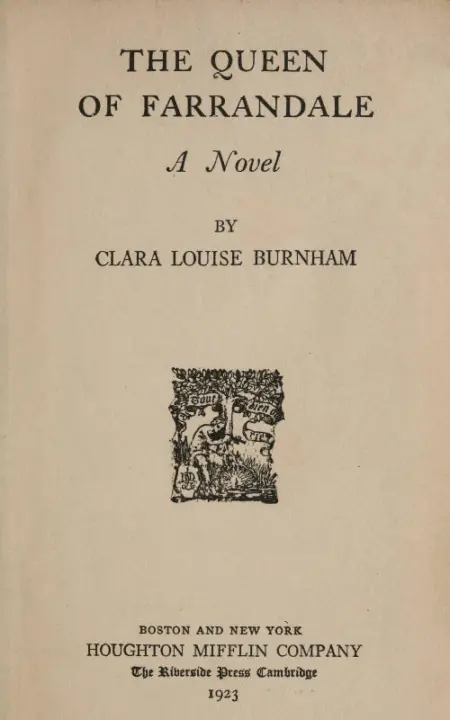
The Queen of Farrandale: A Novel
Clara Louise Burnham
THE CLASSIC COLLECTION · 1906
"The Opened Shutters: A Novel" by Clara Louise Burnham is a work of fiction written in the early 20th century. The narrative centers around a complicated family dynamic involving Judge Calvin Trent, his former love Martha Lacey, and the unexpected arrival of a young girl named Sylvia Lacey, who is the daughter of Martha's estranged brother. The story explores themes of duty, family estrangement, and the societal expectations placed on women during this period. At the start of the novel, we are introduced to Judge Trent and Martha Lacey in a small-town law office where their long-standing unease and history linger. The characters reflect on their past connection, with hints of regrets over choices made, particularly concerning love and responsibility. Martha is determined to take care of her brother’s daughter, Sylvia, who has come to Boston without a clear plan or support. As the chapter unfolds, it becomes evident that both the Judge and Martha are grappling with their feelings towards Sylvia as well as each other, which sets the stage for potential conflict and deeper exploration of their relationships. The tensions rise as both Aunt Martha and Judge Trent must confront not only their past but also their responsibilities to the young woman unexpectedly dropped into their lives.
Introduction adapted from the source catalogue; source summaries may be automatically generated.
Free to read · English · 85,424 words · No account needed
MAKE TIME FOR A GOOD BOOK
On by default. Untick to stop anonymous reading totals. Each page counts after 10 seconds in view. How this works.
Anonymous counting is on unless you have switched it off.
Dunham looked off upon the rolling billows breaking in snow here and
there above unseen ledges.
"Your clothes are wet. You had a rough sail."
"In spots, yes; but it's rather sheltered between here and the Tide Mill. You're looking well, Miss Lacey."
"Who wouldn't in such a place," she rejoined; "and just think, Mr.
Dunham, my niece is here."
"So I understand." The young man gave a tentative glance around at the
house.
"Oh, they're not in. Miss Derwent is never in, unless it storms the way it did yesterday, and then she's liable to be in oilskins hanging on to some rock and scaring me out of my seven senses. Sylvia's just like her. They were both out yesterday."
"I'm glad to learn that your niece is strong enough for that," returned
Dunham.
Miss Lacey made a gesture. "She did it, anyway." She lowered her voice to a confidential pitch. "Haven't things worked around wonderfully, Mr. Dunham?" The speaker drew back, giving him a significant look.
"How do you mean?" asked Dunham cautiously.
"Since that day we were at Hotel Frisbie. I haven't dared look to see how many new gray hairs that week gave me, and here we are, all so calm and happy. Miss Derwent being so kind and hospitable to Sylvia, and none of my doings at all. You see, it would have been such an impossible thing for me to suggest that my niece should visit here, but it came around in the most natural way through Thinkright."
"It is fine," returned Dunham. Sylvia's name still meant for him only the dew-laden eyes that beseeched him as he left her at the Association that day in Boston. He felt some curiosity as to how Miss Lacey had finally made her peace, and he felt sure that she would like to tell him; but the younger Miss Lacey's affairs were none of his.
"I'm sorry not to find Miss Derwent," he said.
"Oh, you'll find her," returned Miss Lacey briskly. "You will stay to dinner with us, of course."
"Certainly not," returned Dunham quickly.
"Why, you will. We have it at noon, you know."
"In these togs?" asked John incredulously--"Miss Derwent?"
"Oh, hers aren't any better," returned Miss Martha. "That's the island
fashion."
"No,--I'll go to the--what did you say? There's some sort of a hotel
here, isn't there?"
"Yes. Some sort," returned Miss Lacey, "but not your sort. Don't say another word about it, Mr. Dunham. Why, Miss Derwent would be scandalized,--an old friend like you. You said you were, didn't you?" she added, with sudden questioning.
Your reading position is saved on this browser. Take it to another device with a library code. Reading pages adapt to text, rather than matching a printed edition.
Clara Louise Burnham
Clara Louise Burnham
Clara Louise Burnham
Clara Louise Burnham
BEHIND THE BOOK
This eBook is for the use of anyone anywhere in the United States and most other parts of the world at no cost and with almost no restrictions whatsoever. You may copy it, give it away or re-use it under the terms of the Project Gutenberg License included with this eBook or online at www.gutenberg.org. If you are not located in the United States, you will have to check the laws of the country where you are located before using this eBook. Read the source licence.
The original source file, including credits and licence, is retained by this library. Request an original-format copy at no charge. Please include the book title and Project Gutenberg identifier #25954.
KEEP YOUR CURIOSITY GOING
Coulson Kernahan

Maurice Baring
Frances Wright
Cécile Tormay

Frederic Jesup Stimson

W. H. P. (William Henry Pope) Jarvis