THE CLASSIC COLLECTION✦The Disappearing EyeCLASSIC FREE BOOKS
The Disappearing Eye
Fergus Hume
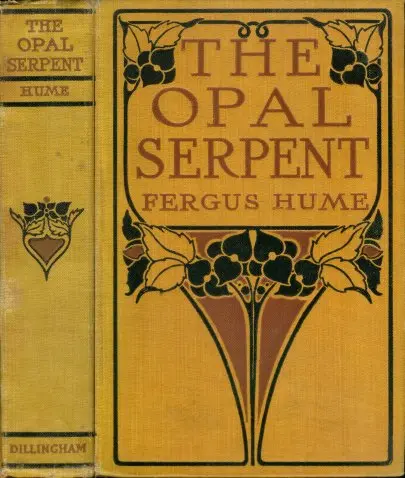
THE CLASSIC COLLECTION · 1905
"The Opal Serpent" by Fergus Hume is a novel written in the early 20th century. The story centers on Paul Beecot, a young aspiring writer who leaves his oppressive home life behind to seek fame and fortune in London. As he navigates the city's literary scene, Paul's affections become entwined with Sylvia Norman, the daughter of a mysterious pawnbroker, Aaron Norman, who harbors secrets related to a peculiar brooch Paul wishes to sell. At the start of the novel, we meet Paul Beecot, who has just made the bold decision to leave his unsupportive family to pursue his writerly ambitions in London. His contentious relationship with his father hints at deeper family dynamics, particularly surrounding aspirations and control. As Paul explores the world of literature, he encounters Sylvia, and their mutual attraction unfolds against a backdrop of intrigue involving a jeweled serpent brooch owned by Sylvia's father. The opening establishes a sense of foreboding with Aaron Norman's peculiar behavior towards the brooch, suggesting that the story will explore themes of ambition, love, and the darker undercurrents of identity.
Introduction adapted from the source catalogue; source summaries may be automatically generated.
Free to read · English · 89,033 words · No account needed
MAKE TIME FOR A GOOD BOOK
On by default. Untick to stop anonymous reading totals. Each page counts after 10 seconds in view. How this works.
Anonymous counting is on unless you have switched it off.
Mr. Jabez Pash heard no more. He stopped his legal ears and fled into the sitting-room, where he found the lovers seated on a sofa near the window. Sylvia was in Paul's embrace, and her head was on his shoulder. Beecot had his arm in a sling, and looked pale, but his eyes were as bright as ever, and his face shone with happiness. Sylvia also looked happy. To know that she was rich, that Paul was to be her husband, filled the cup of her desires to the brim. Moreover, she was beginning to recover from the shock of her father's death, and was feverishly anxious to escape from Gwynne Street, and from the house where the tragedy had taken place.
"Well," said Mr. Pash, drawing a long breath and sucking in his cheeks, "you lose no time, young gentleman."
Paul laughed, but did not change his position. Sylvia indeed blushed and raised her head, but Paul still held her with his uninjured arm, defying Mr. Pash and all the world. "I am gathering rosebuds while I may, Mr. Pash," said he, misquoting Herrick's charming line.
"You have plucked a very pretty one," grinned the monkey; "but may I request the rosebud's attention?"
Sylvia extricated herself from her lover's arm with a heightened color, and nodded gravely. Seeing it was business, she had to descend from heaven to earth, but she secretly hoped that this dull little lawyer, who was a bachelor and had never loved in his dry little life, would soon go away and leave her alone with Prince Charming. Deborah guessed these thoughts with the instinct of fidelity, and swooped down on her young mistress.
"It's the will, poppet," she whispered loudly, "but if it do make your dear head ache Mr. Beecot will listen."
"I wish Mr. Beecot to listen in any case," said Pash, dryly, "if he is to marry my young and esteemed client."
"We are engaged with the consent of my poor father," said Sylvia, taking Paul's hand. "I shall marry no one but Paul."
"And Paul will marry an angel," said that young man, with a tender squeeze, "although he can't keep her in bread-and-butter."
"Oh, I think there will be plenty of bread-and-butter," said the lawyer. "Miss Norman, we have found the will if," added Mr. Pash, disdainfully, "this," he held out the document with a look of contempt, "can be called a will."
"It's all right, isn't it?" asked Sylvia, anxiously.
"I mean the form and the writing and the paper, young lady. It is a good will in law, and duly signed and witnessed."
"Me and Bart having written our names, lovey," put in Deborah.
Your reading position is saved on this browser. Take it to another device with a library code. Reading pages adapt to text, rather than matching a printed edition.
Fergus Hume
Fergus Hume
Fergus Hume
Fergus Hume
BEHIND THE BOOK
This eBook is for the use of anyone anywhere in the United States and most other parts of the world at no cost and with almost no restrictions whatsoever. You may copy it, give it away or re-use it under the terms of the Project Gutenberg License included with this eBook or online at www.gutenberg.org. If you are not located in the United States, you will have to check the laws of the country where you are located before using this eBook. Read the source licence.
The original source file, including credits and licence, is retained by this library. Request an original-format copy at no charge. Please include the book title and Project Gutenberg identifier #24769.
KEEP YOUR CURIOSITY GOING
Coulson Kernahan

Maurice Baring
Frances Wright
Cécile Tormay

Frederic Jesup Stimson

W. H. P. (William Henry Pope) Jarvis