THE CLASSIC COLLECTION✦The Disappearing EyeCLASSIC FREE BOOKS
The Disappearing Eye
Fergus Hume
THE CLASSIC COLLECTION · 1905
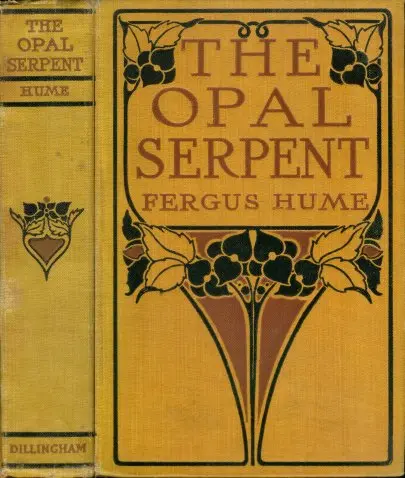
"The Opal Serpent" by Fergus Hume is a novel written in the early 20th century. The story centers on Paul Beecot, a young aspiring writer who leaves his oppressive home life behind to seek fame and fortune in London. As he navigates the city's literary scene, Paul's affections become entwined with Sylvia Norman, the daughter of a mysterious pawnbroker, Aaron Norman, who harbors secrets related to a peculiar brooch Paul wishes to sell. At the start of the novel, we meet Paul Beecot, who has just made the bold decision to leave his unsupportive family to pursue his writerly ambitions in London. His contentious relationship with his father hints at deeper family dynamics, particularly surrounding aspirations and control. As Paul explores the world of literature, he encounters Sylvia, and their mutual attraction unfolds against a backdrop of intrigue involving a jeweled serpent brooch owned by Sylvia's father. The opening establishes a sense of foreboding with Aaron Norman's peculiar behavior towards the brooch, suggesting that the story will explore themes of ambition, love, and the darker undercurrents of identity.
Introduction adapted from the source catalogue; source summaries may be automatically generated.
Free to read · English · 89,033 words · No account needed
MAKE TIME FOR A GOOD BOOK
On by default. Untick to stop anonymous reading totals. Each page counts after 10 seconds in view. How this works.
Anonymous counting is on unless you have switched it off.
"Jus' say your meanin', my pretty queen," said Mrs. Tawsey, as she stood at the sitting-room door, and watched Sylvia reading an ill-written letter. "It's twelve now, and I kin be back by five, arter a long, and enjiable tork with Matilder."
"You certainly must go," replied Sylvia, handing back the letter. "I am sure your sister will be glad to see you, Debby."
Deborah sniffed and scratched her elbow. "Relatives ain't friends in our family," she said, shaking her head, "whatever you may say, my deary-sweet. Father knocked mother int' lunatics arter she'd nagged 'im to drunk an' police-cells. Three brothers I 'ad, and all of 'em that 'andy with their fistises as they couldn't a-bear to live in 'armony without black eyes and swolled bumps all over them. As to Matilder, she an' me never did, what you might call, hit it orf, by reason of 'er not givin' way to me, as she should ha' done, me bein' the youngest and what you might call the baby of the lot. We ain't seen each other fur years, and the meetin' will be cold. She'll not have much forgiveness fur me bein' a bride, when she's but a lone cross-patch, drat her."
"Don't quarrel with her, Debby. She has written you a very nice letter, asking you to go down to Mrs. Krill's house in Kensington, and she really wants to see you before she goes back to Christchurch to-night."
"Well, I'll go," said Deborah, suddenly; "but I don't like leavin' you all by your own very self, my sunflower."
"I'll be all right, Debby. Paul comes at four o'clock, and you'll be
back at five."
"Sooner, if me an' Matilder don't hit if orf, or if we hit each other, which, knowin' 'er 'abits, I do expects. But Bart's out till six, and there won't be anyone to look arter them as washes--four of 'em," added Mrs. Tawsey, rubbing her nose, "and as idle as porkpines."
"Mrs. Purr can look after them."
"Look arter gin more like," said Deborah, contemptuously. "She's allays suckin', sly-like, tryin' to purtend as it's water, as if the smell didn't give it away, whatever the color may be. An' here she is, idling as usual. An' may I arsk, Mrs. Purr ma'am," demanded Deborah with great politeness, "wot I pays you fur in the way of ironin'?"
But Mrs. Purr was too excited to reply. She brushed past her indignant mistress and faced Sylvia, waving a dirty piece of paper. "Lor', miss," she almost screamed, "you do say as you want t'know where that limb Tray 'ave got to--"
Your reading position is saved on this browser. Take it to another device with a library code. Reading pages adapt to text, rather than matching a printed edition.
Fergus Hume

Fergus Hume

Fergus Hume
Fergus Hume
BEHIND THE BOOK
This eBook is for the use of anyone anywhere in the United States and most other parts of the world at no cost and with almost no restrictions whatsoever. You may copy it, give it away or re-use it under the terms of the Project Gutenberg License included with this eBook or online at www.gutenberg.org. If you are not located in the United States, you will have to check the laws of the country where you are located before using this eBook. Read the source licence.
The original source file, including credits and licence, is retained by this library. Request an original-format copy at no charge. Please include the book title and Project Gutenberg identifier #24769.
KEEP YOUR CURIOSITY GOING
Coulson Kernahan

Maurice Baring
Frances Wright
Cécile Tormay

Frederic Jesup Stimson

W. H. P. (William Henry Pope) Jarvis