THE CLASSIC COLLECTION✦The Disappearing EyeCLASSIC FREE BOOKS
The Disappearing Eye
Fergus Hume
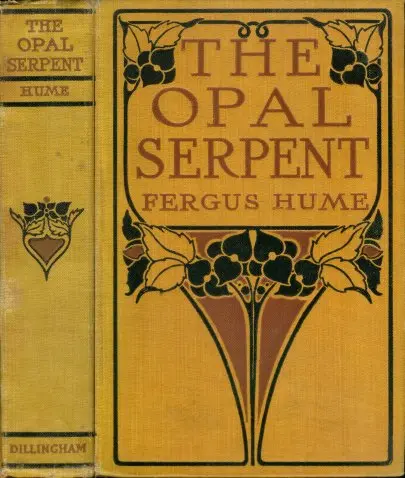
THE CLASSIC COLLECTION · 1905
"The Opal Serpent" by Fergus Hume is a novel written in the early 20th century. The story centers on Paul Beecot, a young aspiring writer who leaves his oppressive home life behind to seek fame and fortune in London. As he navigates the city's literary scene, Paul's affections become entwined with Sylvia Norman, the daughter of a mysterious pawnbroker, Aaron Norman, who harbors secrets related to a peculiar brooch Paul wishes to sell. At the start of the novel, we meet Paul Beecot, who has just made the bold decision to leave his unsupportive family to pursue his writerly ambitions in London. His contentious relationship with his father hints at deeper family dynamics, particularly surrounding aspirations and control. As Paul explores the world of literature, he encounters Sylvia, and their mutual attraction unfolds against a backdrop of intrigue involving a jeweled serpent brooch owned by Sylvia's father. The opening establishes a sense of foreboding with Aaron Norman's peculiar behavior towards the brooch, suggesting that the story will explore themes of ambition, love, and the darker undercurrents of identity.
Introduction adapted from the source catalogue; source summaries may be automatically generated.
Free to read · English · 89,033 words · No account needed
MAKE TIME FOR A GOOD BOOK
On by default. Untick to stop anonymous reading totals. Each page counts after 10 seconds in view. How this works.
Anonymous counting is on unless you have switched it off.
"Which now makes us twenty-five and thirty respectively," said Hay, dryly; "you left school before I did."
"Yes; I had scarlet fever, and was taken home to be nursed. I never went back, and since then I have never met an old Torrington boy--"
"Have you not?" asked Hay, eagerly.
"No. My parents took me abroad, and I sampled a German university. I returned to idle about my father's place, till I grew sick of doing nothing, and, having ambitions, I came to try my luck in town." He looked round and laughed. "You see my luck."
"Well," said Hay, lighting a dainty cigarette produced from a gold case, "my uncle, who died, sent me to Oxford and then I travelled. I am now on my own, as I told you, and haven't a relative in the world."
"Why don't you marry?" asked Paul, with a flush.
Hay, wary man-about-town as he was, noted the flush, and guessed its cause. He could put two and two together as well as most people.
"I might ask you the same question," said he.
The two friends looked at one another, and each thought of the difference in his companion since the old school-days. Hay was clean-shaven, fair-haired, and calm, almost icy, in manner. His eyes were blue and cold. No one could tell what was passing in his mind from the expression of his face. As a matter of fact he usually wore a mask, but at the present moment, better feelings having the upper hand, the mask had slipped a trifle. But as a rule he kept command of expression, and words, and actions. An admirable example of self-control was Grexon Hay.
On the other hand, Beecot was slight, tall and dark, with an eager manner and a face which revealed his thoughts. His complexion was swart; he had large black eyes, a sensitive mouth, and a small moustache smartly twisted upward. He carried his head well, and looked rather military in appearance, probably because many of his forebears had been Army men. While Hay was smartly dressed in a Bond Street kit, Paul wore a well-cut, shabby blue serge. He looked perfectly well-bred, but his clothes were woefully threadbare.
From these and the garret and the lean meal of sausages Hay drew his conclusions and put them into words.
"Your father has cut you off," said he, calmly, "and yet you propose to
marry."
"How do you know both things?"
"I keep my eyes open, Paul. I see this attic and your clothes. I saw also the flush on your face when you asked me why I did not marry. You are in love?"
Your reading position is saved on this browser. Take it to another device with a library code. Reading pages adapt to text, rather than matching a printed edition.
Fergus Hume
Fergus Hume
Fergus Hume
Fergus Hume
BEHIND THE BOOK
This eBook is for the use of anyone anywhere in the United States and most other parts of the world at no cost and with almost no restrictions whatsoever. You may copy it, give it away or re-use it under the terms of the Project Gutenberg License included with this eBook or online at www.gutenberg.org. If you are not located in the United States, you will have to check the laws of the country where you are located before using this eBook. Read the source licence.
The original source file, including credits and licence, is retained by this library. Request an original-format copy at no charge. Please include the book title and Project Gutenberg identifier #24769.
KEEP YOUR CURIOSITY GOING
Coulson Kernahan

Maurice Baring
Frances Wright
Cécile Tormay

Frederic Jesup Stimson

W. H. P. (William Henry Pope) Jarvis