THE CLASSIC COLLECTION✦The Disappearing EyeCLASSIC FREE BOOKS
The Disappearing Eye
Fergus Hume
THE CLASSIC COLLECTION · 1905
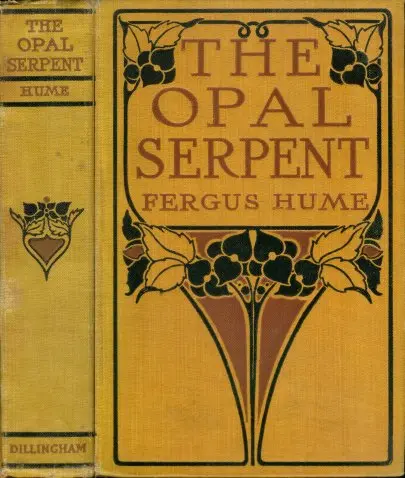
"The Opal Serpent" by Fergus Hume is a novel written in the early 20th century. The story centers on Paul Beecot, a young aspiring writer who leaves his oppressive home life behind to seek fame and fortune in London. As he navigates the city's literary scene, Paul's affections become entwined with Sylvia Norman, the daughter of a mysterious pawnbroker, Aaron Norman, who harbors secrets related to a peculiar brooch Paul wishes to sell. At the start of the novel, we meet Paul Beecot, who has just made the bold decision to leave his unsupportive family to pursue his writerly ambitions in London. His contentious relationship with his father hints at deeper family dynamics, particularly surrounding aspirations and control. As Paul explores the world of literature, he encounters Sylvia, and their mutual attraction unfolds against a backdrop of intrigue involving a jeweled serpent brooch owned by Sylvia's father. The opening establishes a sense of foreboding with Aaron Norman's peculiar behavior towards the brooch, suggesting that the story will explore themes of ambition, love, and the darker undercurrents of identity.
Introduction adapted from the source catalogue; source summaries may be automatically generated.
Free to read · English · 89,033 words · No account needed
MAKE TIME FOR A GOOD BOOK
On by default. Untick to stop anonymous reading totals. Each page counts after 10 seconds in view. How this works.
Anonymous counting is on unless you have switched it off.
A snort from Deborah plainly said that she had her doubts. Sylvia cast a reproving glance in her direction, whereupon she rose and committed perjury. "Of course it don't matter, sir," she said in a loud, hearty voice which made Aaron wince. "My precious believes you, though lie it might be. But folk so good as you, sir, who go to church when there ain't anyone to see, wouldn't tell lies without them a-choking of them in their blessed throats."
"How do you know I go to church?" asked Norman, with the snarl of a
trapped animal.
"Bless you, sir, I don't need glarses at my age, though not so young as I might be. Church you enjiy, say what you may, you being as regular as the taxes, which is saying much. Lor' save us all!"
Deborah might well exclaim this. Her master flung himself forward with outstretched hands clawing the air, and with his lips lifted like those of an enraged dog. "You she-cat," he said in a painfully hissing voice, "you're a spy, are you? They've set you to watch--to drag me to the gallows--" he broke off with a shiver. His rage cooled as suddenly as it had heated, and staggering to the sofa he sat down with his face hidden. "Not that--not that--oh, the years of pain and terror! To come to this--to this--Deborah--don't sell me. Don't. I'll give you money--I am rich. But if the opal serpent--if the opal--" He rose and began to beat the air with his hands.
Sylvia, who had never seen her father like this, shrank back in terror, but Deborah, with all her wits about her, though she was wildly astonished, seized a carafe of water from the table and dashed the contents in his face. The old man gasped, shuddered, and, dripping wet, sank again on the sofa. But the approaching fit was past, and when he looked up after a moment or so, his voice was as calm as his face. "What's all this?" he asked, feebly.
"Nothing, father," said Sylvia, kneeling beside him; "you must not doubt Debby, who is as true as steel."
"Are you, Deborah?" asked Aaron, weakly.
"I should think so," she declared, putting her arms round Sylvia, "so long, sir, as you don't hurt my flower."
"I don't want to hurt her ..."
"There's feelings as well as bones," said Deborah, hugging Sylvia so as to keep her from speaking, "and love you can't squash, try as you may, though, bless you, I'm not given to keeping company myself."
"Love," said Aaron, vacantly. He seemed to think more of his troubles than of Sylvia going to visit a young man.
Your reading position is saved on this browser. Take it to another device with a library code. Reading pages adapt to text, rather than matching a printed edition.
Fergus Hume

Fergus Hume

Fergus Hume
Fergus Hume
BEHIND THE BOOK
This eBook is for the use of anyone anywhere in the United States and most other parts of the world at no cost and with almost no restrictions whatsoever. You may copy it, give it away or re-use it under the terms of the Project Gutenberg License included with this eBook or online at www.gutenberg.org. If you are not located in the United States, you will have to check the laws of the country where you are located before using this eBook. Read the source licence.
The original source file, including credits and licence, is retained by this library. Request an original-format copy at no charge. Please include the book title and Project Gutenberg identifier #24769.
KEEP YOUR CURIOSITY GOING
Coulson Kernahan

Maurice Baring
Frances Wright
Cécile Tormay

Frederic Jesup Stimson

W. H. P. (William Henry Pope) Jarvis