THE CLASSIC COLLECTION✦The Disappearing EyeCLASSIC FREE BOOKS
The Disappearing Eye
Fergus Hume
THE CLASSIC COLLECTION · 1905
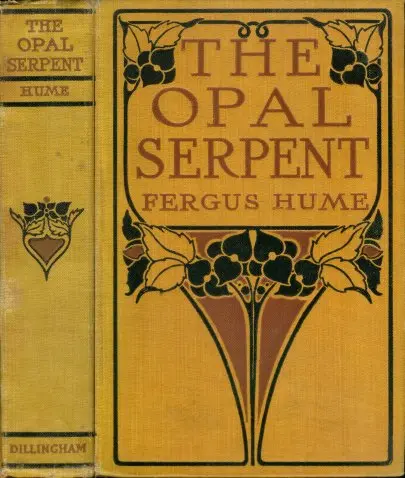
"The Opal Serpent" by Fergus Hume is a novel written in the early 20th century. The story centers on Paul Beecot, a young aspiring writer who leaves his oppressive home life behind to seek fame and fortune in London. As he navigates the city's literary scene, Paul's affections become entwined with Sylvia Norman, the daughter of a mysterious pawnbroker, Aaron Norman, who harbors secrets related to a peculiar brooch Paul wishes to sell. At the start of the novel, we meet Paul Beecot, who has just made the bold decision to leave his unsupportive family to pursue his writerly ambitions in London. His contentious relationship with his father hints at deeper family dynamics, particularly surrounding aspirations and control. As Paul explores the world of literature, he encounters Sylvia, and their mutual attraction unfolds against a backdrop of intrigue involving a jeweled serpent brooch owned by Sylvia's father. The opening establishes a sense of foreboding with Aaron Norman's peculiar behavior towards the brooch, suggesting that the story will explore themes of ambition, love, and the darker undercurrents of identity.
Introduction adapted from the source catalogue; source summaries may be automatically generated.
Free to read · English · 89,033 words · No account needed
MAKE TIME FOR A GOOD BOOK
On by default. Untick to stop anonymous reading totals. Each page counts after 10 seconds in view. How this works.
Anonymous counting is on unless you have switched it off.
"The least he could do," snapped the servant, "knocking folks into orspitals with his fine gent airs. I sawr him out of the winder while you was in the shop, and there he spoke law-de-daw to a brat of a boy as ought to be in gaol, seeing he smoked a cigar stump an' him but a ten-year-old guttersnipe. Ses I, oh, a painted maypole you is, I ses, with a face as hard as bath bricks. A bad un you are, ses I."
"No, Deborah, you are wrong. Mr. Hay is my friend."
"Never shall he be my pretty's friend," declared Debby, obstinately, "for if all the wickedness in him 'ud come out in his face, pimples would be as thick as smuts in a London fog. No, Mr. Beecot, call him not what you do call him, meaning friend, for Judas and Julius Cezar ain't in it with his Belzebubness."
Beecot saw it was vain to stop this chatterer, so he turned to talk in whispers to Sylvia, while Debby murmured on like a brook, only she spoke loud enough at times to drown the whispering of the lovers.
"Sylvia," said Paul, softly, "I want you to send your father to me."
"Yes, Paul. Why do you wish to see him?"
"Because he must be told of our love. I don't think he will be so hard as you think, and I am ashamed of not having told him before. I like to act honorably, and I fear, Sylvia darling, we have not been quite fair to your father."
"I think so, too, Paul, and I intended to speak when we went home. But give me your address, so that if we go away unexpectedly I'll be able to write to you."
Beecot gave her his Bloomsbury address, and also that of his old home at Wargrove in Essex. "Write care of my mother," he said, "and then my father won't get the letter."
"Would he be angry if he knew?" asked the girl, timidly.
Paul laughed to himself at the thought of the turkey-cock's rage. "I think he would, dearest," said he, "but that does not matter. Be true to me and I'll be true to you."
Here the nurse came to turn the visitors away on the plea that Paul had talked quite enough. Debby flared up, but became meek when Sylvia lifted a reproving finger. Then Paul asked Debby to seek his Bloomsbury lodgings and bring to him any letters that might be waiting for him. "I expect to hear from my mother, and must write and tell her of my accident," said he. "I don't want to trouble Mr. Hay, but you, Debby--"
Your reading position is saved on this browser. Take it to another device with a library code. Reading pages adapt to text, rather than matching a printed edition.
Fergus Hume

Fergus Hume

Fergus Hume
Fergus Hume
BEHIND THE BOOK
This eBook is for the use of anyone anywhere in the United States and most other parts of the world at no cost and with almost no restrictions whatsoever. You may copy it, give it away or re-use it under the terms of the Project Gutenberg License included with this eBook or online at www.gutenberg.org. If you are not located in the United States, you will have to check the laws of the country where you are located before using this eBook. Read the source licence.
The original source file, including credits and licence, is retained by this library. Request an original-format copy at no charge. Please include the book title and Project Gutenberg identifier #24769.
KEEP YOUR CURIOSITY GOING
Coulson Kernahan

Maurice Baring
Frances Wright
Cécile Tormay

Frederic Jesup Stimson

W. H. P. (William Henry Pope) Jarvis