THE CLASSIC COLLECTION✦The Disappearing EyeCLASSIC FREE BOOKS
The Disappearing Eye
Fergus Hume
THE CLASSIC COLLECTION · 1905
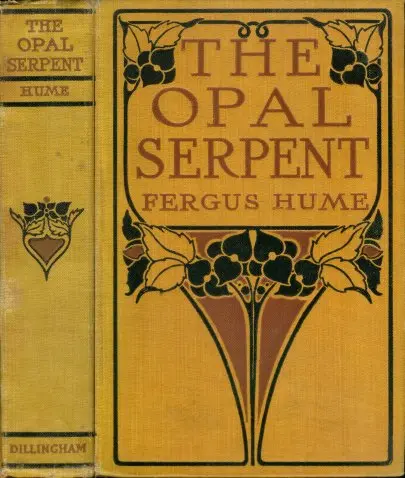
"The Opal Serpent" by Fergus Hume is a novel written in the early 20th century. The story centers on Paul Beecot, a young aspiring writer who leaves his oppressive home life behind to seek fame and fortune in London. As he navigates the city's literary scene, Paul's affections become entwined with Sylvia Norman, the daughter of a mysterious pawnbroker, Aaron Norman, who harbors secrets related to a peculiar brooch Paul wishes to sell. At the start of the novel, we meet Paul Beecot, who has just made the bold decision to leave his unsupportive family to pursue his writerly ambitions in London. His contentious relationship with his father hints at deeper family dynamics, particularly surrounding aspirations and control. As Paul explores the world of literature, he encounters Sylvia, and their mutual attraction unfolds against a backdrop of intrigue involving a jeweled serpent brooch owned by Sylvia's father. The opening establishes a sense of foreboding with Aaron Norman's peculiar behavior towards the brooch, suggesting that the story will explore themes of ambition, love, and the darker undercurrents of identity.
Introduction adapted from the source catalogue; source summaries may be automatically generated.
Free to read · English · 89,033 words · No account needed
MAKE TIME FOR A GOOD BOOK
On by default. Untick to stop anonymous reading totals. Each page counts after 10 seconds in view. How this works.
Anonymous counting is on unless you have switched it off.
"Yes. You came with your mother to Gwynne Street," replied Sylvia, wondering why she had been honored with a visit.
"Quite so. May I have a few minutes' conversation with you?"
"Certainly." Sylvia saw no reason to deny this request, although she did not like Miss Krill. But it struck her that something might be learned from that young woman relative to the murder, and thought she would have something to tell Paul about when he arrived. "Will you walk in, please," and she threw open the sitting-room door.
"Are you quite alone?" asked Maud, entering, and seating herself in the
chair near the fire.
"Quite," answered Sylvia, stiffly, and wondering why the question was asked; "that is, the four washerwomen are in the place at the back. But Mrs. Tawsey went to your house to see her sister."
"She arrived before I left," said Maud, coolly. "I saw them quarrelling in a most friendly way. Where is Mr. Beecot?"
"I expect him later."
"And Bart Tawsey who married your nurse?"
"He is absent on his rounds. May I ask why you question me in this way, Miss Krill?" asked Sylvia, coldly.
"Because I have much to say to you which no one else must hear," was the calm reply. "Dear me, how hot this fire is!" and she moved her chair so that it blocked Sylvia's way to the door. Also, Miss Krill cast a glance at the window. It was not snibbed, and she made a movement as if to go to it; but, restraining herself, she turned her calm, cold face to the girl. "I have much to say to you," she repeated.
"Indeed," replied Sylvia, politely, "I don't think you have treated me so well that you should trouble to converse with me. Will you please to be brief. Mr. Beecot is coming at four, and he will not be at all pleased to see you."
Maud glanced at the clock. "We have an hour," she said coldly; "it is just a few minutes after three. My business will not take long," she added, with an unpleasant smile.
"What is your business?" asked Sylvia, uneasily, for she did not like
the smile.
"If you will sit down, I'll tell you."
Miss Norman took a chair near the wall, and as far from her visitor as was possible in so small a room. Maud took from her neck a black silk handkerchief which she wore, evidently as a protection against the cold, and folding it lengthways, laid it across her lap. Then she looked at Sylvia, in a cold, critical way. "You are very pretty, my dear," she said insolently.
Your reading position is saved on this browser. Take it to another device with a library code. Reading pages adapt to text, rather than matching a printed edition.
Fergus Hume

Fergus Hume

Fergus Hume
Fergus Hume
BEHIND THE BOOK
This eBook is for the use of anyone anywhere in the United States and most other parts of the world at no cost and with almost no restrictions whatsoever. You may copy it, give it away or re-use it under the terms of the Project Gutenberg License included with this eBook or online at www.gutenberg.org. If you are not located in the United States, you will have to check the laws of the country where you are located before using this eBook. Read the source licence.
The original source file, including credits and licence, is retained by this library. Request an original-format copy at no charge. Please include the book title and Project Gutenberg identifier #24769.
KEEP YOUR CURIOSITY GOING
Coulson Kernahan

Maurice Baring
Frances Wright
Cécile Tormay

Frederic Jesup Stimson

W. H. P. (William Henry Pope) Jarvis