THE CLASSIC COLLECTION✦The Disappearing EyeCLASSIC FREE BOOKS
The Disappearing Eye
Fergus Hume
THE CLASSIC COLLECTION · 1905
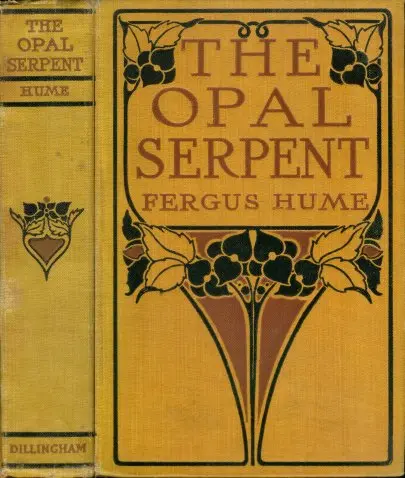
"The Opal Serpent" by Fergus Hume is a novel written in the early 20th century. The story centers on Paul Beecot, a young aspiring writer who leaves his oppressive home life behind to seek fame and fortune in London. As he navigates the city's literary scene, Paul's affections become entwined with Sylvia Norman, the daughter of a mysterious pawnbroker, Aaron Norman, who harbors secrets related to a peculiar brooch Paul wishes to sell. At the start of the novel, we meet Paul Beecot, who has just made the bold decision to leave his unsupportive family to pursue his writerly ambitions in London. His contentious relationship with his father hints at deeper family dynamics, particularly surrounding aspirations and control. As Paul explores the world of literature, he encounters Sylvia, and their mutual attraction unfolds against a backdrop of intrigue involving a jeweled serpent brooch owned by Sylvia's father. The opening establishes a sense of foreboding with Aaron Norman's peculiar behavior towards the brooch, suggesting that the story will explore themes of ambition, love, and the darker undercurrents of identity.
Introduction adapted from the source catalogue; source summaries may be automatically generated.
Free to read · English · 89,033 words · No account needed
MAKE TIME FOR A GOOD BOOK
On by default. Untick to stop anonymous reading totals. Each page counts after 10 seconds in view. How this works.
Anonymous counting is on unless you have switched it off.
Jessop wiped his forehead. "I heard something about it. That there lady committed suicide they say."
"I know what they say, but I want to know what you say?"
"I won't be arsked questions," shouted the captain, angrily.
"Don't raise your voice," said the detective, smoothly; "we may as well conduct this conversation pleasantly."
"I don't converse no more," said Jessop in a shaky voice, and staggered to his feet, rapidly growing sober under the influence of a deadly fear. Hurd did not move as the man crossed the room, but felt if the key was safe in his pocket. The sailor tried to open the door, and then realized that it was locked. He turned on his host with a volley of bad language, and found himself facing a levelled revolver.
"Sit down," said Hurd, quietly; "go back to your chair."
Jessop, with staring eyes and outspread hands, backed to the wall. "Who are you anyhow?" he demanded, hardly able to speak.
"Perhaps that will tell you," said Hurd, and threw the warrant on the table. Jessop staggered forward and looked at it. One glance was sufficient to inform him what it was, and he sank back into his chair with a groan, leaving the warrant on the table. Hurd picked it up and slipped it into his pocket. He thought Jessop might destroy it; but there was no fight in the mariner.
"And now that we understand one another," said Hurd, putting away his
weapon, "I want to talk."
"Sha'n't talk," said Jessop, savagely.
"Oh, yes, I think so; otherwise I can make things unpleasant for you."
"You can't arrest me. I've done nothing."
"That may be so, but arrest you I can and I have done so now. To-morrow morning you will go to London in charge of a plain-clothes policeman, while I go to Stowley."
"To my crib. No, I'm blest if you do."
"I sha'n't go immediately to your crib," rejoined Hurd, dryly, "though I may do so later. My first visit will be to that old pawnbroker. I think if I describe you--and you are rather a noticeable man, Captain Jessop--he will recognize the individual who pawned an opal serpent brooch with him shortly after the death of Lady Rachel Sandal, to whom the said brooch belonged."
"It's a lie," said Jessop hoarsely, and sober enough now.
"Quite so, and perhaps it is also a lie that a man resembling yourself tried to get certain jewellery from a lawyer called Pash--"
Jessop lost his self-control, which he was trying desperately to preserve, and rose to his feet, white-faced and haggard. "Who are you?" he shouted, "who are you?"
Your reading position is saved on this browser. Take it to another device with a library code. Reading pages adapt to text, rather than matching a printed edition.
Fergus Hume

Fergus Hume

Fergus Hume
Fergus Hume
BEHIND THE BOOK
This eBook is for the use of anyone anywhere in the United States and most other parts of the world at no cost and with almost no restrictions whatsoever. You may copy it, give it away or re-use it under the terms of the Project Gutenberg License included with this eBook or online at www.gutenberg.org. If you are not located in the United States, you will have to check the laws of the country where you are located before using this eBook. Read the source licence.
The original source file, including credits and licence, is retained by this library. Request an original-format copy at no charge. Please include the book title and Project Gutenberg identifier #24769.
KEEP YOUR CURIOSITY GOING
Coulson Kernahan

Maurice Baring
Frances Wright
Cécile Tormay

Frederic Jesup Stimson

W. H. P. (William Henry Pope) Jarvis