THE CLASSIC COLLECTION✦The Disappearing EyeCLASSIC FREE BOOKS
The Disappearing Eye
Fergus Hume
THE CLASSIC COLLECTION · 1905
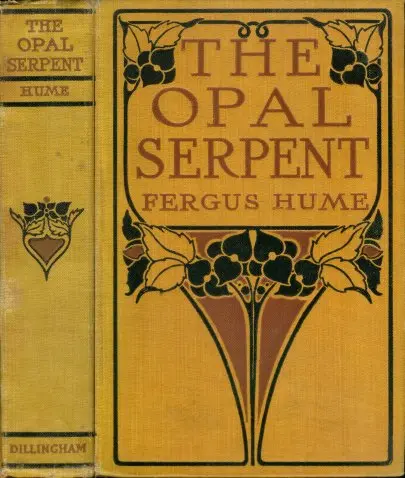
"The Opal Serpent" by Fergus Hume is a novel written in the early 20th century. The story centers on Paul Beecot, a young aspiring writer who leaves his oppressive home life behind to seek fame and fortune in London. As he navigates the city's literary scene, Paul's affections become entwined with Sylvia Norman, the daughter of a mysterious pawnbroker, Aaron Norman, who harbors secrets related to a peculiar brooch Paul wishes to sell. At the start of the novel, we meet Paul Beecot, who has just made the bold decision to leave his unsupportive family to pursue his writerly ambitions in London. His contentious relationship with his father hints at deeper family dynamics, particularly surrounding aspirations and control. As Paul explores the world of literature, he encounters Sylvia, and their mutual attraction unfolds against a backdrop of intrigue involving a jeweled serpent brooch owned by Sylvia's father. The opening establishes a sense of foreboding with Aaron Norman's peculiar behavior towards the brooch, suggesting that the story will explore themes of ambition, love, and the darker undercurrents of identity.
Introduction adapted from the source catalogue; source summaries may be automatically generated.
Free to read · English · 89,033 words · No account needed
MAKE TIME FOR A GOOD BOOK
On by default. Untick to stop anonymous reading totals. Each page counts after 10 seconds in view. How this works.
Anonymous counting is on unless you have switched it off.
Lord George followed, grumbling, with the ever-smiling Maud. Miss Qian skipped into a hansom, and offered Paul a drive back to town which he refused. As the cab was driving off she bent down and whispered, "Be careful," with a side-glance at Hay.
Paul laughed. Everyone seemed to doubt Hay. But that gentleman handed Mrs. Krill and her daughter into their carriage, and looked towards Lord George. "You don't want your revenge to-night?" he asked.
"No, confound you!" said the young man, sulkily.
"In that case I'll drive into Kensington with Mrs. Krill, and borrow her carriage for a trip to Piccadilly. Good-night, Sandal. Good-night, Beecot."
He waved his hand, and the ladies waved theirs, and then the three drove away. Lord George lighted a cigar, and putting his arm within that of Beecot, strolled down the road. "Come to my club," he said.
"No, thank you," answered Paul, politely, "I must get home."
"But I wish you'd come. I hate being by myself and you seem such a good
sort of chap."
"Well," said Beecot, thinking he might say a word in season to this young fool, "I don't gamble."
"Oh, you cry down that, do you?"
"Well, I think it's foolish."
"It is," assented Lord George, frankly, "infernally foolish. And Hay has all the luck. I wonder if he plays square."
This was dangerous ground, and Paul shied. "I really can't say," he said coldly, "I don't play cards."
"But what do you know of Hay?" asked Sandal.
"Only that he was at school with me at Torrington. We met by accident the other day, and he asked me to dinner."
"Torrington. Yes. I had a brother at that school once," said Lord George, "but you and Hay wouldn't get on well together, I should think. You're straight, and he's--"
"You forget, we have been dining with him," said Paul, quickly.
"What of that. I've dined often and have paid pretty dearly for the privilege. I must have lost at least five thousand to him within the last few months."
"In that case I should advise you to play cards no more. The remedy is
easy," said Paul, dryly.
"It isn't so easy to leave off cards," rejoined Sandal, gloomily. "I'm that fond of gambling that I only seem to live when I've got the cards or dice in my hand. I suppose it's like dram-drinking."
"If you take my advice, Lord George, you'll give up card-playing."
"With Hay, do you mean?" asked the other, shrewdly.
"With anyone. I know nothing about Hay beyond what I have told you."
Your reading position is saved on this browser. Take it to another device with a library code. Reading pages adapt to text, rather than matching a printed edition.
Fergus Hume

Fergus Hume

Fergus Hume
Fergus Hume
BEHIND THE BOOK
This eBook is for the use of anyone anywhere in the United States and most other parts of the world at no cost and with almost no restrictions whatsoever. You may copy it, give it away or re-use it under the terms of the Project Gutenberg License included with this eBook or online at www.gutenberg.org. If you are not located in the United States, you will have to check the laws of the country where you are located before using this eBook. Read the source licence.
The original source file, including credits and licence, is retained by this library. Request an original-format copy at no charge. Please include the book title and Project Gutenberg identifier #24769.
KEEP YOUR CURIOSITY GOING
Coulson Kernahan

Maurice Baring
Frances Wright
Cécile Tormay

Frederic Jesup Stimson

W. H. P. (William Henry Pope) Jarvis