THE CLASSIC COLLECTION✦The Disappearing EyeCLASSIC FREE BOOKS
The Disappearing Eye
Fergus Hume
THE CLASSIC COLLECTION · 1905
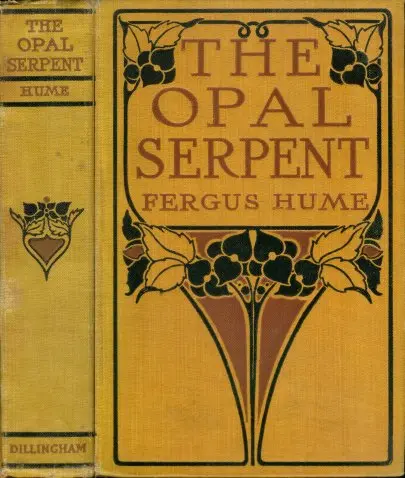
"The Opal Serpent" by Fergus Hume is a novel written in the early 20th century. The story centers on Paul Beecot, a young aspiring writer who leaves his oppressive home life behind to seek fame and fortune in London. As he navigates the city's literary scene, Paul's affections become entwined with Sylvia Norman, the daughter of a mysterious pawnbroker, Aaron Norman, who harbors secrets related to a peculiar brooch Paul wishes to sell. At the start of the novel, we meet Paul Beecot, who has just made the bold decision to leave his unsupportive family to pursue his writerly ambitions in London. His contentious relationship with his father hints at deeper family dynamics, particularly surrounding aspirations and control. As Paul explores the world of literature, he encounters Sylvia, and their mutual attraction unfolds against a backdrop of intrigue involving a jeweled serpent brooch owned by Sylvia's father. The opening establishes a sense of foreboding with Aaron Norman's peculiar behavior towards the brooch, suggesting that the story will explore themes of ambition, love, and the darker undercurrents of identity.
Introduction adapted from the source catalogue; source summaries may be automatically generated.
Free to read · English · 89,033 words · No account needed
MAKE TIME FOR A GOOD BOOK
On by default. Untick to stop anonymous reading totals. Each page counts after 10 seconds in view. How this works.
Anonymous counting is on unless you have switched it off.
"What," cried Paul, staring, "Miss Krill?"
"The same," responded Hay, coldly. "You see I have taken your advice and intend to settle. Pash presented me to the ladies when next they came to his office, and since then I have been almost constantly with them. Miss Krill's affections were disengaged, and she, therefore, with her mother's consent, became my promised wife."
"I wish you joy," said Lord George, draining his glass and filling another, "and, by Jove! for your sake, I hope she's got money."
"Oh, yes, she's well off," said Hay, calmly, "and you, Paul?"
"I congratulate you, of course," stammered Beecot, dazed; "but it's so sudden. You haven't known her above a month."
"Five weeks or so," said Hay, smiling, and sinking his voice lower, he added, "I can't afford to let grass grow under my feet. This young ass here might snap her up, and Mrs. Krill would only be too glad to secure a title for Maud."
"I say," said Lord George suddenly, and waking from a brown study, "who is Mrs. Krill? I've heard the name."
"It's not an uncommon name," said Hay, untruthfully and quickly. "She is a rich widow who has lately come to London."
"Where did she come from?"
"I can't tell you that. From the wilds of Yorkshire I believe. You had
better ask her."
"Oh, by Jove, no, I wouldn't be so rude. But I seem to know the name." Paul privately thought that if he read the papers, he ought certainly to know the name, and he was on the point of making, perhaps an injudicious remark, but Hay pointedly looked at him in such a meaning way, that he held his tongue. More, when they left their wine for the society of the ladies, Hay squeezed his friend's arm in the passage.
"Don't mention the death," he said, using a politer word by preference. "Sandal doesn't connect Mrs. Krill with the dead man. She wants to live the matter down."
"In that case she ought to leave London for a time."
"She intends to. When I make Maud my wife, we will travel with her mother for a year or two, until the scandal of the murder blows over. Luckily the name of Lemuel Krill was not mentioned often in the papers, and Sandal hasn't seen a hand-bill that I know of. I suppose you agree with me that silence is judicious?"
"Yes," assented Paul, "I think it is."
"And you congratulate me on my approaching marriage?"
"Certainly. Now, perhaps, you will live like Falstaff when he was made a
knight."
Your reading position is saved on this browser. Take it to another device with a library code. Reading pages adapt to text, rather than matching a printed edition.
Fergus Hume

Fergus Hume

Fergus Hume
Fergus Hume
BEHIND THE BOOK
This eBook is for the use of anyone anywhere in the United States and most other parts of the world at no cost and with almost no restrictions whatsoever. You may copy it, give it away or re-use it under the terms of the Project Gutenberg License included with this eBook or online at www.gutenberg.org. If you are not located in the United States, you will have to check the laws of the country where you are located before using this eBook. Read the source licence.
The original source file, including credits and licence, is retained by this library. Request an original-format copy at no charge. Please include the book title and Project Gutenberg identifier #24769.
KEEP YOUR CURIOSITY GOING
Coulson Kernahan

Maurice Baring
Frances Wright
Cécile Tormay

Frederic Jesup Stimson

W. H. P. (William Henry Pope) Jarvis